

New trouble for RWE: Farmers from Pakistan have sued the former coal company for damages in the Heidelberg district court. They are demanding proportional compensation for flooded fields and destroyed crops in 2022 caused by extremely heavy monsoon rains that were exacerbated by climate change. At that time, three times more water came from the sky than normal – 1,700 people died in the floods, 33 million became homeless, and an area equivalent to two thirds of Germany was under water.
The cement company “Heidelberg Materials” is also the defendant. The farmers want to fight for around one million euros; the lawsuit is supported by the European Center for Constitutional and Human Rights (ECCHR). Lukas Kemnitz, presiding judge at the regional court, confirmed receipt of the lawsuit to taz: “We are now examining the indictment.”
RWE has already been sued once for damages related to climate change. Back then, 2015, a Peruvian farmer complainedthat a glacial lake threatens his village because the melting glacier could cause a tidal wave. To prevent this, it is necessary to pump out the additional water. RWE should contribute half a percent of the costs because the company is responsible for 0.5 percent of all global greenhouse gases. The nine-year process ultimately involved a few thousand euros.
The Hamm Higher Regional Court rejected the Peruvian farmer’s claims in May last year. At the same time, however, the judges ruled that major emitters can in principle be held liable for climate-related damage abroad. And exactly on that appointed The human rights activists from ECCHR now focus on the Civil Code and “a simple but fundamental legal principle: Anyone who causes damage must be liable for it.”
RWE reacts violently
Maybe that’s why the company reacted intense this week: “The lawsuit is a renewed attempt to shift climate policy demands into German courtrooms,” and RWE has always operated its power plants in accordance with applicable law. It goes on to say: “It would be an irresolvable contradiction if the state of CO2-Emissions are permitted, regulated in detail by law and even required in individual cases, but at the same time would retroactively allow civil liability for this.
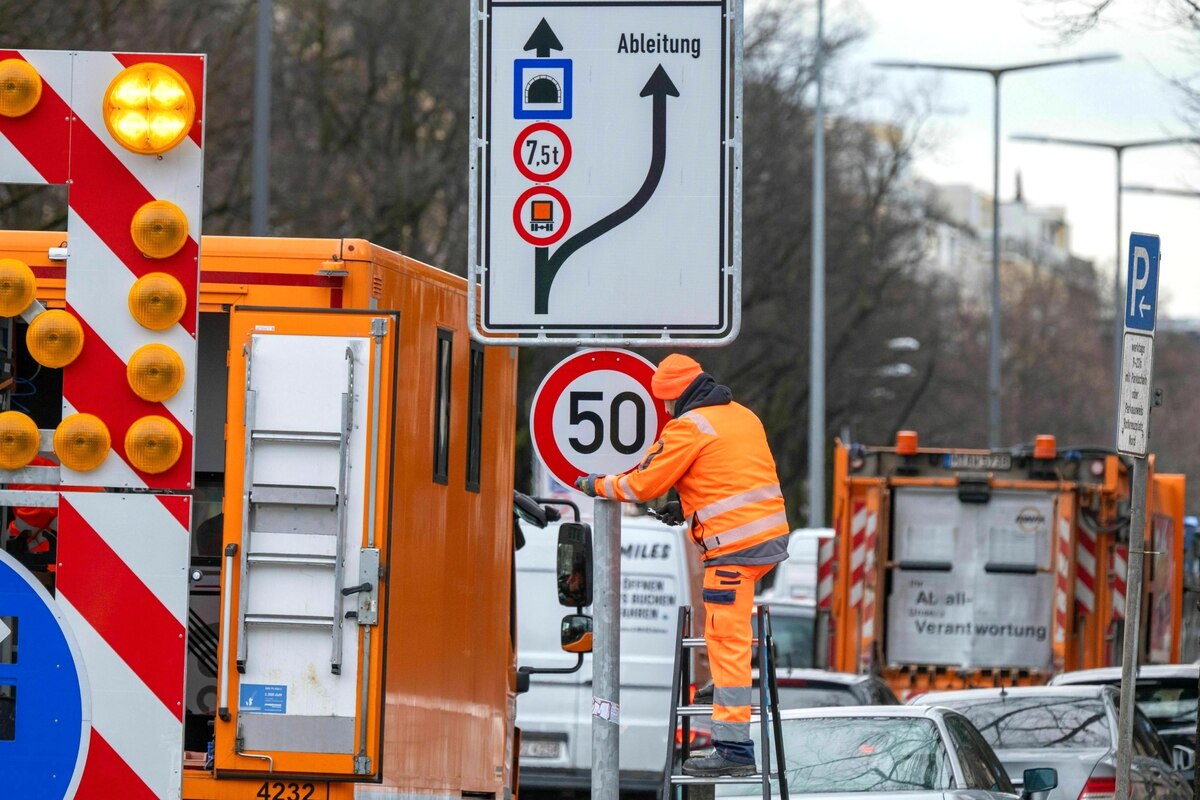
Another lawsuit in Munich this week is not about liability, but about speed: there it had City administration speed limit 30 lifted on a section of the Middle Ring. The German Environmental Aid (DUH) and some residents are suing against this in expedited proceedings before the Munich Administrative Court. Tempo 30 is stipulated in the currently valid air pollution control plan, “even a mayor must observe the law in Germany,” explained DUH boss Jürgen Resch. As long as the city council does not change the air pollution control plan, the 30 km/h speed limit should not be abolished “in the landlord style”.
Environmental aid relies on figures from the European Environment Agency (EEA), according to which there are more than 1,900 premature deaths in Munich every year due to excessive fine dust and nitrogen oxide pollution. For years, the measuring station on Landshuter Allee has shown the highest or second highest NO2-burden across Germany.
The federal government will be forced to improve its climate policy.
Remo Clinger, DUH-Andalt
Meanwhile, a fundamental decision for the Federal Republic is due before the highest German administrative court next week: “The first question on Thursday in Leipzig will be whether an association like Deutsche Umwelthilfe can legally control the climate protection program at all,” explains Remo Klinger, lawyer for the DUH.
The traffic light coalition failed to provide immediate programs
In spring 2021, the Federal Constitutional Court ruled that the federal government’s climate policy violated the rights of future generations. After the verdict, the then federal government of Angela Merkel (CDU) tightened the climate protection law: In order to achieve the goal by 2030 – minus 65 percent of greenhouse gas emissions compared to 1990 – immediate climate protection programs were considered. They should take effect if there is no progress in a sector – construction, transport, agriculture.
Despite missing the target The traffic light government had not presented such an immediate program. Deutsche Umwelthilfe sued against this – and won before the Berlin-Brandenburg Higher Administrative Court.
If the Federal Administrative Court also determines that the DUH lawsuit was legal, a second highest court decision will be pending, which could have far-reaching effects on the government of Friedrich Merz (CDU): The court must then decide whether and, if so, how specifically the federal government must design climate protection measures in order to achieve the legal climate goals.
The Higher Administrative Court had rejected the traffic light coalition’s plans as too unambitious; the black-red coalition could now be pushed to do more climate protection. DUH lawyer Klinger is certain: “The federal government will be forced to their climate policy to improve.”
File number of the lawsuit against RWE: 8O310/25