

We are comfortable, take our seats and await the big and moving show. Normally! But in Peter Handkes There is nothing normal about the “audience insult” piece. Above all, because the audience itself suddenly becomes the focus, being actively observed and evaluated by the ensemble on stage. You can well imagine that this experimental work caused astonishment when it was first performed by Claus Peymann in 1966.
And even today it has lost none of its effectiveness, especially as contemporary theater continues to evolve Criticism from different sides faces. Too “woke” for some, too well-behaved for others, it seems to be in a constant state of self-search. With her rediscovery of the classic at Schauspiel Frankfurt, Claudia Bauer brings the discussion back to essential and philosophical questions: What should and can stage art do?
The players (including Anna Kubin, Sebastian Kuschmann, Lotte Schubert) agree. “No symbolism should arise,” “there is no other world here,” they shout at us head on. Likewise, you don’t take on roles or want to create any sensations. For almost 90 minutes you take part in Handke’s main movement festival, which wants nothing other than to subvert all the conventions of the theater.
Even the protagonists later say it’s a bland soup when they sit in a row of chairs across from us and briefly slip into an imaginary audience. One ponders where the excellence remains. In addition, another complains: “I go to the theater one day and nothing is going on in my pants!” What do people actually pay tax money for here? the ensemble whispers.
Peter Handke: “Audience insults”. Director: Claudia Bauer. Again on January 26th and 30th and in February at the Schauspiel Frankfurt.
Based on Brecht
We are amused by our own caricature, as it releases us for a brief moment from the demanding attitude of reflection in which this evening puts us. Ultimately we are dealing with a reckoning with Aristotelian drama. Instead of lulling us to sleep, Handke shakes us awake with reference to Brecht’s political aesthetics of alienation. We shouldn’t believe what we see. This is the warning from a player in a glass box on the right edge of the stage.
He tells us that there is no door we can look through – as she and others after her are suddenly pushed into the middle of the stalls. They open and white harlequins with masks emerge from them. The thoroughly utopian message: Even where theater denies itself, it proves to be present. It is reality and imagination at the same time, is in and yet outside of time.

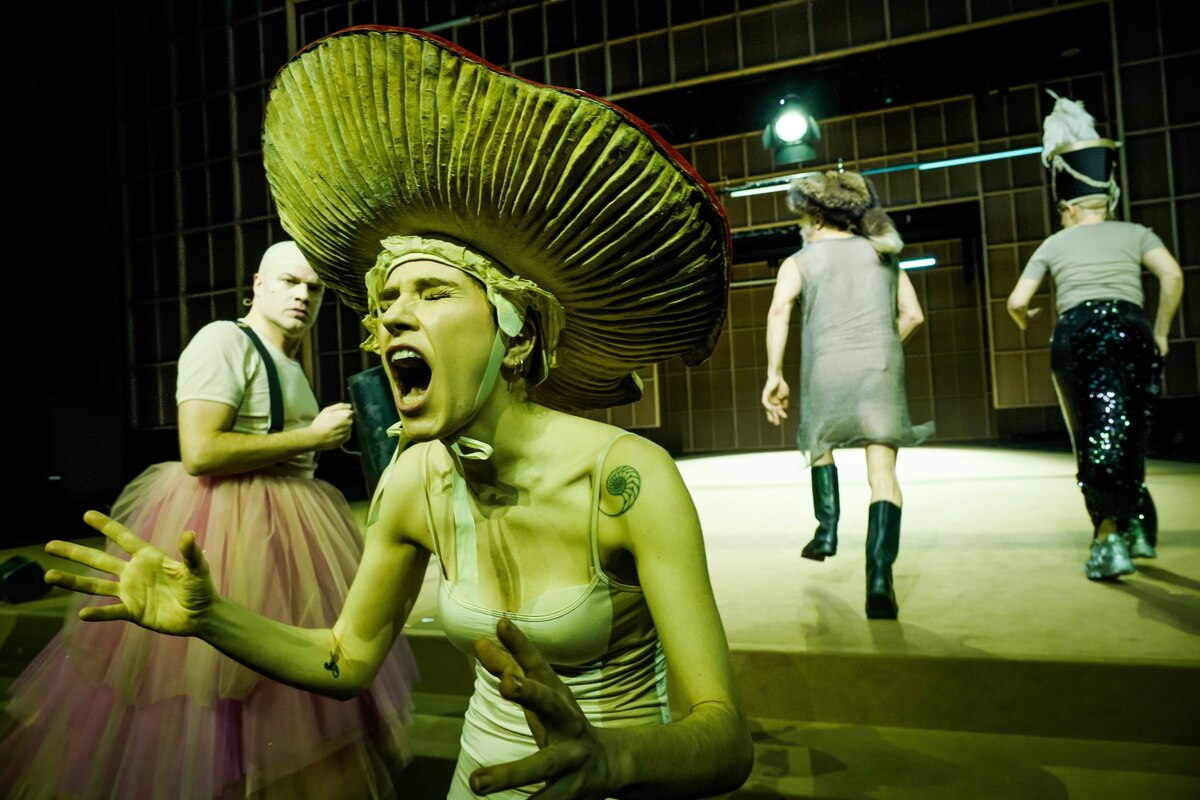
In order to do justice to this ambivalence, Director Claudia Bauer decided to largely forego effects or an ornate backdrop. We are therefore looking at a stage that narrows like a vanishing point. Several beige wooden walls positioned one behind the other with a hardware store flair frame them and sometimes go up and sometimes down. Given this minimalism, illusions are supposed to develop solely in the mind. The same applies to constructions of meaning. If the players sometimes wear toadstool hats and crow’s feet, ball gowns or dinosaur tails, all attempts at psychologization and logic come to nothing.
But the premiere is already following a plan, and a convincing one. With the conductor Salome Niedecken in the front row and a musical combo in the left glass box, the production is reminiscent of a composition. In addition to the actors’ frequent singing, there are bizarre, funny and sometimes powerful sounds. With a fine sense of flair, the performance achieves changeable mood dynamics and precise dramatic climaxes.
The confrontation with death seems particularly strong in the last part. A protagonist draws our attention – again from the glass box – to our physical being, to our heartbeat and our breathing, while we become aware of a baroque-dressed death allegory on a mini stage in the center. Theater now seems more than appearance, it can expose us to finiteness and at the same time continue the horror of existence as a stage trick. Death is real and unreal. Everything in sync!
Accordingly, irony also accompanies seriousness. The titular insulting of the audience as brats and starry-eyed people is therefore a must, just like the antiquated golden curtain. It is rare to experience theater so furious and witty, and with virtuoso lightness, which proves its importance in Frankfurt despite all the current complainers.