

When reading this book, one cannot help but think of the words of Holocaust survivor Anita Lasker-Wallfisch, who said after the concentration camps were liberated in 1945, “the Auschwitz prisoners are all afraid that the world will not believe what happened there.” The Ukrainian writer Anatoly Kuznetsov tried to do this in the 1960s Massacre von Babyn Jar to make it descriptive and comprehensible in a prose text, and the doubts about whether language can say what happened there are constantly on his mind.
He also repeatedly intervenes in the text as the author’s voice, reminding the reader several times that what he has written down is true: “Nothing is made up, nothing is exaggerated. Everything happened to real people, there is not the slightest literary invention in this book. But (…) I write tendentiously because, despite all my efforts to be objective, I am a human being made of flesh and blood and not a calculating machine.” The calculating and killing machines were the Nazis, who murdered 33,771 Jews in just two days at the end of September 1941, as they neatly recorded.
The mass murder of Babyn Yar, committed shortly after the Nazis’ conquest of Kyiv in the “Women’s Gorge” (“Babyn Yar” in German), is, on the one hand, a harbinger of the limitless cruelty that the Nazis would still be capable of (shortly before, they had already murdered over 23,000 Jews in Kamenets-Podolsk). On the other hand, Babyn Yar is a terrible testimony to the lack of interest in historical analysis in the Soviet era. Not only did the National Socialists later want to cover up the traces of their crimes, the Soviets also wanted to prevent a culture of remembrance, also for anti-Semitic motives.
What is largely forgotten today: During the Khrushchev era, more people died in an attempt to prevent commemoration at the site. The area was sealed off with a dam and the gorge was flooded with water and mud. In March 1961 the dam burst and 145 people are said to have died.
A great contemporary witness novel
“Babyn Jar. Novel of an Eyewitness,” which has now been republished and retranslated for the second time by Matthes & Seitz (by Christiane Körner), can be counted among the great contemporary witness novels. The history of the edition alone tells a lot about the 20th century: In the Soviet Union, the book was published in a censored version in 1966 in the CPSU-affiliated youth literature magazine Yunost; among other things, the Jewish identity of the victims was omitted from that version. Kuznetsov managed to escape to the West in 1969, where the book was published for the first time in 1970 in a version without censorship and self-censorship.
Anatoly Kusnezow was only 12 years old when Kyiv was occupied by the Nazis in the fall of 1941. He sees how Jewish people are being transported away en masse and shot, and how other people are being killed arbitrarily. One reads this book like a linguistic struggle to come to terms with the new world reality, an attempt by the narrator to integrate it into his view of humanity; partly the 12-year-old self seems to be speaking, partly the adult author self.
“Babyn Jar. Novel of an Eyewitness” is initially a montage novel. So Kuznetsov incorporates the original announcements and orders from the Nazis (“All Yidds from Kiev and the surrounding area must be present at the corner of Melnikovaya and Dokterivskaya Streets by 8 a.m. on Monday, September 29, 1941”); it also documents the incredible history of Dina Pronitschewaone of the few Jewish survivors of Babyn Yar.
Blinded by the new rulers
Pronicheva was virtually overlooked during the mass killing; she was lying in the pit where those who had been shot were piling up. The SS men believed she was dead – but she had survived and was able to free herself from the pit. Just remembering her story (Pronicheva died in 1977) is a merit of this new edition. Kuznetsov’s own family history, on the other hand, reflects everyday life in the “Bloodlands” at that time. The author’s grandfather, who despised the Bolsheviks, initially allows himself to be blinded by Hitler and the new rulers; He puts all his hope in her and will later see how wrong he was.
Anatoly Kusnezow: “Babyn Jar. Novel of an eyewitness”, translation: Christiane Körner, Matthes & Seitz, Berlin 2026, 400 pages, 28 euros
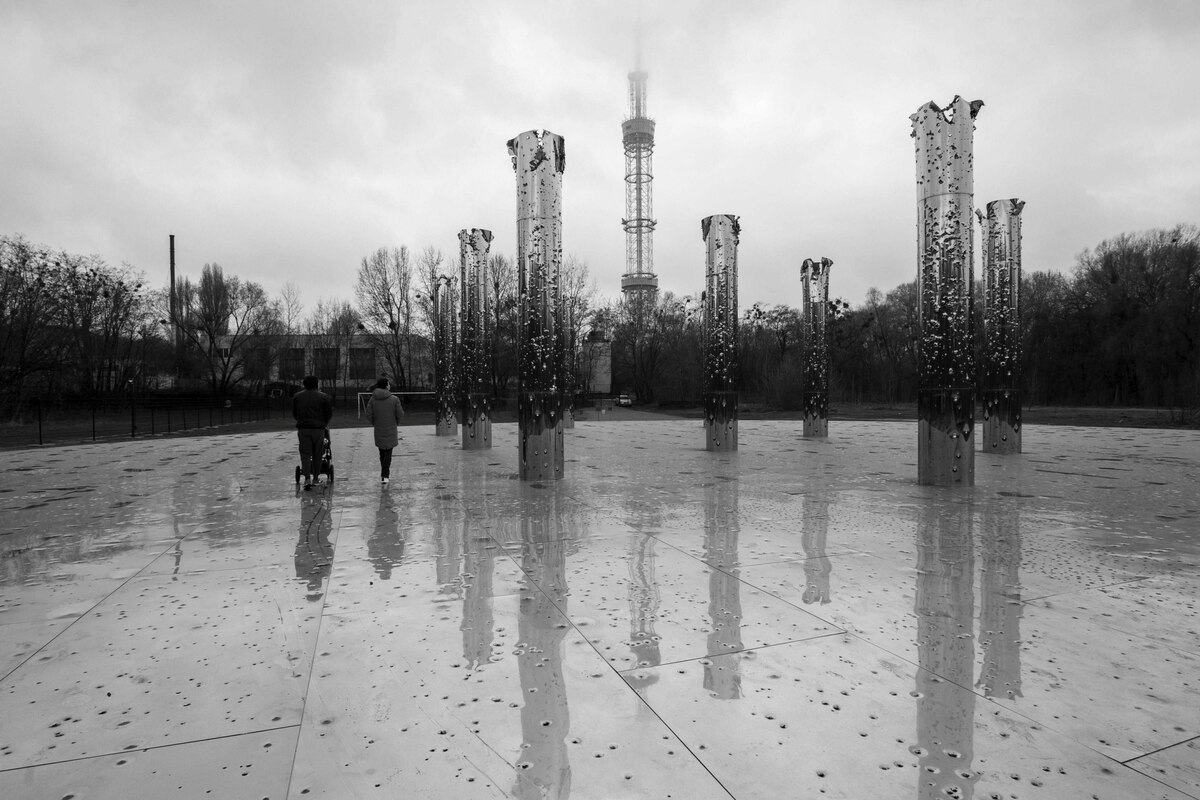
The fact that today there are memorials for various groups of victims in Babyn Yar, that one passes Marina Abramovic’s “Crystal Wall of Crying” and walks through the “Mirror Field” is anything but self-evident; reading this book makes this clear. One can also hope that after the dispute over the Babyn Yar Holocaust Memorial Center (BYHMC), which was supposed to be built there, a worthy documentary center will be opened at some point.
The re-publication of the novel at this time is of course no coincidence; many reflective passages allude to the methodology and nature of current totalitarianism; they can be related to Russian barbarism, but also to the tech-fascism that is currently spreading in the USA. Even then, Kuznetsov saw a new “technocratic barbarism” emerging and asked: “Which new Babyn Yar, Majdanek or Hiroshima (or Kolyma or Potma) is waiting (where and with what new techniques), now hidden in the void, for its moment?” This question would still have to be asked today, supplemented by a few places.