

In 2078 the time has come: the Nobel Prize in Literature goes to a comic artist for the first time, for her “walk-in Möbius strip” called “Cycle” comprising 10,000 individual images. The Berlin comic artist Jens Harder allows himself some futuristic jokes in his work, hidden in the explanatory text sections between the comic chapters. An “anti-Putin coup” will therefore take place this decade. And Elon Musk is elected US president for life.
“Gamma…visions” is the name of the final volume of Harder’s “Grand Narrative,” a story of our universe in pictures that he began over 20 years ago. In 2010 the award-winning inaugural volume “Alpha… directions” was published. It begins in an impressive sequence lasting over 20 pages with the Big Bang and ends with the demise of the dinosaurs on Earth.
The following two volumes, “Beta … civilizations” I and II, were published in 2014 and 2022 and dealt with human evolution up to the present day. In order to depict change and developments, the illustrator, who was born in Upper Lusatia in 1970, uses a methodology he invented himself: First, he selects suitable images, especially from the areas of art, photography, illustration, film, pop, media or science. Essential image cultures that shape our collective idea of the creation of the world to this day.
Jens Harder: “GAMMA… visions”. Carlsen Verlag, Hamburg 2025, 216 pages, 44 euros.
In the next step, these individual images are integrated into Harder’s overall content concept. “It seemed presumptuous to me to try to visually reimagine the entire history of the world – when almost every fact (at least every fact that is still remembered today) has already been depicted many times over,” said Harder, describing his approach at the presentation of his new book.
Computer-aided measurement of the world
For the resulting flow of images, Jens Harder subjects each individual panel to a processing procedure that brings together different origins, styles or eras of the images. “While I drew ‘Alpha’ with colored pencils and ink brushes on A3 and colored it on the light table,” explains Harder, “for ‘Beta’ I switched to more fleeting pencil drawings and digital coloring. For ‘Gamma’ I chose an almost completely computer-aided implementation of the pages.”
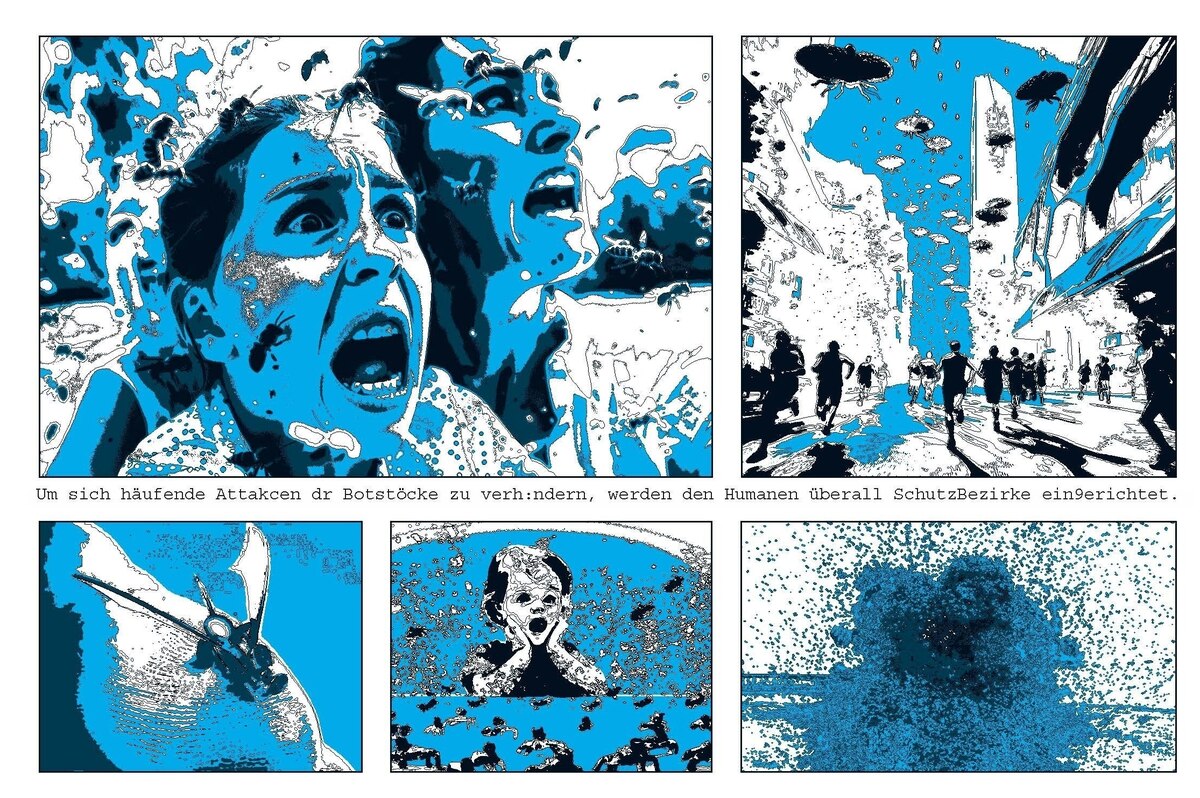
Finally, all panels are adapted to the color concept. The black and white and gray tones receive additional colors. While earthy ocher tones predominated in “Alpha”, and then metallic ones such as gold, copper or bronze in “Beta 2”, the new volume is dominated by a toxic turquoise blue. This fits well with Harder’s dystopian science fiction visions.
In contrast to the scientifically based previous volumes, “Gamma” is now based on speculation about the future. According to Harder’s chronology, we are now in the “computer age” and the age of space conquest. The planet is not overheating as the eruption of a supervolcano in North America causes global cooling of 2 degrees, but sea levels are rising, flooding many coastal areas around the world.
Beginning of the “solar era”
From 2066 onwards, the “solar era” will follow, in which robot colonies will take over people’s most dangerous jobs and, operated by AIs that can no longer be controlled, will act in an increasingly separatist manner. A “Great Separation” leads to separate living worlds for “humans” and “robots”. The first emigration programs lead to colonization of Mars and other celestial bodies.
In 2280 the phase of the “Ultimate Cybernetic Replacement” begins: Due to the collapse of the ecosystem and further rise in sea levels, the earth becomes almost uninhabitable. In the solar system, AI took over power in the form of “symbiotic bolides” (large spherical space gliders) in 6850. The time periods in the book become larger, and at the end, in around 100 billion years, there is the “Big Crunch”, the collapse of the universe.
With this finale, which illustrates one of the most common scientific hypotheses about the end of space, Jens Harder ties in with the Big Bang of “Alpha” and thus creates a cycle of all life that could begin again.
Harder mainly uses images that already exist of the future. To do this, “I chose motifs from the thousands of futures that SF authors, filmmakers and illustrators have imagined over the last few decades and then combined these quotes with other meaningful sources, such as the latest renderings of futuristic scenarios from various companies or institutes, but also outdated representations from the late 19th century (so-called paleofuture).”
Reiz des Mixes
This mix of very different image sources is what makes the book so appealing. Many motifs are recognizable, such as stills from “2001 – A Space Odyssey”, “Alien” or “Blade Runner”, comic panels by Hannes Hegen, Shigeru Mizuki or Enki Bilal. Paintings by Picasso and Raphael stand next to film posters from trash films from the 1950s and record covers.
Megacities or domed cities and human-robot encounters characterize the visually stunning book. The dystopian predominates
In between there are also some graphics that Harder deliberately created using AI. In particular, the diverse visions of future mega or domed cities as well as human-robot encounters in countless variations (and mutations) characterize the visually stunning book. The dystopian predominates: in later civilizations, humans and machines wage merciless wars against each other.
For his narrative about the future, Jens Harder “thought up the progression of developments, the specific texts and most of the neologisms himself – of course closely based on all possible future forecasts or predictions”.
Somewhat plausible
Harder relied on scenarios from science and sci-fi literature that “seem somewhat plausible and do not arise entirely from the realm of fantasy.” “Homo Deus” were important von Yuval Noah Harari (2016), “Visions. 1900–2000–2001. A Chronicle of the Future” (1999) by the GDR science fiction author team Angela and Karlheinz Steinmüller as well as various specialist books and articles on the development of AI.
The futuristic comic images are occasionally accompanied by cleverly distorted text comments that supposedly come from an AI from the future and are therefore riddled with “transmission errors”. For this, Jens Harder was inspired, among other things, by George Orwell’s “Newspeak” from his novel “1984” or the communist slogans of the GDR government, as well as programming languages of the late 1980s. Example from the era from 2280 onwards: “So: both longed for and feared, semi-conscious algorithms combine to form a know-all..”
Jens Harder has achieved something gigantic with the conclusion of his four-volume epic: an image composition comprising around 1,300 pages that is vivid and inspiring the history of the universe tell the story right up to a possible ending. It contains an urgent warning about the already foreseeable dangers of an artificial intelligence that is out of control.
“Gamma… Visions” brings a truly “grand narrative” to a worthy end. This volume encourages you to think about current scientific-technical and associated social developments and to come to your own vision of the future. Or help shape it.