

Heavy stones dangle from the concrete ceiling on thick white ropes. The lights are dimmed, people are stretching out on the carpet, cuddling and dancing. Slow music does that Little stalls in the wood marketin front there is an altar with photos, skulls and candles. Everyone can put something here that they associate with the topic of death and dying.
“If you die, do you want your family with you?” one participant asks another. Another question is: “Which phrase is most inappropriate when someone has died?” or more practically: “Which plants should decorate your resting place?”
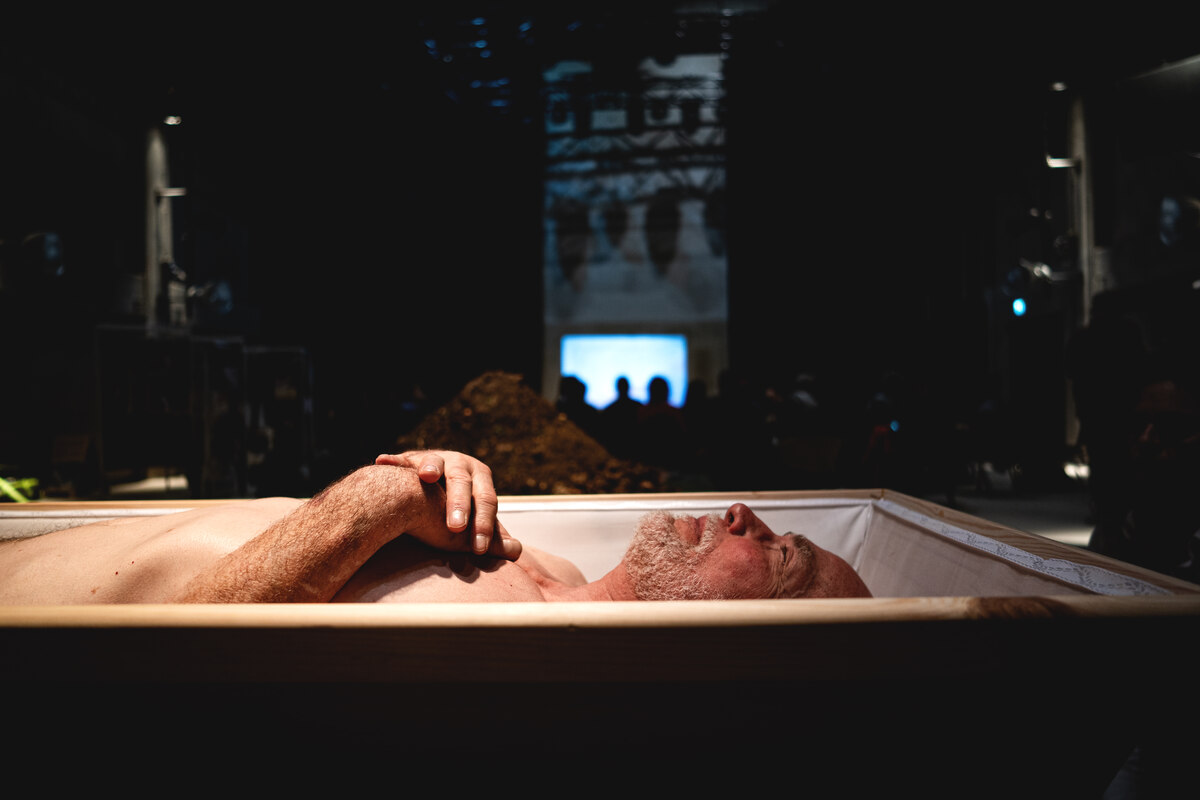
These questions will be discussed on Friday morning in the #yodo (you only die once) workshop. He is part of the Death Festival, which was dedicated to the question of how someone else for the second time this weekend Dealing with death and dying could look like – beyond repression, denial and fearas is widespread in Western cultures. Over 40 workshops, performances and ceremonies took place from Friday to Sunday. The organizers expected around 240 guests.
“We have always been confronted with death,” says Judith Salamander. She sits on a bench in the dark room, her gray hair peeking out from under her black cap. She organizes the festival together with her partner, palliative care specialist Matthias Gockel, and three other people. Salamander and Gockel come from the sex-positive scene; they always eroticized death at their kink events, she says. During the Corona period, the idea of our own festival arose. The “Festival of Death and Dying”, which Peter Banki launched in Sydney in 2018, provided inspiration.
Relatives and dying people become isolated
“It’s a topic that many people are afraid of,” says Salamander. People often don’t know how to deal with death, become afraid and withdraw. The result: relatives and dying people would become lonely. “You have to bring more normality into the topic,” she says. The festival aims to make a contribution to this by bringing together people in the area of death with body workers and artists who have different approaches to the topic. Because: “Death and dying are not dealt with physically enough,” says Salamander. “Fear is physical. Dying is physical.”
#yodo workshop leader Michi Maxi Schulz also shares this perspective. The artist is a volunteer caregiver at the Lazarus Hospice in Mitte. The trigger for the decision was the death of a close friend’s mother from cancer. The sudden death broke up the group of friends. “Nobody knew how to deal with it,” she says. She never wanted to feel so disoriented again. Around 40 people take part in her workshop to jointly explore the question of what process a dying person goes through biologically and emotionally.
In addition to dance workshops, there are also practical workshops by palliative medicine specialists, death and grief counselors and undertakers. The Home Care Berlin association, for example, gives “last aid” workshops, i.e. tips on caring for the dying. Gockel provides information about care structures at the end of life. At the “Creative Dying Fantasy” workshop, ideas about dying are discussed, for example through illness, old age, an accident, suicide or in an erotic fantasy.
Why bother with it? Because mortality is “the intensification of life,” according to the festival motto. “We often spend our lives in waiting mode,” explains Salamander. Anyone who becomes aware of their own finitude lives differently. That’s why it’s about supporting people with questions like: What do I actually want? Is there another letter I should write or a conversation I should have?
Living more intensely through dealing with death
Some of the participants also had this experience. A man who uses a wheelchair reports that he was almost killed in an accident 20 years ago. As absurd as it sounds: “In retrospect, it was an enriching experience. Life is more valuable when you feel closer to death,” he says. “The sky is bluer.” Since then he has been working as a grief counselor in the hospice.
While participants answer questions through dance at the yodo workshop, in the Red Salon one floor above there is a discussion about how funeral ceremonies can be designed as living rites of passage. Sunlight falls on the red walls and seats, the participants sit on cushions in small groups. The outside staircase leads to the IKSK, the Institute for Body Research and Sexual Culture. Bamboo sticks hang from thick white ropes from the ceiling of the room overlooking the Spree. Where bondage workshops usually take place, the petrification workshop will take place on Friday, during which rigidity is danced – a feeling that confrontation with death often triggers
“We deliberately kept the kink area out of the festival,” says Salamander. The eroticization of death scares many people away. Although pleasure and mortality are closely linked, sexuality in the face of death is often taboo. “It can definitely be a coping mechanism,” she says. Salamander is critical of the fact that togetherness is hardly possible in palliative care units. The workshop “Sexuality in Times of Mourning” therefore addresses the need for sexuality in times of serious illness and after death.
Meanwhile, down in the small room, feelings are being kneaded at a table. provider is Ahorn, a company that deals with the design of funeral rituals and grief management. In the Ahorn Space, a so-called Funeral Concept Space on Hermannplatz in Neukölln, people can paint coffins and urns, organize a funeral service and test lie in coffins.
Modernization of the funeral industry
“A lot is happening in the area of death culture,” says Salamander. There are a few good offers, for example from Ahorn or the Leisure and Recreation Center (FEZ) in Treptow-Köpenick, which offers workshops about death and loss for children and parents. “But the offers are not comprehensive.” She would like to see more exchange of knowledge, for example about care structures or alternative burials, as well as more opportunities to talk and, above all, explore things.
At the end of the yodo workshop, all participants are allowed to leave something in the room: one says goodbye to the fear of his disability, another to the grief of the past year, a third to the responsibility for the death of her father. Tears flow, the circle gets closer and closer together. Everyone breathes in together, pauses and then blows out the candle on the altar.