

M one must imagine the battle in the Wesermarsch in January 1514 as brutal: It was freezing cold in the winter back then, in the Little Ice Age. The ground was frozen or streaked with icy mud. The fighting had to overcome trenches and sluices everywhere.
The armies of the Counts of Oldenburg and the Dukes of Braunschweig-Lüneburg advanced between the frozen Weser and the Jade. Their goal: to subjugate one of the last autonomous regions on the North Sea coast.
Opposing the well-armed band of mercenaries and the knightly cavalry were the farmers from Butjadingen and Stadland, who were only armed with pikes and spears. The Hartwarder Landwehr near Rodenkirchen, an artificially raised wall with a ditch, was their last line of defense.
But the military superiority of the princes, who operated with artillery and professional tactics, was overwhelming. The decision was made on January 21st. Of those who did not die, many fled or were driven into exile; the land was plundered and the farms were subjected to heavy taxes.
A precursor to real self-determination
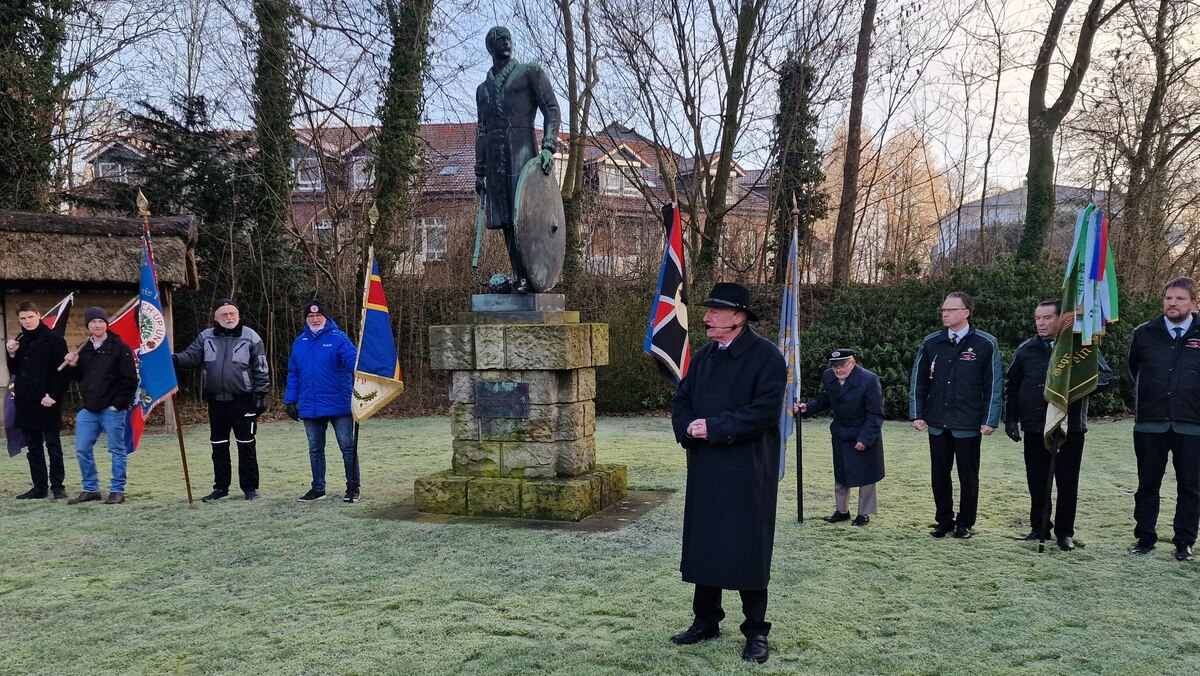
This Sunday, the Frisian Friends of Rüstringen-Stedingen will commemorate this battle and the end of the so-called Butjadinger Peasants’ Republic 512 years ago with a memorial event at the “Hartwarder Friese” monument.
The cultural-political association Frisian Forumwho cares about Frisian culture in East Frisia and cooperation with the Frisians in the Netherlands and Schleswig-Holstein, supports the event. They meet at 10 a.m. at the Friesenheim in Rodenkirchen-Hartwarden, lay wreaths and the former Lower Saxony Minister of Culture and Science Björn Thümler (CDU) gives a speech.
The clubs try to read history as a precursor to real self-determination – without perpetuating the nationalist appropriation of the past.
There is nothing express about this appropriation in the invitation, but “we are aware of this problem,” says Arno Ulrichs from the Frisian Forum of the taz. However, there is not enough space to examine this in depth within the framework of a brief communication and a commemorative event.
A complex story
“Where we have the opportunity, we want to present the story in a more differentiated way, so we’ll bring that in too,” he says, referring to events surrounding the event Upstalsboom near Auricha historical meeting place where the Frisian regional communities met in the Middle Ages to seal alliances and peace. Historian was Ubbo Emmius early on described the Uptalsboom as the “altar of freedom”.
There is an 1833 one there today East Frisian landscape erected stone pyramid, which symbolizes Frisian independence and freedom. The Nazis wanted this spot build a thing place. The plans were not implemented.
At these events surrounding the Upstalsboom, commemoration was also linked to current issues, says Ulrichs. The tenor was, “if we want to achieve something for the Frisians or for other minorities, then we will do it in a European context”. The issue must be removed from the burdened context of the Nazi era. The story is too important to be left to the right as “burnt”.
But it’s not that easy. Because the Battle of the Hartwarder Landwehr is shrouded in myths. The first reactivations of history occurred long before the Nazis in the 19th century, when the old Frisia was glorified in a romantic and nationalistic way. An example of this is the saying “Lever dod as Sklav” – “better dead than a slave” – which adorns the Frisian monument today; it does not come from 1514, but from this later era of myth-making.
In the Butjadinger Peasants’ Republic, freedom was inextricably linked to land rights and the burden on dikes. The principle: If you don’t want to build a dike, you have to move
In the 1930s, “Frisian freedom” became a central projection surface for the Nazis, who were looking for a “Germanic” tradition that they could subordinate to their blood and soil ideology. The Frisians, who defended themselves against “foreign” princes, fit the narrative perfectly.
The history of the battle of 1514 was massively exploited. The Nazis styled the Frisian farmers as “elite racial warriors”. The “Nordic will to resist” against the Oldenburg counts was not interpreted as a political struggle for self-determination, but rather as an expression of biologically based superiority.
The Nazis reinterpreted memorial ceremonies as stagings by the national community. The aim was to suggest to the farmers of the Wesermarsch that their supposedly “ancestor-proud” freedom now culminated in unconditional loyalty to the “leader”.
In fact, there are good reasons to commemorate the battle and the end of Frisian freedom today. The bloodbath that day marked the end of a cooperative system of self-government in feudal Europe, which was inextricably linked to land law and the burden or duty of dikes. The principle applied: “If you don’t want to build a dike, you have to move.”

The Frisians elected their own judges and made decisions in thing assemblies: an early, pragmatic form of autonomy. The surrounding princes viewed it as a dangerous source of unrest – and a lost source of taxes.
But there is no reason to remythologize. Historians like Gerd Steinwascher emphasize that Frisian freedom often only meant autonomy for a few rich farming families. They didn’t tolerate noble gentlemen acting like little nobles themselves. The majority of the population did not fare any worse under the later Oldenburg rule.
No natural desire for freedom
The fact that the Frisians had “no sovereigns” at that time also had more to do with a power vacuum. This triggered disputes between the East Frisian chieftain family of the Cirksena, the Saxons and the Oldenburgers.
Because the Cirksena from Greetsiel had been separated from Emperor Friedrich III in 1464. be enfeoffed with all Frisian lands. His son, Maximilian I, simply gave the same fief again to Duke Albrecht of Saxony in 1498. And while the big players fought for supremacy, the Oldenburg counts seized the opportunity: They tried to take the country by force – with success.
Current historical research on Frisian freedom has long since corrected the image of a “natural urge for freedom” and replaced it with an analysis of legal-historical and economic conditions.
Highly complex interest groups
Today, the peasant republics are seen as highly complex interest groups. They were able to maintain their autonomy primarily because they organized the complex infrastructure of coastal protection more efficiently than any feudal state.
Arno Ulrichs from the Frisian Forum therefore wants to explicitly link commemoration today with the “right of self-determination of individuals” and a clear “European perspective”. The forum wants to strengthen minority rights in modern Europe. Where the Nazis had imposed a crude master ideology, the forum emphasized the “singularity” of a history without serfdom.
Die Frisian freedom is therefore a “foundation that is still relevant today,” says Ulrichs. Precisely because it can be read as a precursor to real self-determination before it was ideologically distorted a hundred years ago.
The story of the Battle of the Landwehr thus becomes a lesson in the conditions and limits of local self-government – beyond pathos and false hero worship.