

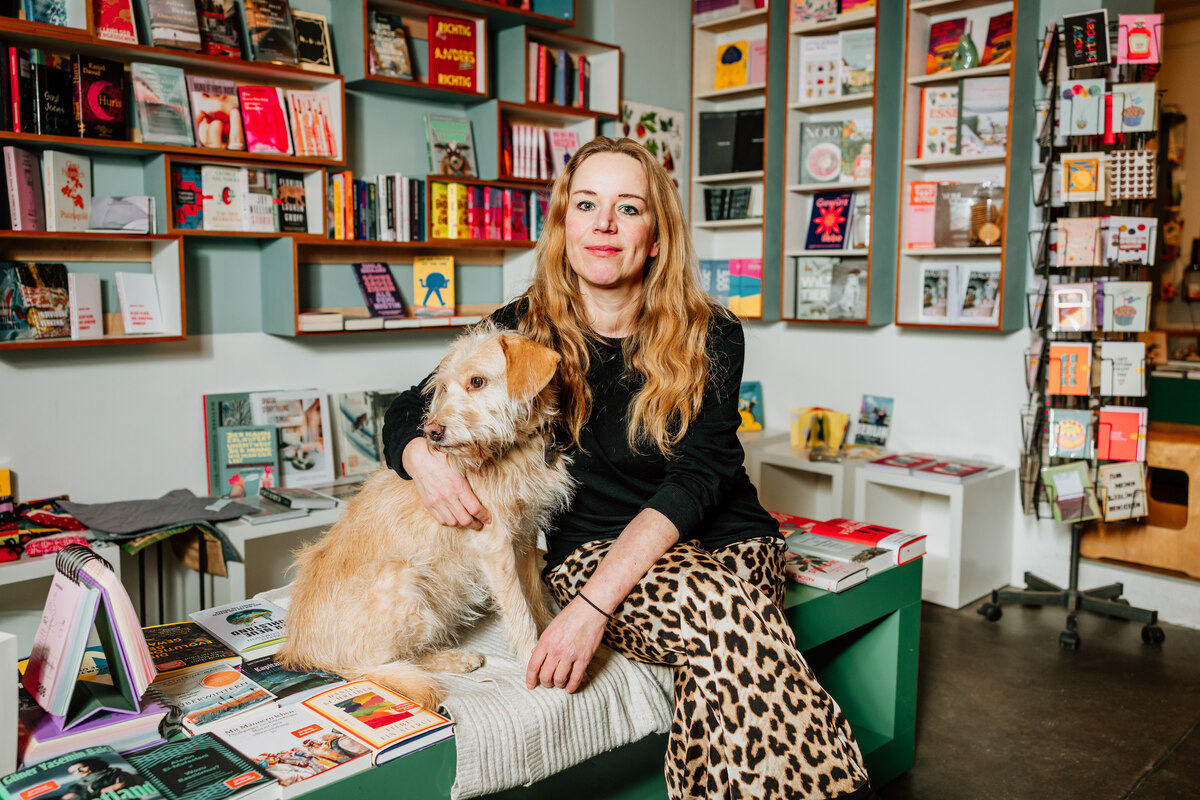
Monday morning at 9 a.m. on Falckensteinstrasse, corner of Schlesische. Christina Galandi stands in front of her with a broom Ebertundweber bookstoresweeps up the dirt from the weekend, pushes aside a dry Christmas tree, picks up a few empty beer bottles. Five minutes later, the first of eight booksellers arrive.
After passing out cups of steaming hot drinks and a game of Tetris on the large sofa in the back room, we concentrate on the topic. The eight owners recently founded a new interest group: the IG Indie bookstores in Berlin.
They want to talk about what independent bookstores are doing in this city. What they do every day besides selling books. And why it is becoming increasingly difficult to continue this work. It’s about the question of what place these warming rooms have for the spirit in a city like Berlin that is getting colder.
The book business is no longer easy anywhere. There are fewer bookstores across Germany today than there were five years ago. According to the German Book Trade Association, the number of bookstores nationwide fell by around 12 percent between 2018 and 2023. many have closed downothers were taken over by large chains. Thalia and Hugendubel continue to grow and online trading is flourishing. Although Berlin is at the forefront nationwide with around 210 bookstores, the situation is getting worse.
Places that contribute to the functioning of a city
The biggest problems that the women name are quickly listed: the skyrocketing commercial rents. The few funding programs that exist. Too much paperwork with too little chance of success. The unpaid additional work. And the big ones buy books in large quantitiesthat means lower purchase prices, higher profits and English-language books – due to the lack of fixed book prices – at dumping prices. In addition, the book trade is a female-dominated industry in which female entrepreneurship is often taken less seriously by banks and authorities.
And yet they want to stay. That’s exactly why the bookstores have joined forces as preliminary founding members: in Mitte about bookshop and GOLDA books and morethe bookstores in Friedrichshain InterKontinental and Mouse and Bear, in Kreuzberg book affairs and ebertundweber and the bookstores in Neukölln Buchkönigin and City lights.
Buying books is a political act
Christina Galandi, ebertundweber bookstore
Their goal is not a nostalgic appeal for rescue, but rather political and economic visibility. They would like to have regular discussions with politicians, publishers and industry associations. They want to have a say when urban development, rents or cultural funding are discussed. They want bookstores to be seen not just as points of sale, but as places that contribute to the functioning of a city. Because for them, their bookstores are third places between work and home.
“Bookstores are cultural places. But they are not treated that way,” says Jenny Bühler from book affairs. “Buying books is a political act,” says Christina Galandi. What follows is a kind of situation report from the engine room of the well-read city.
Stefanie Hirsbrunner from the InterKontinental bookstore reports on customers who photograph covers in order to choose the one they can afford each month at home.
There are people who come in after their shift in their overalls and look at poems
Stefanie Hirsbrunner, InterKontinental bookstore
And then it goes all over the place: one of the booksellers helps a regular customer by translating the letters from the office into simple language. One lends her technology to the grandmothers against the right. One person orders flannel shirts online for an elderly neighbor because he doesn’t know his way around – or because he can’t afford one. “For us, literature is not an ivory tower,” says Hirsbrunner. “We’re in the neighborhood. There are people who come in after their shift in their overalls and look at poems.”
For the women, their shops are places, of which there are fewer and fewer in Berlin, where you can stay without having to buy something. Places of attention, of slow conversations in which the cell phone sometimes remains in silent mode, debating clubs, refuges against the erosion of democracy, against the city’s drifting apart.
This is also confirmed by a look at Christina Galandi’s table with non-fiction books: Next Heike Geißler’s book “Working”which mercilessly exposes how exploitative our system of wage labor is, there are books about the meaning and benefits of class society. One more Dirk Brockmanns „Survival of the Nettest“ against the myth that only the strongest always win, and Timothy Snyder’s “On Freedom”which is about the freedom of responsible participation. This is called curated reading.
The situation is becoming increasingly difficult
The women talk about shops that have disappeared. “Read and let read” in Friedrichshain, a permanent location in the neighborhood for 28 years, failed because of the rent. The Tucholsky bookstore in Mitte could also not be taken over because the rent would have doubled.
The situation is becoming more difficult because readings are increasingly becoming a luxury. Christina Galandi says that well-known authors today have to charge 600 euros or more to get their cut. Small shops often only fit 40 people.
“So we often do it ourselves,” adds Catherine Feldmeier from the Mouse and Bear children’s bookstore, giggling. She regularly reads to groups from school and kindergarten herself so that there are enough events.
What is described here sounds romantic. But it’s only from the outside. In reality it means: self-exploitation and long days, often from morning until late at night. In addition to sales, there are social media and online business, newsletters, events, accounting, shop windows, orders and more and more conversations. Many stores now also sell games, postcards, gifts, coffee or cake – in the language of business: cross-channeling. Not for lifestyle reasons, but because books alone are often no longer enough.
At the end the conversation returns to the beginning. To sidewalks. When the others have already left, Christina Galandi and Ileana Seidl from the Book Queen talk for a while about how much effort it takes to keep the area in front of their shops clean. It’s about garbage, rats and smells in summer. And whether that is better than the Christmas trees and the black ice in winter. They laugh.
It’s a small scene. Almost irrelevant. And yet it tells pretty much exactly what this is about: Someone is sweeping. Someone clean up. Someone cares. Almost every day.