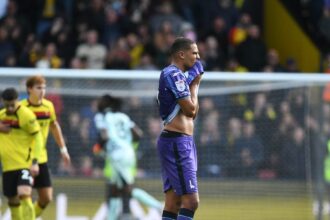


What initially seemed like a routine injury has suddenly become much more serious, and Jalen Hurts’ long-term NFL career is now in doubt.
Hurts’ agent, Nicole Lynn, released a statement yesterday announcing that the blood clot underneath the skin of his calf has moved into his lungs. As a result, doctors have put Hurts on blood thinners. The Eagles placed Hurts on IR, and since you can’t play football while on blood thinners, Hurts is out for the foreseeable future. That could be three months, six months, or much longer.
This raises a lot of questions. For starters, the Eagles medical staff allowed Hurts to take an international flight after discovering the blood clot. Since superficial blood clots can worsen during international flights, was that the right decision? Early reports also indicated that Hurts didn’t sleep for 36 hours leading up to last weekend’s game in London, based on the recommendation of team doctors. Who made that call and why? And given that the initial ultrasound performed in London showed a superficial blood clot on Saturday night, why did the Eagles medical staff wait until the following Wednesday to do another ultrasound?
Those answers matter, but they also only scratch the surface of the potential issue at hand. So for today’s newsletter, we’re going to cover everything you need to know, including the timeline of events, the injury Hurts is dealing with now, why negligence might have made it worse, other professional athletes who have dealt with similar issues (and what happened to them as a result), and why this could potentially lead to a nine-figure lawsuit between Hurts and the Eagles medical staff.
Let’s start with a complete timeline of everything that has happened:
-
October 4: Hurts was cleated in the calf during a Week 4 game against the Los Angeles Rams. He finished the game that Sunday without issue.
-
October 7: Hurts is a full participant in practice (no injury designation)
-
October 8: Hurts is a full participant in practice (receives first treatment)
-
October 9: Hurts is a full participant in practice (added to injury report)
-
October 10: After flying to London on Friday, October 9, Hurts undergoes an ultrasound in London that confirms the superficial blood clot.
-
October 11: Hurts plays in the London game against the Jacksonville Jaguars without issue. Tom Pelissero initially reported yesterday that the Eagles team doctors told Hurts not to sleep after the ultrasound, meaning he was awake for 36 hours before playing, but Pelissero later walked back that claim, saying Hurts slept a few hours in the hotel before the game. The Eagles (and Hurts) then flew from London back to Philadelphia after the game.
-
October 12: Hurts receives treatment in Philadelphia
-
October 13: Hurts receives treatment in Philadelphia
-
October 14: After participating in Wednesday’s practice, Hurts undergoes a second ultrasound. Doctors find movement in the blood clot and advise him to sit out the team’s Week 6 game.
-
October 15: The Eagles announce to the public for the first time that Jalen Hurts has a blood clot.
-
October 16: Hurts undergoes additional testing and evaluation
-
October 17: The Eagles place Hurts on IR (out a minimum of 4 games)
-
October 19: Nicole Lynn (Hurts’ agent) releases a statement saying that while the initial diagnosis was a left calf superficial vein thrombosis (small blood clot under the skin), the blood clot has moved into Hurts’ lungs and the current diagnosis is a deep vein thrombosis (blood clots deep inside the body), as well as bilateral pulmonary emboli (blood clots in both the left and right lungs). In the statement, Lynn also said that “treatment should only involve” blood thinners and that while Hurts will remain around the team with no long-term effects, he will not be allowed to participate in contact activities.
You don’t have to be a doctor to understand how serious this is. Bilateral pulmonary embolism is a fancy way of saying that blood clots are blocking arteries in both the left and right lungs. It is a critical, life-threatening medical emergency. It can lead to everything from difficulty breathing and chest pain to dangerous drops in blood pressure or sudden cardiac arrest. Pulmonary embolisms are a leading cause of cardiovascular death, and bilateral cases carry a significant risk of death within hours of symptoms if not treated immediately.
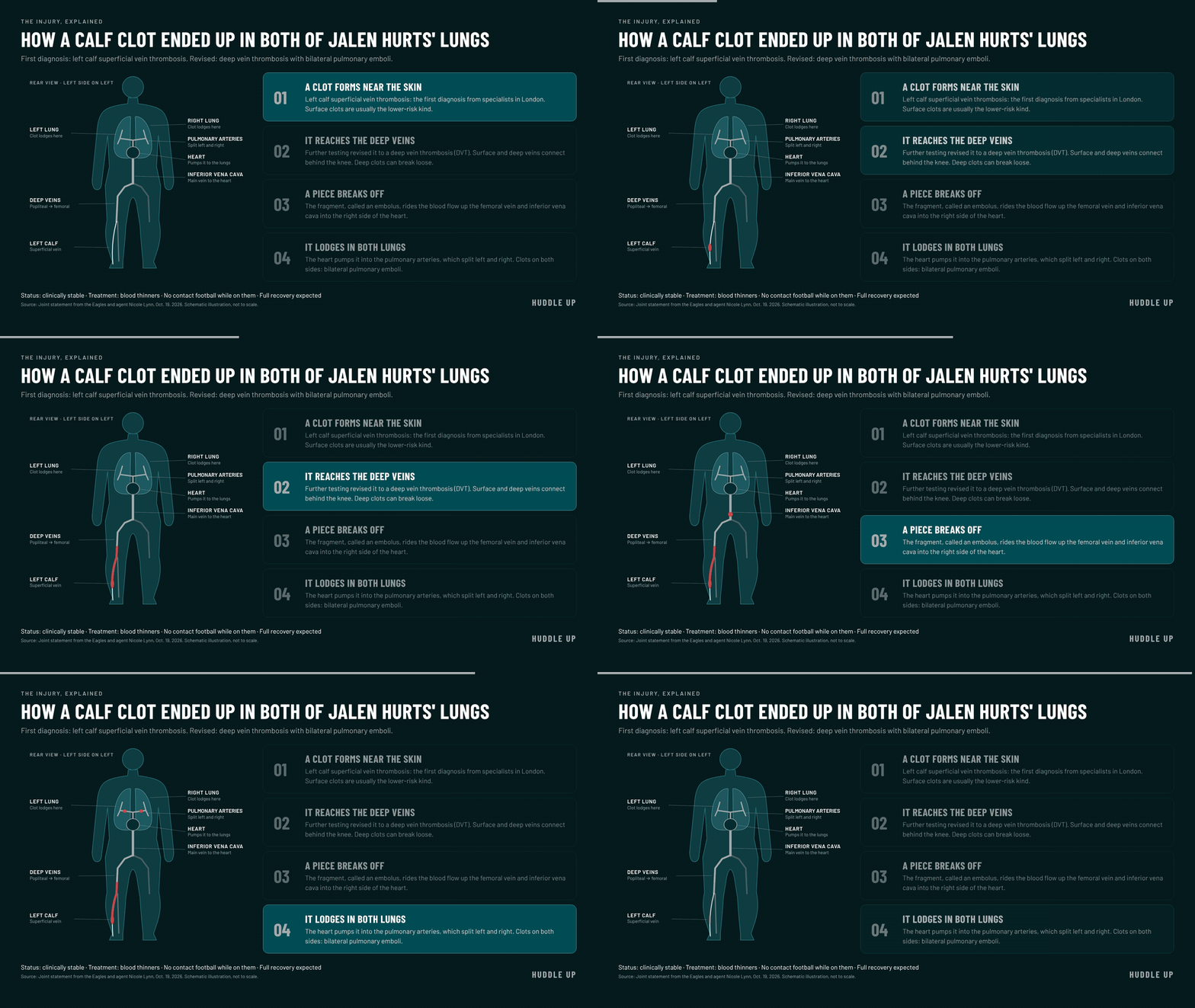
Everyone reading this newsletter is smart. We don’t know exactly what went into Hurts’ medical care, and it would be foolish to speculate or cast doubt on medical professionals without that knowledge. That said, it’s fair to ask whether traveling internationally made Hurts’ condition worse. Hurts was already in London when the blood clot was discovered, but we all know flying in an airplane — especially long, international flights — can make blood clots worse. That’s because of the prolonged immobility, which slows blood flow and increases the risk of a clot.
As for Pelissero’s report that the Eagles told Hurts not to sleep before the game, I think something probably got lost in translation. Since this isn’t my area of expertise, I talked to a couple of doctors yesterday, and both said there’s no good reason for Hurts not to sleep. Instead, my guess is that Hurts was up late at the hospital getting the ultrasound, consulting with doctors then extended his wait into the early morning hours, and he only slept a few hours once back at the hotel.
We will likely hear more about Hurts’ treatment plan in the coming days and weeks. Right now, he’s on blood thinners, which is standard. However, since blood thinners impair the body’s ability to stop bleeding after an injury, no doctor in their right mind would advise Hurts to keep playing while on them (because a head injury or even a hard tackle could cause dangerous bleeding inside the skull).
This situation could be worse, though. For example, I have seen a lot of people comparing Hurts’ injury to Chris Bosh. The TLDR is that Bosh had a blood clot reach his lungs, which ended his career. But that comparison is incomplete.
For starters, Bosh actually recovered from the initial blood clot that reached his lungs in 2015. He returned to basketball on opening day the following year, but another clotting episode interrupted that season and forced him to retire. Bosh attributed the blood clots to the amount of travel NBA players have to endure throughout a season, but he wasn’t forced to retire because a blood clot reached his lungs. He recovered from that blood clot episode and was only forced to retire when the blood clots kept returning, which kept him on blood thinners.
That’s a key distinction. The doctors I spoke with all said the biggest clue to whether Hurts will fully recover and resume his NFL career is whether these clots were caused by a temporary trigger or an ongoing tendency to clot. The good news is that every report so far indicates that the first clot developed because of a cleat Hurts received to his calf during the game against the Rams. Not only does that suggest an identifiable trigger, which was then made worse by international travel, but Hurts has no prior publicly reported blood clots, and he also doesn’t appear to have any genetic disorder that would make more blood clots more likely.
In a perfect world, Hurts takes blood thinners, the clot disappears, doctors see no harm in letting him keep playing football, and his NFL career resumes next season. For perspective, the British Medical Journal released a study several years ago that found patients with a first unprovoked clot had about a 10% recurrence rate in the first year and 25% within five years after stopping blood thinners. It’s also probably worth mentioning that, in some cases, doctors will prescribe a treatment plan that allows athletes to go on and off blood thinners in between competitions, although that is unlikely given the physical nature of football, even if the Eagles medical staff is known as one of the NFL’s most aggressive units.
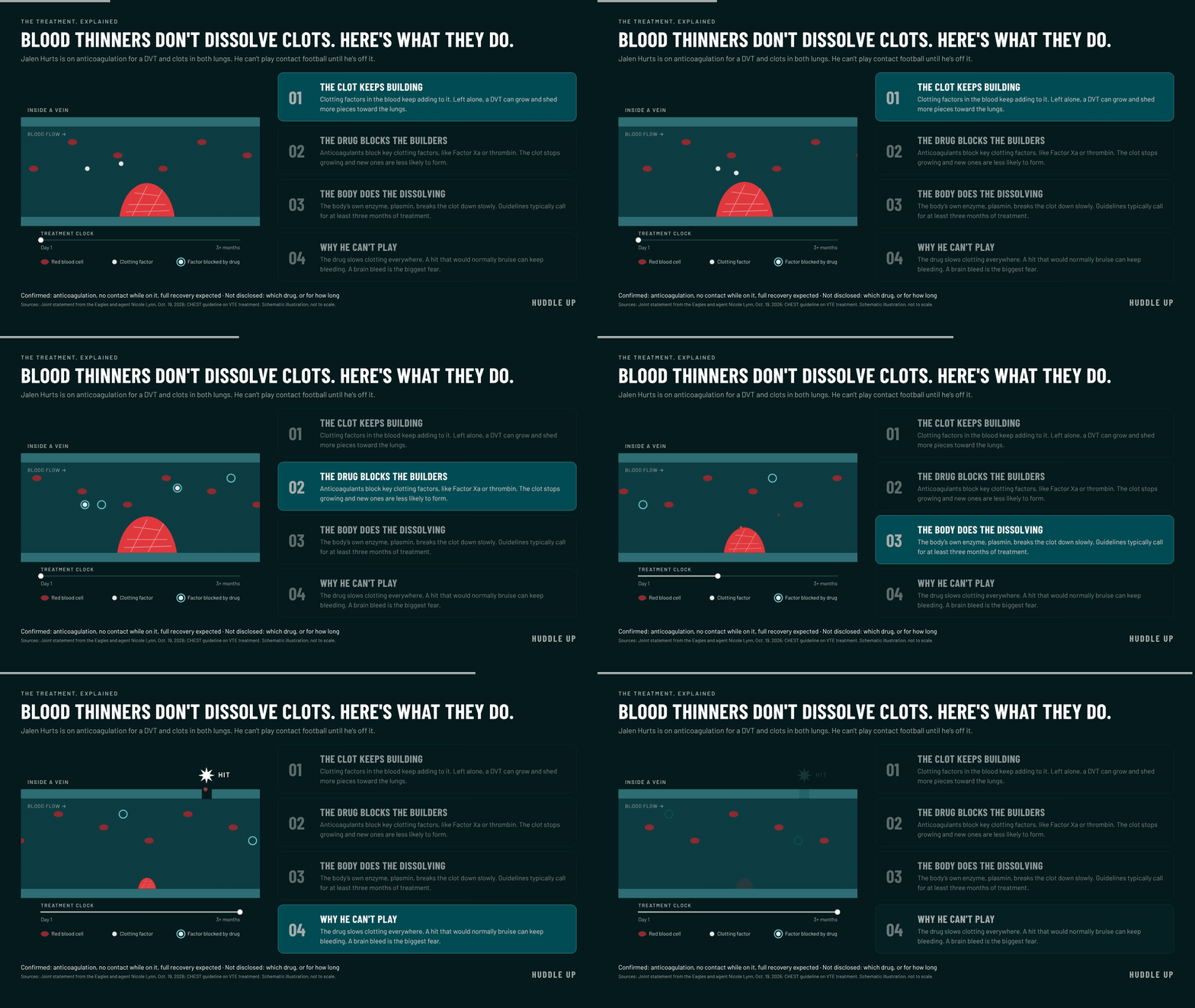
There have also been several athletes who dealt with blood clots and returned to play their respective sports. Russell Okung, David Andrews, Christian Barmore, and Chris Olave have done it in the NFL, with Olave actually suffering a similar injury to Hurts (pulmonary embolism). Olave’s clot was discovered before Week 18 last season; he took blood thinners during the offseason and returned this year.
That said, the Eagles medical staff could be in trouble if things get worse. Under Pennsylvania law, a successful malpractice claim generally requires proof of:
-
A duty of care: The provider was responsible for treating him
-
A breach: The care fell below accepted professional standards
-
Causation: That failure caused or contributed to additional harm
-
Damages: Physical injury, additional treatment, or lost earning capacity
I am obviously not a lawyer, but the Eagles’ medical staff allowing Hurts to play and then putting him on a long international flight (knowing he had a blood clot in his leg) feels like a pretty decent argument for causation. There is no indication that Hurts is going this route, but malpractice is an important caveat to consider because a case like this could result in hundreds of millions of dollars in damages.
Funny story, I was at a sports medicine conference in Chicago last year. Team doctors for the Buffalo Bills and New York Yankees spoke on panels, along with some of the world’s best surgeons. But one thing that really stuck out to me was when Dr. Neal ElAttrache, who has operated on everyone from Kobe Bryant and Shohei Ohtani to Tom Brady and Conor McGregor, said that you would have to be crazy to operate on athletes given the threat of malpractice lawsuits, and that ego was the only thing keeping him going. Of course, all these surgeons have insurance to cover the worst-case outcome, but those plans only cover you up to a point, leaving you personally liable for any additional damages awarded.
Hurts is also a unique case. Even if we ignore his current contract, the best NFL quarterbacks are now making $50 million per year. That means Hurts could argue that a career-ending injury is potentially worth $500 million or more. If the Eagles medical team were found liable, that would be the biggest payout in sports history.
That may feel unlikely, but it’s worth discussing. Former Eagles player Chris Maragos was awarded $43.5 million after a jury ruled that doctors botched a surgery on his meniscus in 2017. Sharrif Floyd filed a $180 million lawsuit against Dr. James Andrews after suffering permanent nerve damage following a 2016 knee surgery, ultimately settling the dispute out of court. Tyrod Taylor even filed a complaint against the team physician of the Los Angeles Chargers, later agreeing to an undisclosed settlement after arguing that a pregame painkilling injection punctured his lung and cost him the starting job to Justin Herbert.
So my point is simple: Hurts may make a full recovery and get back to playing football, but that wouldn’t necessarily answer the questions about how this injury was handled. Those are two separate issues. We still need a lot more information before drawing conclusions about either one, but I don’t think it’s a coincidence that the Eagles immediately asked Tom Pelissero to clean up his reporting.
If you enjoyed today’s newsletter, share it with a friend.