

Karl Hofer is rightly considered an important artist of the first half of the 20th century in Germany. With his own expressive, classicist style, he was already an exponent of the modern movement during the times of the Empire. Good thing for him the Moritzburg Hall is organizing an extensive exhibition with “Karl Hofer. Between Beauty and Truth”. And it’s a shame that the show still remains unclear about a tragic point in his biography.
Hofer, born in the Grand Duchy of Baden in 1878, was connected to the German art tradition but was never a nationalist. Educated at the Karlsruhe and Stuttgart Academy, he moved to Rome and Paris, Europe’s art metropolis at the time, for several years.
In his portraits and landscape paintings he was concerned with the perception of his surroundings; he painted people in convivial conversation at the table, playing cards or figures in a silent posture.
Karl Hofer: “Between Beauty and Truth”. Moritzburg Halle, until February 15th. From April 11th in Achberg Castle, Ravensburg, then other stops. Catalog (EA Seemann Verlag): 40 euros
He maintains his expressive imagery, the sharply defined body silhouettes, the shadowy eye sockets of many figures, and the earthy colors across the different political contemporaries.
Subtle work on the human image
In 1920 he was appointed to the Berlin Art School. As a publicly avowed opponent of the Nazis and as an expressive painter, he had to end his teaching career with the change of power in the first wave of “purges” in April 1933.
It was only in 1945, after the end of the war, that he returned to teaching and was appointed director of the Berlin University of Fine Arts. He directed these in the Post-war years focused entirely on modern artists who were considered unencumbered. Hofer subtly tried to work on the human image in his art. He took up motifs again and again and varied them in the changing context of the times.

Does not correspond to the academicism and “German art” of the Nazis: Karl Hofer: “Two Men in the Winter Forest”, 1938, oil on canvas
Photo:
Sophia Kesting, VG Bild-Kunst, Bonn 2025; Courtesy Collection Arthouse
He repainted his nocturnal “Caller” from 1924 in a very similar manner in 1935. But now the painting stood in tension with the boundaries of aesthetic academicism, which for many Nazis was the means of “German art”. Hofer remained an independent modern.
The exhibition does not reflect on how Hofer maintained his own artistic attitude despite the changing conditions caused by National Socialist art policy. When his Berlin studio burned down in 1943 with the art stored there, he worked on new versions of his paintings during the war.
Bad Night is a dark symbol of his emotional state during the Nazi regime
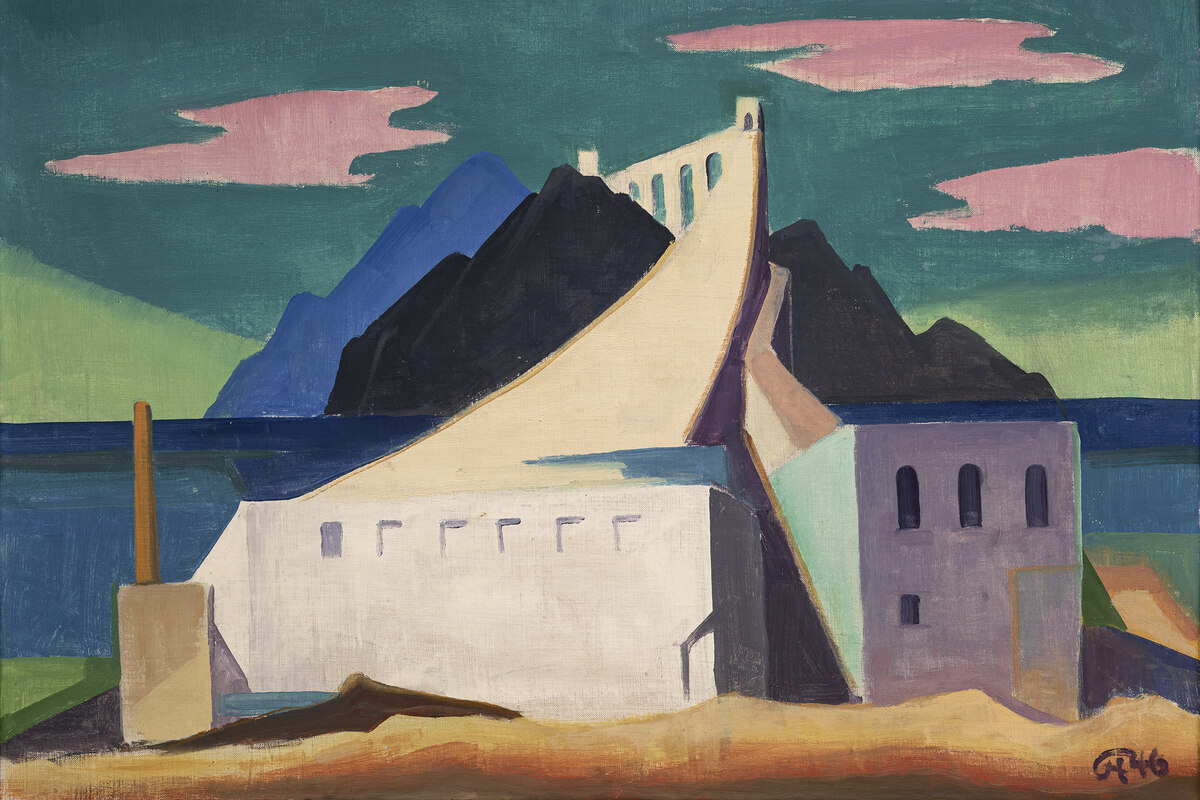
His painting “Bad Night” from 1946, which shows a landscape with ruins and threatening, wolf-like predators, must be interpreted as a dark symbol of his emotional state during the Nazi regime and in the post-war period.
Things become difficult when the exhibition catalog oversimplifies a tragic passage in Hofer’s biography and attributes him as being responsible for the murder of his first wife by the Nazis. He had been married to the singer Mathilda Scheinberger since 1903 and they had three children. The two separated amicably in the mid-1920s. She came from a Protestant assimilated family of Jewish origin.
In order to legalize Karl Hofer’s new relationship in a “wild marriage”, he asked Mathilda for a divorce in 1931 and 1933, to no avail. Meanwhile, Nazi art policy increasingly restricted him. The “Degenerate Art” exhibition in 1937 showed nine of Hofer’s works, and a further 311 were taken from state collections to be sold in Switzerland.
The first wife is murdered in Auschwitz
Hofer was threatened with the end of his professional career as a visual artist. In 1938, after submitting new works, he received an award from an artists’ commission of the Reich Chamber of Fine Arts his affiliation with “German art” was recognized. In the same year, Mathilda agreed to the divorce. Immediately afterwards, Hofer married his second wife, Elisabeth Schmidt.
Mathilda Scheinberger, on the other hand, was excluded in German society as “non-Aryan” and was forced to emigrate. She hoped in vain for an invitation from the museum in Pittsburg so that she could start a new life as a musician in the USA. Why her request was rejected there is unexplored. She was murdered in Auschwitz in 1942.
Can one blame Hofer for not foreseeing this terrible development in 1938? It was only in November 1941, when the USA entered the war, that Hitler decided to initiate the systematic extermination of all European Jews, something the historian Hans Mommsen researched in detail in the 2000s.
The catalog fails to describe this disastrous entanglement of professional and private life in Hofer’s life in more detail. Instead, he relies on simple blame with the knowledge of hindsight.
His role in divided Germany
“Karl Hofer: Between Beauty and Truth” is still an impressive exhibition. Although it does not highlight Hofer’s aesthetic independence, which he retained across time and political regimes, it does highlight his role in divided Germany.
For some artists in Halle he was still seen as a role model in the first post-war years. In the Formalism debate in the 1950s in the GDR he was excluded with the label of a “bourgeois artist” and no longer exhibited. It was not until his 100th birthday in 1978 that the painter received another major retrospective, in Halle as well as in West Berlin.