



If Dodgers fans didn’t have it bad enough after getting swept by the Milwaukee Brewers in this year’s MLB playoffs, team owner Mark Walter is back in the news, now facing an onslaught of lawsuits alleging he intentionally misled investors.
We have covered the Mark Walter investigation extensively. The TLDR is that Walter owns insurance companies. Those insurance companies raise money by selling annuities (think: a guaranteed stream of income for retirement). But instead of investing that money in stocks or bonds, which would have been lower-risk and ensured that retirees get paid out when their policy comes due, Walter used the money to buy sports teams, including the Dodgers, Lakers, and Chelsea.
And Walter didn’t just buy sports teams. The DOJ believes Walter intentionally sent money from his insurance companies to third parties, then instructed those same third parties to route the money back to himself. Yes, you read that right. Walter is being accused of washing the money. Now, why would he want to do that? The obvious answer is that regulators have strict rules about where you can and can’t invest premiums, and if Walter had disclosed he was loaning the money to himself to buy sports teams, state regulators would have shut it down instantly.
You can guess what happened next. A whistleblower came forward, and FBI agents raided Walter’s private jet in Chicago, confiscating his cell phone and laptop. But despite the paper trail, Walter didn’t just admit wrongdoing. He has essentially taken the stance that he didn’t properly understand which loans needed to be disclosed as related-party transactions, and now that investigators had brought it to his attention, he would clean up his books within 6-12 months.
The only issue with that defense is that the problem turned out to be much bigger than anyone realized.
Regulators usually allow insurance companies to loan ~5% of their investable assets to related parties. On paper, Walter’s insurance companies, Delaware Life and Clear Spring, complied with this rule, with 3% and 4% related-party exposure, respectively. But after digging into the details, Walter was forced to revise those numbers to 42% and 59%. That meant roughly 50 cents of every dollar invested with Walter ended up at a company he had a relationship with, and total related-party exposure rose from $3 billion to $21 billion. So to get his related-party exposure back under 10%, Walter would need to replace $15 billion in assets.
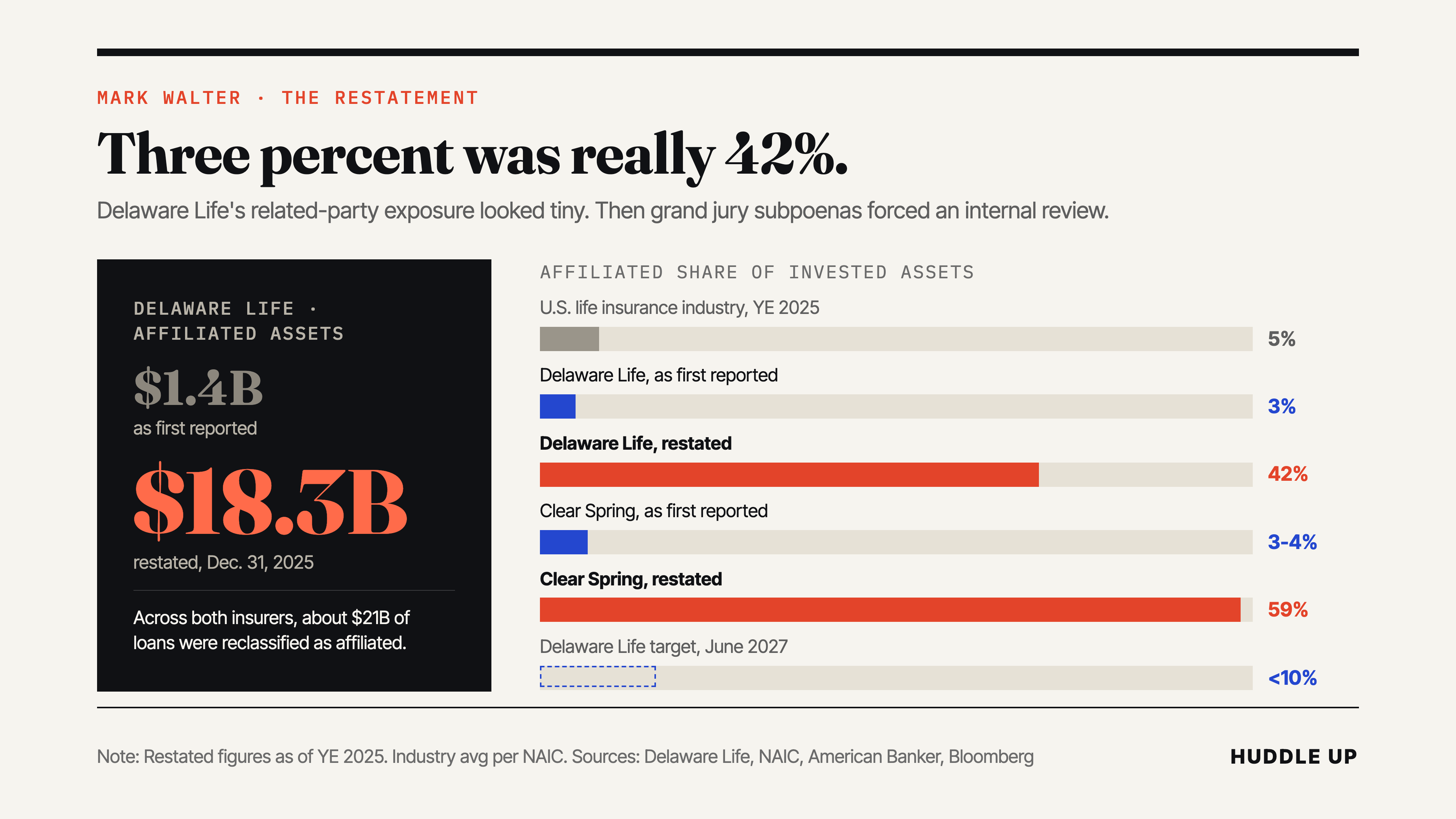
To be clear, Walter doesn’t need to raise $15 billion from investors. He needs to move $15 billion of investable assets at his insurance companies from affiliated parties to unaffiliated parties. That money could then be invested in stocks, bonds, or real estate. It just can’t be loaned out to one of Walter’s own entities.
This is why Walter sold his stakes in the Lakers and Chelsea FC. Walter didn’t own 100% of the Lakers, and he was a minority investor in Chelsea, but those two deals alone likely freed up about $10 billion. Walter could cover a lot more selling the Dodgers, but he doesn’t plan to do that right now. Instead, Walter will sell some non-sports assets and has reportedly even talked with private equity firms about taking out personal loans backed by his ownership stake in Guggenheim.
I know it sounds crazy to say out loud, but I’m really not that concerned about the money. This money exists; it’s just spread across different assets. Walter will find liquidity, then put it back. It’s not that complicated. But with that said, even if Walter puts the money back, that doesn’t mean he won’t face consequences.
At least three people have filed lawsuits against Walter and his insurance companies. The class-action lawyers who brought these lawsuits are asking the judge to let them represent hundreds of thousands of policyholders. And if Walter is found liable for selling annuities based on misrepresentations and false promises, he might have to sell the Dodgers and some of his other sports assets.
This is the end of today’s free section. If you are enjoying today’s newsletter, consider becoming a paid subscriber. The rest of today’s email covers what these lawsuits are about, the rate of return policyholders realized vs. what they should have received based on the risk, why Walter’s insurance companies might be found liable, and what that would mean for his sports empire.
Read more