

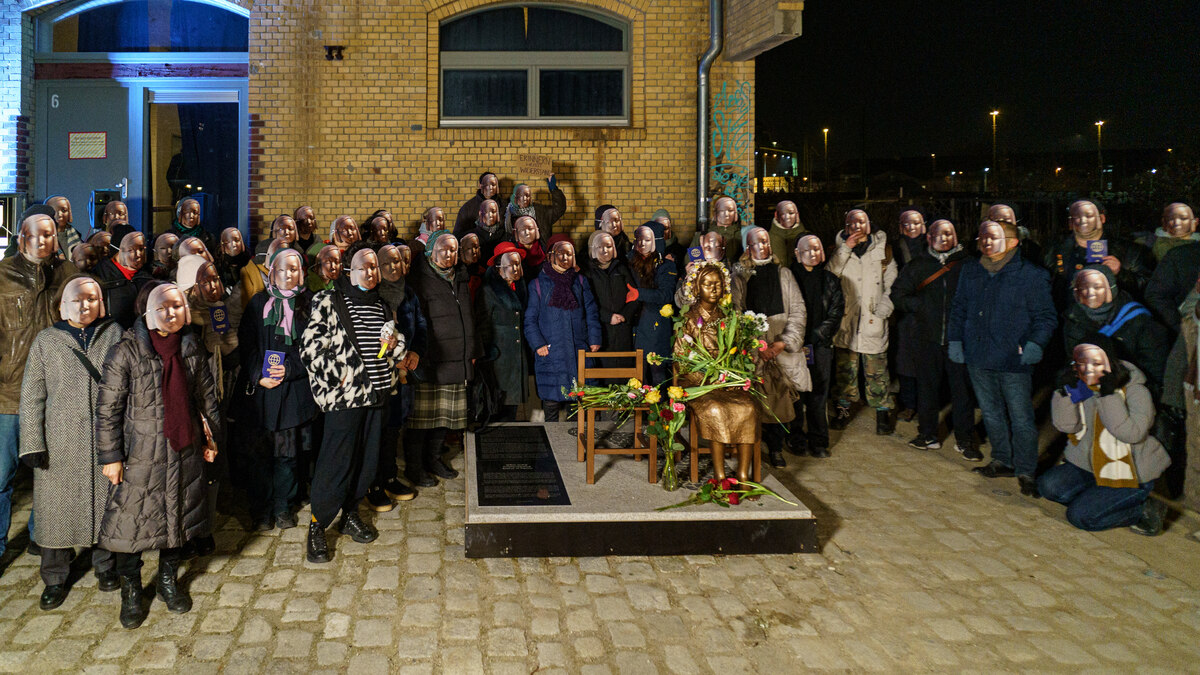
97 days after the Mitte district erected the so-called Peace Statue remove under police protection she has now received asylum in a residence for artists and urban researchers in the immediate vicinity of her old location in Moabit. “We offer 13 studios in our house,” said Philip Horst from the Center for Art and Urban Studies (ZK/U) when the statue was unveiled on Thursday evening. “And now we basically have the 14th studio in front of the house with the statue. And that’s for all of you!”
The statue is now a roommate in a temporary, international microcosm. “The question arises: what is a monument anyway, who is allowed to commemorate when global and local issues meet, who even gets a place to commemorate?,” said Horst in front of the 100 guests. After a drumbeat of Korean women, they celebrated the unveiling of the statue and wore masks with their faces.
The memorial shows a young woman wearing a traditional dress (“Hanbok”) sitting on a chair. The bronze statue symbolizes one of the approximately 200,000 mostly Korean forced prostitutes by the Japanese military during World War II, euphemistically called comfort women. An empty chair next to the woman calls for us to also deal with sexualized war violence in current conflicts.
Japan’s government is putting pressure on it
The statue comes from a South Korean artist couple a thorn in the side of the government in Tokyo. After decades, Japan officially apologized for the sexual enslavement of Asian women during the war. But while many victims found the apology to be half-hearted and the conservative government did not want to be reminded of the past if possible, nationalist Japanese deny the crimes of that time to this day.
Japan’s embassy repeatedly urged the Senate and the Mitte district, which approved the installation of the statue by the German Korea Association in 2020, to remove the monument, which was discredited as “one-sided”, from public spaces.
The government in Tokyo has often had success with such pressure in other countries and cities. Mitte’s mayor Stefanie Remlinger (Greens) was so annoyed by the pressure from the embassy that she declared at a district council meeting in September 2024 that she no longer receives ambassadors.
But she also wanted to get rid of the statue, which was controversial within her party. Remlinger insisted that the original two-year time limit must be adhered to. While this had been handled loosely up until then and an extension of the deadline could not be ruled out, the district subsequently tightened its regulations in the dispute over the statue. The condition for private art to remain in public space for a longer period of time is its prior selection through a public competition.
When the Korea Association rejected Remlinger’s proposal, the Relocate statue to private propertya legal dispute arose. The district won in October 2025 and had the monument dismantled the next day. It had stood for five years on the corner of Emdener Strasse and Birkenstrasse, in the immediate vicinity of the small one Korea Association Comfort Women Museum.
The statue is back on public land
The new location on the ZK/U property, a former train depot at Siemensstrasse 27, is only about 100 meters from the old place. Ironically, the property also belongs to the State of Berlin, but is leased to the ZK/U on a long-term basis.
It would be absurd if the district wanted to subsequently prohibit the urban researchers from setting up this memorial on the land they leased, which would be an excellent way to discuss the culture of remembrance in a plural urban society.
According to Horst, Japan’s embassy has not yet intervened with the ZK/U. Has she perhaps noticed that her interventions are continually bringing publicity and solidarity to the monument from below and the crimes against women it symbolizes?
It is also unclear whether the Senate and district have now noticed that the statue not only stands for distant crimes of the past, but also for the treatment of migrants and their historical and current experiences in Berlin. A theater maker from Iran, who, like the statue, is currently a guest at the ZK/U, referred to the current resistance of women against the mullahs’ regime.
The name Ari of the statue also has an international impact. On the one hand, it stands for the folk song Arirang, South Korea’s unofficial national anthem full of longing and sadness, on the other hand, Ari means “the brave one” in Armenian and commemorates the genocide of the Armenians in 1915.