

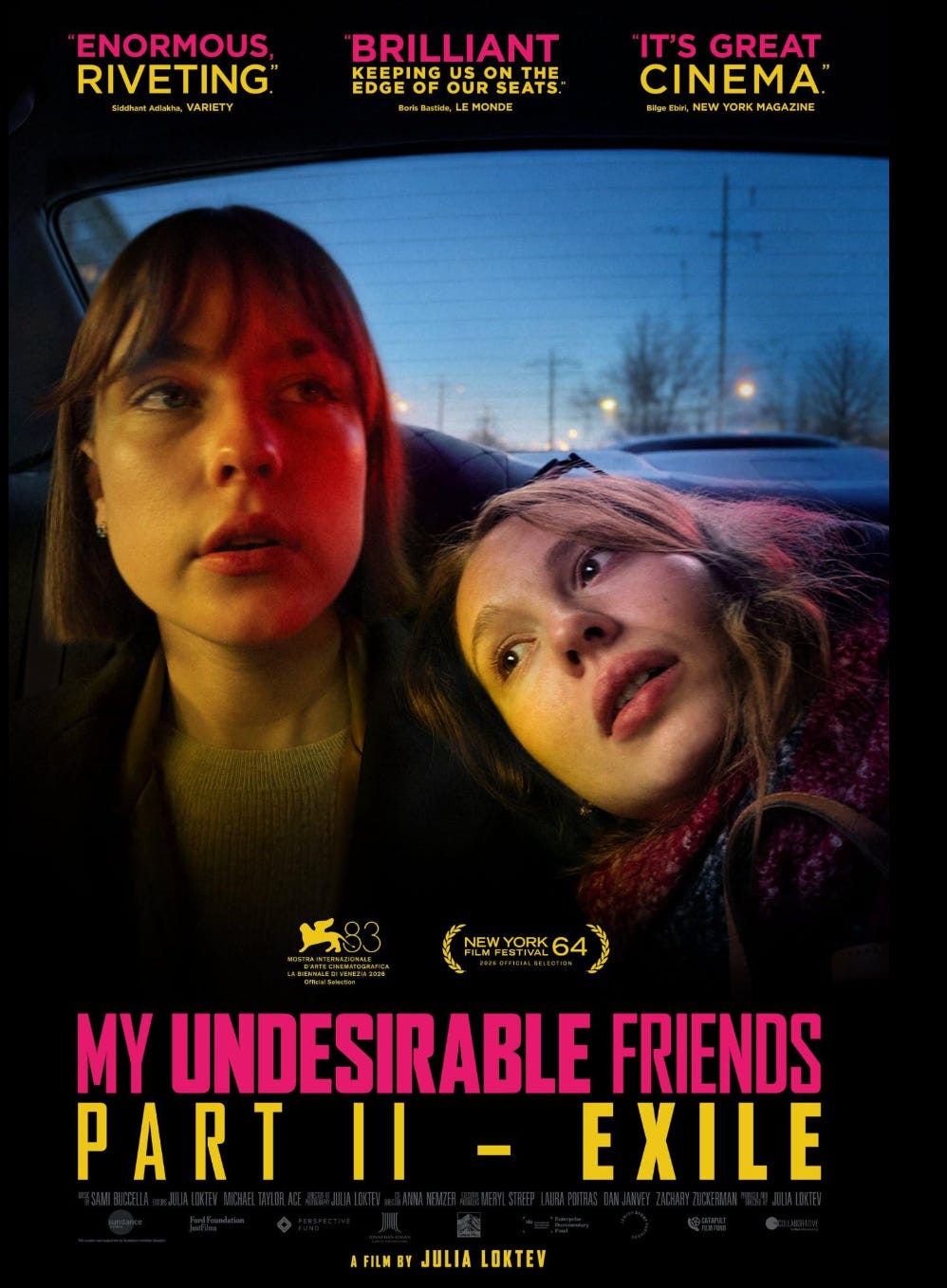
In this vHopeful Conversation, I welcome back award-winning filmmaker Julia Loktev, my first returning guest, to talk about My Undesirable Friends: Part II — Exile. She describes shooting alone on an iPhone while editing Part I with Michael Taylor, and why she treats her subjects like actors giving the performance of their lives. She recalls the hours after February 24, 2022, when the young Russian journalists she was filming caught whatever flights they could to Istanbul and found themselves “thrown to the winds.” She explains how exile suspends time, and why the “after” interests her more than the escape. We talk about the journalists’ awareness of their own privilege next to Ukrainians and political prisoners, the threats they still face abroad, and their constant cat-and-mouse game with censorship as they keep reporting to Russians from outside the country. Julia shares the story of meeting Lera in a $10-a-night Istanbul hostel and the friendships at the heart of the film. She says working without second takes freed her after years of writer’s block. We contrast her subjects’ sense of responsibility with Americans who say “I didn’t vote for that,” and Julia argues against fatigue under authoritarianism: the choir needs preaching, and showing up day after day, without glamorous victories, may be the most inspiring thing of all.
Transcript lightly edited. Podcast available on Apple, Spotify or wherever you listen on this Substack or Ted’s Hope for Film
Vanessa Hope: I am extremely excited to be joined by award-winning filmmaker Julia Loktev, my first returning guest on vHopeful Conversations, because she is so fast and she has made epic, epic documentary films. My Undesirable Friends: Part I — Last Air in Moscow won the Gotham Award and the New York, Los Angeles, and National Society of Film Critics Awards for Best Documentary, and was shortlisted for the Oscar.
Now, remarkably fast, Julia returns with My Undesirable Friends: Part II — Exile, an official selection of the 2026 Venice and New York Film Festivals. Shot entirely by Julia alone on an iPhone across four years and a dozen countries, the film follows the same brave, darkly funny young Russian journalists as they flee Moscow when telling the truth becomes a crime, and they keep reporting from exile. Julia joined me to talk about Part I when it came out, and it’s incredible to have her returning now.
Backstory: Julia was born in St. Petersburg and emigrated from the Soviet Union to the United States at age nine. She has built a body of work across fiction and documentary, I believe edited always with Michael Taylor. We can talk about that. Our friend and yours. And her films include Day Night Day Night, The Loneliest Planet, and Moment of Impact, which won the Sundance Documentary Directing Award. Julia, it’s so great to see you again. Thank you for joining.
Julia Loktev: Thank you, Vanessa. I’m so happy to be your first return guest.
Vanessa: Yes. And there’s something about the women you follow who are journalists, and they’re anchors. I know you are a filmmaker first, you don’t even describe yourself as a journalist, and yet here you are, deeply embedded with all these journalists, in a way doing your own form of journalism.
But maybe you could talk to us about how you were editing one film while shooting the other, and then releasing one while still filming and cutting the next, and what in the world it took to work at that speed, solo, living inside this story every day for five years. Did that change you as a filmmaker? Slash, maybe you really are a journalist?
Julia: I’m always pushing back. The only journalism education, or the only journalism I’ve done, is some music reviews and being on my high school newspaper. I very much don’t come from journalism. My education is in cinema history. It’s in filmmaking, but very much from the point of view of fiction, really not documentary. And I don’t really draw a line between the two. And really, I think that’s part of how I shot this film.
Obviously these are real people whose lives are falling apart, but I think when my camera’s trained on them, it’s like that moment when an actor is giving the most amazing performance of their life, and they’re in the moment and having that emotion, and you’re just so focused in that moment with them, on their face. I shoot in close-ups. I shoot in scenes. It’s very much part of film, rather than information, I guess, for me.
And it’s the same with editing. When Michael Taylor and I started editing, he’s like, “I’m just going to edit them like they’re actresses.” I hope that’s not insulting to them, because we are very aware that this is their real lives, but in terms of that focus on character, emotion, a person living through this, rather than just, “I’m going to give you a bunch of information.” You’ll get that through osmosis.
But yeah, the reason I’m back so soon is all of this was happening simultaneously. I started out filming this film that was not supposed to happen. It was supposed to be what was kind of the first chapter of Last Air in Moscow. I thought I was making a film called The Lives of Foreign Agents, about these journalists that had just been named foreign agents by the Putin regime, which meant they had to put this huge paragraph in front of everything they wrote, plus their Instagram cat pictures, saying, you know, “The following information is created and/or distributed by a source of mass media foreign agents,” in all caps. It’s like Hollywood credits. It was specified it had to be bigger than any other fonts on the page. And I thought that’s what I was making a film about.
And then, what we didn’t know is all of this was leading up to Russia starting this full-scale war in Ukraine that’s now been raging for four and a half years. And that a few months later, every single person I was filming in Russia in Last Air in Moscow would flee their country in a matter of hours, kind of having to face this decision of: Do I go to work right now? Do I go to work tomorrow? No, go to the airport, pack a suitcase, buy the first plane ticket you can buy, and leave. And at the time there were very few planes flying out of Russia. There still are not planes flying to Europe or the US.
And so Exile starts where all of these people have just left their country. They have no idea what the next hour, the next day brings, because they’ve left their country, not to a country they planned to go to, but to the country they could buy a plane ticket to. In many cases Turkey, that’s where we start, but then they keep going.
And, you know, one of the characters says, beautifully, she says, “Yesterday I had a job, I was an anchor at TV Rain, I had a home, a boyfriend, and bank cards that worked.” Because also their bank cards aren’t working. They can’t get money because of sanctions. “And now I’m some loser in Istanbul.” They have no media, and they have a sense that they have to get back up on their feet as soon as possible and start working.
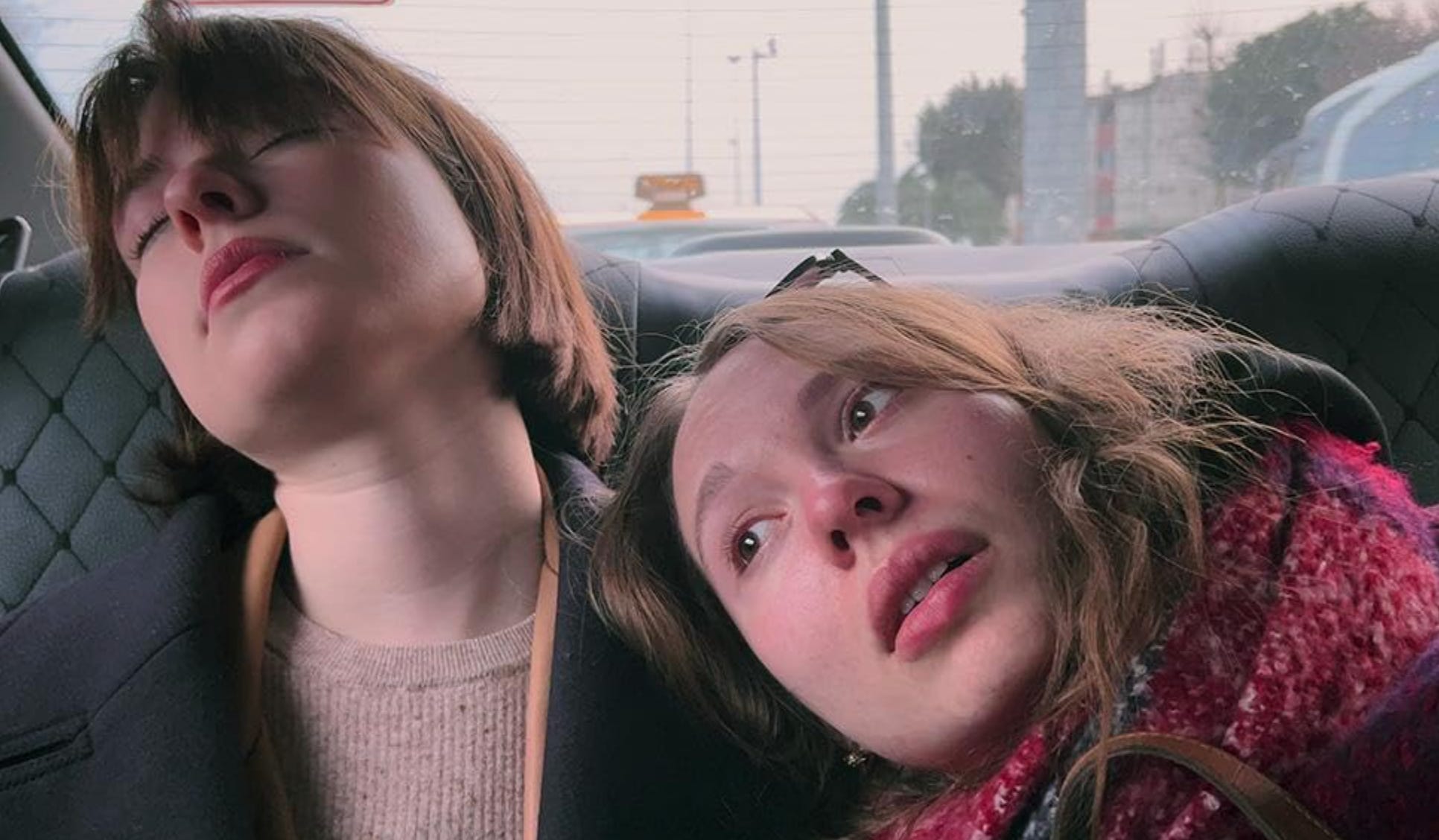
And so I was able to chronicle this through these characters from its very, very, very first days, when they’re just lost. It’s like those cartoons when somebody hits someone with a sack on the head, like a sack of flour, and you see the stars spinning around. That’s what I kept picturing.
And as they get back up on their feet as journalists and try to continue reporting the truth to Russians that they hope to reach in Russia, as an alternative to propaganda, year after year, as they’re threatened, pursued, their media face crises, and they can’t go to the place they’re reporting on. They can’t go, really, in most cases, to Russia or Ukraine, for most of them. And they keep talking about Russia’s war crimes. The reason they can’t go back home is because they speak out about Russia’s war crimes.
And so all of this wasn’t supposed to happen. That was not part of the plan. And so I was just filming and filming. And then I was editing Part I, Last Air in Moscow. Which, I should really say, I feel like we always try to say this: If you haven’t seen Last Air in Moscow, you can watch Exile without seeing it. You’re just going to come in.
Vanessa: You give a recap. You give a bit of a recap at the beginning.
Julia: Yes. I mean, how many times have you started watching a series with the second season? We all have. And you kind of get the idea, and you can meet these people and have the full experience. And then if you want to, you can go back and see Last Air in Moscow.
But it takes place across a dozen countries. So I was editing Last Air in Moscow, continuing to shoot Exile. It all is this kind of giant mush. Last year, as I was talking to you, I was probably flying off to shoot something a week later. It really was this five-year blur, because I feel like I had this incredibly unique opportunity as a filmmaker to capture history as it’s lived by these very lovable, funny people. You don’t get to do that. It just happened.
Vanessa: And you can’t say this about yourself, maybe, but you are an incredible filmmaker, and what you achieve is something close to novelistic, and you embed all kinds of film genres within your storytelling. You’ve got the horror of the war in Ukraine. You’ve got love stories. You’ve got friendship stories. You’ve got community and connection. There are so many levels and layers to the storytelling, and ten characters you are juggling. Some overlap from Part I to Part II, some new ones are introduced in Part II.
On that moment of exile, I was surprised, but it makes sense, to be reminded that when all of your journalists first flee, they think the war is only going to last a couple of months. They have no idea. I mean, no one could have predicted it would last almost five years, four and a half years. But what happens to your sense of time when you’re in the thick of it like that?
Julia: I love this question, because, as a filmmaker, time is very important, but also in the condition of exile. I’ve talked about this a lot with a lot of the characters, their sense of time. Because Exile isn’t an easy plot. It’s not like a single plot. Someone compared it to The Odyssey, among many, many, many weird comparisons. They can’t go home. They’re going from place to place to place. One thing happens, then another challenge, then this other plot. It’s a collection of plots and challenges. But otherwise, it’s a kind of condition.
And that condition is almost very fast and suspended in time. People talk about this a lot, that something feels like, “Oh my God, that was yesterday,” but then it feels like it was so long ago at the same time. It is this very odd suspended state of time. I kind of describe it like mashed potatoes, you know?
Vanessa: Yeah. You’ve also talked about the before and the after. It’s like February 24th, 2022. That’s it. That’s the break. The start of the war.
Julia: Yeah. It’s the moment everyone’s lives collapsed. And I know that’s a strange thing to say, because they’re not Ukrainian, and they’re very aware. They will be the first people to tell you that people in Ukraine are suffering much more. “Our country is bombing people in Ukraine.” They keep saying this: “My problems don’t matter. My country is bombing Ukraine.” But for all of these people, on February 24th, their life completely collapsed.
Up until February 24th, it was really possible, not very pleasant, but possible, to work out in the open as a journalist or as a civil society leader in Russia. There was still a space where you could have a TV station like TV Rain that looked like MTV, that had punk rock bands saying, “I’m the fifth column, my Russia exists autonomously from you,” and saying all these anti-Putin things and criticizing his actions and his government, and not get arrested. I mean, you were always afraid you might get arrested, but you weren’t getting arrested yet, and you could still work.
Whereas when Russia started the war, they passed a number of laws: the fake news law, the discreditation of the army law. It became illegal to call the war a war. It basically became absolutely impossible to be a journalist working not anonymously in Russia, under your own name, and talking about the war which Russia is waging in Ukraine, and certainly talking about war crimes. You could not be in Russia and talk about those things and not go to jail.
So for all of these people, everything collapsed. Their idea of their country collapsed. They couldn’t imagine Russia invading Ukraine. And suddenly they went from having a home to being just thrown to the winds, having no idea, going country to country. Their lives are made of visas and hostel rooms and trying to figure out where you can go next. And then they pick up the pieces of those lives and try to keep working, but in this state of ongoing war. So there really is this before and the after.
And it’s a strange thing to say, but I’m always interested in the after. Because Last Air in Moscow was really a plot. They’re fighting, they’re fighting Putin, they’re reporting the news, they have to flee. And it’s a clear plot. But I think it’s a much more interesting story to me: And then what? And then how do you get up the next morning? And how do you keep going? And how do you keep telling the truth? How do you report the news? What are the different challenges? The after is actually more interesting to me. It’s a richer story for me.
Vanessa: Yeah. And it is moving how much your characters all have that sense of, even in these most dire and uncomfortable circumstances, their own privilege. That they’re still reporting on what’s happening in Ukraine, and their homes are not being bombed. They’re not fleeing war. They’re fleeing a government they object to for starting a war. They are not in the same situation as the Ukrainians.
And then you also have this new couple you introduce, with a woman named Natalka, who is a Ukrainian journalist. But it was really impressive that they had this sense of: It’s hard for us, but it’s not the same as if we were Ukrainian in Ukraine.
Julia: Yeah, absolutely. I mean, they all are just… I don’t know how else to say it. They’re just pretty decent people, and they try to be decent people. So they have an awareness, of course, and they have a tremendous sense of shame about the war their country is waging. And then they think, “Well, what can we do? We can keep trying to bring this information to Russians. That’s what we can do today. We can talk about war crimes Russia is committing.” They interview soldiers to get testimony from soldiers.
I mean, it’s a strange thing that I kind of find as a parallel now, because of course I think one of the most tremendous films now is Naza. And I think about this… aside from what’s inside the film, there’s this kind of meta quality to it for me, because Yuval and Rachel are now facing the possibility of not being able to go home because of interviewing Israeli soldiers and speaking out about Israeli war crimes and the genocide.
And very much like, especially, some of the characters in my film, like Lena. She’s like, “I’m going home. I’m going home. I’m going home. I don’t care. I will go to jail. I’m ready to go to jail.” And the only reason she doesn’t end up going to Russia and going to jail is she’s tipped off that there’s actually been an order to kill her, which is fairly easy to make look like a hate crime, because she’s an out lesbian in a country that has declared the international LGBT movement to be an extremist terrorist organization.
And she’d worked for a newspaper where, while she was working there, four of the journalists were killed, and others had been killed also. But that was just in the time that she was working there alone. And the famous Anna Politkovskaya, and it was just the 20th anniversary of her murder in Russia, was a journalist at her newspaper. So for her, that was always a possibility, that she might get killed.
And then she says, “Well, I’m not going to do that, because then I can’t write if I’m dead.” She’s like, “I don’t want to lie around. If I go to prison, I can write a book. If I lie around in a dank grave, that’s the end of everything. I can’t report.” So she doesn’t go back.
And the pain that they carry for speaking out and not being able to go back to Russia… A lot of them have been labeled extremists and terrorists in Russia. They have prison sentences of seven, eight, nine, ten years waiting for them, which sounds kind of like, okay, not too scary if you’re not in Russia. And they keep telling themselves, “It’s not too bad. I’m not in Russia.” Because, again, in addition to comparing themselves constantly to Ukrainians being bombed, they’re also very aware that there are political prisoners serving time in Russia, including Ksusha’s fiancé, Ivan Safronov, who is now serving 22 years for so-called treason as a journalist. So they’re always aware that they’re privileged, even compared to people who are in jail in Russia.
But if you have a criminal case against you and you’ve been convicted, that means you can’t go to half the world. Places you don’t really think of: India will extradite you, Vietnam. All these places that your parents could get a visa to, because it’s hard for them to get a visa, including places that they lived before as exiles, like Turkey or Georgia. If you have a conviction in Russia, you probably should not go there, because you may end up like those political prisoners.
Vanessa: Wow. Yeah. It’s so, so extreme. And it feels like the solidarity between your characters is so important, sometimes when they get the opportunity to flee together and share a hostel room together, sometimes just through the internet or the work they do… Or maybe you were also a glue in helping to build this community. I liked learning that you have a group called Desirable Friends, that you’re all connected, and that that is maybe one of the strongest counterforces to authoritarianism.
Julia: Yeah. I don’t think I was the glue. I think they have so much glue between all of them. And we don’t even see some of it. For example, you mentioned Petya and Natalka, this Ukrainian and Russian couple. Petya and Anya, another character, are actually good friends, but we never see them together in the film. All of these people are separated by really one degree of separation. So they’re all part of a community. And I just kind of inserted myself into this glue and got glued and stickied with them.
And I’ve been doing these Q&As with Lera, and it’s been lovely how she talked about it, because she’s a new character in Exile. And there’s a great story of how we have a meet-cute. We really have a meet-cute, as a filmmaker and a protagonist. Because I’d seen her as an anchor on TV Rain. She was the youngest anchor. She was 22, like this baby, hosting the show.
And we even saw her in the first week of the full war, where she’s arguing with this Putinist who keeps saying it’s all lies… this Putinist pundit. That’s a hard thing to say. It’s like a tongue twister. She keeps talking about Russia bombing cities in Ukraine, and he’s like, “It’s lies, it’s lies, lies. We should take you off the air for spreading lies.” And then he calls her “young lady,” and she’s like, “My name is Valeria.”
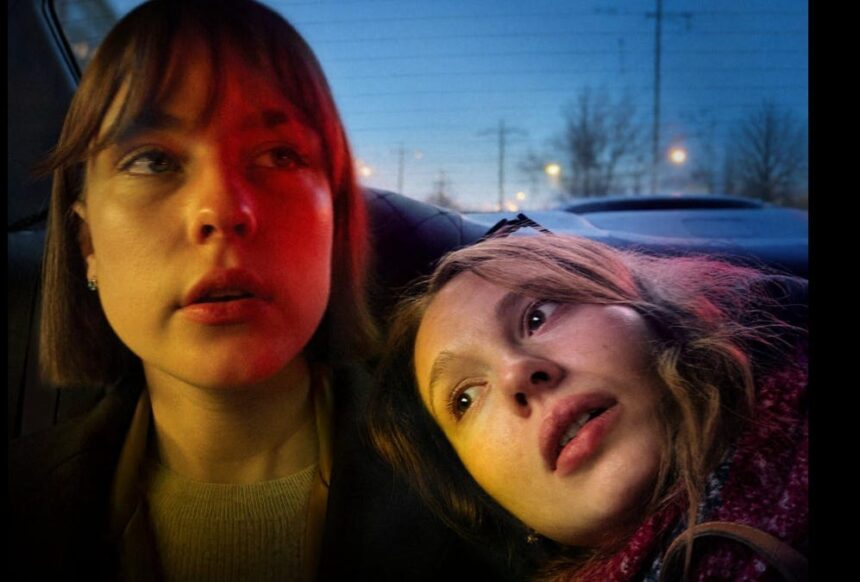
And so we’d seen her, but I’d never filmed her, because she wasn’t a foreign agent yet. She was just this very energetic anchor. So I wasn’t filming her in Russia. And then, by chance, she happened to be sharing this hostel room, this $10-a-night hostel room in Istanbul, with Ksusha, who was a protagonist in Last Air in Moscow. And I walked into this room, and it was really the first time I met Lera, and I started filming her because she was so, so filmable.
I mean, she has this incredible face. I think the LA Times just described her as looking like a silent movie star. She’s just incredibly expressive. And I had no idea who she was, because she looks so different without makeup. I didn’t even know she was a Rain anchor. I just knew I could not stop filming her. And it’s this incredibly emotional scene that opens up the film, really. It’s the first real scene in the movie. But that was the first time we met.
And the way that she describes it, she’s just like, “I felt you were a friend when I met you.” She said, “It was comforting to have you around. It was nice. I was lonely. I was scared. You were here. You were with a camera. You were accompanying us.” And so she talks about how the friends aspect of My Undesirable Friends is so important. And in our case, it happened instantly. There was this connection. And then she becomes really one of the main protagonists.
Vanessa: Yeah. And you are another lifeline. I mean, they’re getting the stories out against all odds, and you’re also giving them comfort. I love that. Can you talk about how they do keep on keeping on with their journalism when they know everything is slowly getting… That’s like another cartoon image. Everything is crumbling in front of them as they try to take their next step and get the story out. Censorship, lockdown, whether it’s YouTube, the VPNs, Telegram, mobile internet. How the cat-and-mouse game with Putin controlling the media keeps on going, but they keep on keeping on.
Julia: It’s crazy. Obviously, when they left Russia, all their websites were shut down. Their media were outlawed in Russia. They were all banned as undesirable organizations. That means that giving them an interview is a crime. Working for them is a crime. Reposting their stories is a crime. That is a challenge for reporting.
So they have to anonymize their guests. They often have people give testimony and they’ll have a voice reading it, or they will disguise the voices. But they also still manage to do video reports, and they find all these workarounds so that the person is not directly giving the information to Rain. So they have to find intermediaries. That’s just in terms of reporting.
And there’s a scene in the film, for example, where Sonya is filming one of… Actually, I think he was the first person to be charged with discreditation of the army in Russia. He was this very pious, religious Muslim man who saw a Z sticker on a car. It’s like the Nazi symbol of Russia, the Z. And apparently he just suggested, “Well, someone should tear that off.” And his daughter went and tore off this Z sticker from the car, and he ended up with a discreditation of the army case against him.
And the way that Sonya has to film him is she has to work with an anonymous camera person. She can’t see what he’s filming. She’s instructing him over the phone. She’s like, “Just describe to me what you’re shooting.” She’s not going to get the footage till after the fact. It keeps breaking up. But then, it looks like she manages to actually do this hour-long video report, all with anonymous camera people. Some of them are wedding videographers they hire, because they can’t reveal who’s shooting it. They have to have all these intermediaries, and that’s largely how they work. They produce stories that look like they’re shot there, but they have to go through tremendous, tremendous hoops to do it.
And then, on the side of bringing the news to Russians, it’s a constant cat-and-mouse game. YouTube is still not fully shut down in Russia, but Russia has slowed it down. There are VPNs, and then Russia will threaten the VPNs. And the different media develop apps, and then Russia finds ways of shutting those down. It’s constant. There are certain means of communication, for example, like WhatsApp video calls or Telegram video calls or FaceTime, that are no longer working in Russia as video calls. So it’s not just shutting that down; that also makes communicating with your family quite difficult. It’s a constant game.
And Lera the other day was saying, “If you are Russian-language media abroad now, an opposition media, you have to have, in addition to journalists, this IT team that is constantly figuring out workarounds.” Because the Russian government puts up a block, and then you’re going around it, and they put up another block, and you’re going around it. And it’s this constant game.
Plus, from the Russian side, they’re getting these technical attacks, and so you have to find a way to protect your content and protect your servers. It’s crazy. And on top of that, they get other kinds of attacks. TV Rain had these journalists come in pretending to be opposition journalists doing a story, and it ended up being this propaganda film on the main Russian propaganda channel about how these Western journalists are living the life in the West and selling out to the West.
And then they face threats that are much more serious, physical threats from the secret services. They’ve been poisoned, followed. They all thought that it would be kind of okay and they were safe when they were leaving Russia. And then it’s not all it’s cracked up to be, being abroad. It’s not as safe as they thought.
Vanessa: No. And now you have me worried about you. I wasn’t thinking beyond, you know, you’re a solo camera, you’re doing everything yourself, you’re having to upload your footage and make sure it’s downloaded by Michael in New York. Were you also under similar levels of pressure or threat, or fearing for your life, or fearing for being shut down? And then, because you’ve worked in fiction and in documentary now, how did this process maybe change your thinking about your filmmaking?
Julia: Well, I was afraid when I was shooting Last Air in Moscow. I was afraid every day I was in Moscow. But the place I was most afraid was when I went to work with them, the place they show up to work every single day. So I was like, “Shut up. Don’t worry about yourself. They come here to work. They’ve been bugged, threatened, and they’re still coming here to work. So just do your job.”
But then abroad, I guess I try not to think about it. There’s this funny logic that everyone goes through. I think every single person in the film at some point said to me, “Well, I’m not important enough to be poisoned. They have so many other people to poison before they get to me.” Of course it doesn’t work that way, but everyone is always telling themselves that there’s such a long list. And so I think that there is such a long list, including all the characters in the film, before anyone should take any interest in me. So…
Vanessa: And you enjoy this form of working up close, and just with an iPhone.
Julia: I loved it. And this goes to your question of how it changed my filmmaking. I’m going to be honest and say, between The Loneliest Planet and this, I struggled with writer’s block. I think I struggled with meaning. I couldn’t figure out what was meaningful to make for a long time. And then I wrote this script that I think is really meaningful, that I hope one day I’ll make, but that fell apart during COVID.
But a lot of what I struggled with is that in fiction there’s so much organization, and you convince yourself of all these things that you think are necessary to make a film. And suddenly I was put in this situation where it was me and these incredible, super filmable characters that were funny and witty and smart, and very dramatic things were happening to them. And I just had to kind of point the camera and try to frame the shot and get the sound, and follow it almost like a dance with my camera.
And it was incredibly liberating, because there’s no second take. There is no second take. This moment is happening once. You’re there, and you can mess up filming it, or you can capture it and get the emotion of it. And I realized that’s what matters: Am I able, through the camera, to convey the feelings of what’s happening, the experience of what’s happening, the life of what’s happening, the texture of it?
Vanessa: Right. So we have yet to see, and we will all be fortunate to see, how you bring that experience into the next fiction film you make. And again, I think you’ve mentioned, if everyone is allowed back into Russia at some point, Putin dies, circumstances change, there’s a potential Part III. This is a potential trilogy, and you just keep evolving. It’s very exciting.
Another aspect that I was really struck by: Yes, they’re all good people, as you’ve said. Yes, they’re all journalists. However, they could also all change their minds, or give up, or do what a lot of Americans do, which is say about our government when it commits war crimes, “Oh, I didn’t vote for that. Oh, I’m not of that party. Oh, no, that’s happening over there. It has nothing to do with me. Nobody knows what they’re talking about.” Or whatever it is that distances us from taking responsibility.
It feels like the opposite of what your characters are doing on a regular basis, which is thinking deeply, taking serious responsibility for every single thing their government does and puts out, and wanting to counter that with the truth, and wanting to speak up and stand up for what’s right. Where do you think that comes from? Or what can we learn from that here in this country? Because it really struck me.
Julia: It struck me as well, exactly. I don’t know where it comes from. I have a hard time with these kinds of “it’s the Russian soul” explanations. But it is so remarkably different, I think, from what I’m used to hearing people say. I think all of the characters in the film were absolutely mortified when Russia invaded Ukraine. But they felt that it was somehow a failure on their part, that they had not done enough, that there were not enough of them. Because all of them were opposing Putin’s regime and trying to bring the news to Russians before, and obviously were against the invasion of Crimea when it happened in 2014. I mean, some of them were 15 or 14 when that happened, so they were kids, but they still were against it. They weren’t working as professional journalists then.
But it’s really remarkable to me the extent to which nobody says, “Well, I’m going to wash my hands of this,” or “This has nothing to do with me.” There’s the sense of accountability, and the sense that you have to act and you have to do what you can, whether it’s bringing the stories of Ukrainians or bringing the stories of Russia’s war crimes.
Or, one of the things they talk about a lot, which sometimes they get in trouble for, is how Russian soldiers are mistreated on the front. Because they think, what is going to convince a Russian who is thinking of going into the army to not go into the army? Maybe he’s not going to be terribly sympathetic to the suffering of Ukrainians, but if you say, “You’re not going to have food, you’re not going to have equipment, and they’re going to throw you into a meat grinder,” maybe that causes one more guy to not go into the army. So they really see it as the work they have to do now.
Vanessa: And being in this country with Trump again, it is unfortunate, the increasing similarity between him and his policies and Putin. What can Americans learn from watching this movie? It’s deeply inspiring, their commitment and their speaking truth to power and standing up.
Julia: That’s a great question. I mean, I’m not one for lessons, but I can tell you what I’ve learned from it. I hope the film isn’t didactic in that way.
Vanessa: It’s not remotely didactic.
Julia: But I think it’s incredibly inspiring to be with all of these characters. Among the many things it’s been described as, it’s been described as a hangout film. So it’s very inspiring to hang out with these characters, because they just keep working.
I think one of the things we’re facing now is fatigue. People say that they feel like they’re tired of talking about press freedoms and authoritarianism. And that’s a natural human response, because that’s exactly how it works: you do get tired. You want to watch something nice. You want to watch something about something else.
I don’t know why. I think we’re looking for some kind of distraction now. For example, I’m fascinated by the fact that we have a huge number of films right now about sociopaths and kind of nasty characters. I don’t know what that says about our psyche and distraction, you know? But you want to look away. It’s a very natural reaction to look away. It’s the same way that the war’s been going on four and a half years, and it’s actually getting worse, not better. And it’s hard to pay attention, because you’re like, another 12 people bombed here, another 12 here, and you go numb. And it’s the same with authoritarianism. I think that you get tired. You get worn down.
And I think that’s something I learned from all of them: not to give up. I know that sounds corny and cheesy, but literally, don’t stop paying attention, and get up and do what you can the next day, even when you’re not accomplishing your desired results. They haven’t overthrown Putin. They haven’t ended the war. Some of them question, why on earth are we doing this? But all of them find purpose.
For example, I was talking to a funder, and they said, “Well, how are you going to convince people and reach across the aisle, so it’s not just preaching to the choir?” And I was like, the choir needs preaching. There is tremendous value, actually, I think, in inspiring people to keep going and to do whatever small thing they can.
And for all of these media, they may not be winning over the majority of Russians. But for those Russians in Russia who oppose the war, who think it’s wrong, and who cannot speak to their neighbors about it, who probably can’t speak to their friends… You can’t watch TV Rain on the subway in Russia. It’s a really bad idea to open that up in your app. You’re going to get arrested. You can’t talk to your friends. If your kid goes to school and says, “I like peace, war is bad,” you might lose your parental rights. It’s that kind of situation. You can’t speak to people.
So to be able to go home and log into Rain and, as Sonya says in the film, to see nice people somewhere, and they’re describing the truth, and they’re describing reality, and you feel like you’re not crazy and you’re not alone. And that’s what’s so important: community, and not losing attention when we’re not winning. It’s day after day after day, and that’s not a glamorous thing. There’s no glamorous victory in it. But actually, I think it’s the most inspiring thing of all.
Vanessa: Yeah. Keep on keeping on.
Julia: Keep on keeping on. Exactly.
Vanessa: Do not give up. Thank you so much, Julia. I absolutely love your films. Your twelve hours. It’s two films, could become three. It’s many films within each film, and it’s just remarkable. Epic, epic, what you’ve given us. So thank you.
Julia: Thank you so much. Such a pleasure to talk to you, Vanessa.
Vanessa: You too.
Julia Loktev (director, producer, cinematographer, editor)
Born in St. Petersburg, Julia Loktev emigrated from the Soviet Union to the U.S. at age nine. She has made both fiction and documentary features. Prior to the award-winning MY UNDESIRABLE FRIENDS: PART I — LAST AIR IN MOSCOW, which premiered at the New York Film Festival, followed by Berlinale and won numerous awards, she made THE LONELIEST PLANET starring Gael Garcia Bernal, which premiered at Locarno, screened at the New York Film Festival, received the Grand Jury Prize at the AFI Film Festival and nominations for Best Director at Independent Spirit Awards, and Best Feature at Gotham Awards, and was chosen by Indiewire as one of the “100 Best Films of Last Decade.” Her fiction debut DAY NIGHT DAY NIGHT premiered at Cannes in Directors’ Fortnight, received two Gotham Awards nominations, and earned the Someone to Watch Award at Independent Spirit Awards. MOMENT OF IMPACT, her only documentary prior to MY UNDESIRABLE FRIENDS, won the Sundance Film Festival Documentary Directing Award and the Grand Prize at Cinéma du Reél, screened in New Directors/New Films at MoMA, and was an Independent Spirit Awards Truer Than Fiction nominee. Julia is a recipient of a Guggenheim Fellowship and an Emerging Icons Award from the George Eastman Museum.
My Undesirable Friends: Part I —Last Air in Moscow,
is streaming now on MUBI as will Part II in the future.
Upcoming screenings of
My Undesirable Friends: Part II — Exile
-
New York, Film Forum: Now playing through Thursday, November 5. Chapters 1–3 and Chapters 4–5 are separate tickets.
-
Sunday, November 1: Chapters 1–3 at 12:30, introduced by executive producer Meryl Streep. Then Chapters 4–5 at 4:20, with a Q&A with Julia, Ksenia Mironova, and Elena Kostyuchenko.
-
-
San Francisco, New People Cinema, Japantown: Chapters 1–3 on Friday, October 30 at 6:15 p.m.. Chapters 4–5 on Saturday, November 7 at 2:30 p.m., with a Q&A with Ksenia Mironova.
-
Cambridge, MA, Brattle Theatre: Chapters 1–3 on Wednesday, November 11, and Chapters 4–6 on Thursday, November 12, both days at 4:00 and 7:30 p.m..
-
London, Bertha DocHouse at Curzon Bloomsbury: Saturday, November 14 at 12:00.
-
Amsterdam, IDFA: Sunday, November 15, 15:00–22:14 at The Pulse 2, with a talk after the film. Monday, November 16, 12:00–18:36 at Tuschinski 3, with a Q&A.
-
Pittsburgh, Harris Theater: Chapters 1–3 on November 16, Chapters 4–5 on November 17, and the full film on November 18.
-
Austin, AFS Cinema: Sunday, November 29 at 2:00 p.m. The listing runs 5 hours 55 minutes, so it’s the full film.
-
Chicago, Siskel Film Center: An exclusive screening on Saturday, December 5 at 11:00 a.m. Tickets go on sale the week of the screening.