

Ted’s note: The last time we featured Chris’ book I told you how much I had needed it when I first got hired in the film biz. I knew absolutely nothing about what it meant to be on set, let alone what it meant to do my job. Of course things were very different then, but it many ways they remain the same. You have to hustle to get work. I used to spend two days each week sleuthing for new gigs and sharing the news with those that had helped me along the way. It wasn’t very efficient, but eventually I was working all the time. I am always excited to get to work, and still often the most excited.
The film production industry isn’t formally organized like the corporate world. There aren’t job fairs or open hiring periods like other industries have. It’s very word of mouth, very person to person, and very unofficial. Because the shoots are only a few months long, you’ll be looking for work often. It’s rare that you find an on-set production job that lasts longer than a year, so if you want a consistent career, it’s important to develop the skills off the set to find work for yourself. There are LOTS of websites, Facebook groups, and publications where production jobs are posted, and when you’re starting out, that’s where you’ll be looking. But I’ve found that most of the time, the job offer will come from someone you know and worked with before. It’s a very informal network of recommendations. That’s not likely to change soon, so keep that in mind while you’re working. Your next job is probably going to come from someone you’re already working with.
Normally, Set PAs are hired by the ADs on a show. They often know PAs they like working with and will put a staff together out of their networks. They look for competence and skill but also attitude and demeanor. The ADs will do interviews with potential PAs and then discuss how the group dynamic might work out and take other things like demographic balance into consideration too. The important thing for you to know is that the biggest deciding factor is if the ADs have worked with that specific PA before, or if they are recommended by someone the ADs trust. So, if you like the ADs you’re working with, and you want to work with them again, it’s going to be up to you to keep in touch with them. Most of the jobs you get will come from that personal network and building and maintaining that network takes intention. But it doesn’t have to be a chore. Think of it like making new friends. If you consider the people you like to work with as friends, and look to each other for mutual support, your professional network will become your community.
Building a network
You’re going to meet a lot of people on set! I mean, more than the average person meets at a job, especially if you’re working in a big market, like LA, NY, or ATL. It’s important to get to know the people you’re working with, since you’ll be working with them again in the future if you’re lucky. This is especially true of the PAs and ADs you’re working with. Learn what they like, their personalities, and let them get to know you too. Keep up with them after the job is over as well. The closer you’re in contact with them, the better the chance that when they hear of a job you might be right for, they’ll think of you. You’ll also gravitate to ADs and PAs that you enjoy working with, and over time you’ll become friends.
Another important reason to get to know the people you’re working with is to know who you don’t want to work with. It’s tough when you’re starting out, because your network is small, but as it grows you can be more selective about who is in it. You’ll find people on set who you don’t get along with as well, people who don’t see things the same way you do or just rub you the wrong way. It’s ok to not try and work with them again. This work is hard and working with people you don’t like only makes it harder.
It’s hard to be selective at first. When you’re starting out, you’ll have to take the jobs you get, and that will mean working with people you may not get along with all the time. But always be looking for people you connect with, because those are the people who you’re going to spend your career with. You’ll all learn together, struggle together, and move up the ladder together. They’ll become part of your life, and you’ll become part of theirs. The set is an environment that emphasizes interdependence, and that’s a practice you can bring into those same relationships away from set too.
Set Story
When you’re starting out as a PA, attitude is huge. Showing up early, being excited to be there, enjoying the day, those things matter. I hear people complain about being assigned as an additional PA, like it’s beneath them, and I just don’t get that. I would give anything to be on a deep road lockup, sitting on a condor tire, watching the electricians work. That’s the best place to learn. Talk to the electrician running the light. Make a friend. You’re going to see them again. You might never work with that same producer or AD again—but you will work with that electrician again. And when you do, those relationships matter. People remember how you treated them. That’s how you build trust across departments. More broadly, this is a lifestyle choice. We’re not forced to be here. We choose this job. We choose these hours. If someone wants a strict 9-to-5, that’s fine, but this isn’t that.
– Lance Anger
Going where the work is
If you live in a rural part of the world, then you’ll likely have to go where the opportunities to get into the film industry are. But it doesn’t have to be Los Angeles or New York. Over the last ten years the business has grown in many new places all around the U.S. and around the world. Cities like Atlanta, Albuquerque, Vancouver, London, Dublin, Mumbai, and Abuja all have their own film production industries. If you’re serious about making film production your career, then you’ll need to be where it’s happening. While you’re starting out, it’s a good idea to stay flexible and open to traveling for work if you’re able to. Just like you won’t always know where your next job will come from, you also won’t know where it will be. Don’t be afraid to go to a production city for a few weeks to see how you like it and meet with some film makers there. But try not to stay on the fence too long. The film industry values commitment, so having made the commitment of moving to a new place will demonstrate your commitment to the people you’re hoping to work with.
Set Story
I’ve often talked to PAs, who have graduated film school, but they’re still living somewhere where there isn’t much of a film industry, and they’re like, “Well, once I get a job in a bigger market, maybe I’ll move.” But for me, at the start of my career, all I had going for me was being in Los Angeles and being available. And a lot of my early work was because they needed someone to come in that day, or I’d get a call like, “Hey, we had a PA, drop out. Can you be in Simi Valley at 5 AM tomorrow?” The film industry is so fast paced, and if you’re not already where the job is, you’re not going to get hired. So, if you want to get hired, you just have to be where the work is. I feel like when you’re starting out it’s just about showing up, and you just keep showing up and keep putting yourself out there. Eventually, people keep calling you because you keep showing up.
– Heather Wagner
Chasing a Job
Sometimes you’ll hear about a job, and you’ll know it’s what you want to do. Maybe it’s a show that you’re already a fan of, or a movie by your favorite director. If you want to do it, you should go after it! Here are some techniques that can help you along the way.
Use Your Network
Do you know anyone who’s already working on this project? If so, call them up and tell them how much you really want to work on it. Ask if they’ll recommend you to the ADs. Most of the time, people will help you out if you have a good relationship with them. There was a show I really wanted to do early on, and I bugged EVERYONE I knew who worked on it to recommend me for it. I eventually got the job, and it made a big difference in my career. So don’t be afraid to ask for those recommendations.
The Internet
Everyone is findable online these days. Don’t be afraid to cold email someone and tell them how much you want to work with them. When writing this kind of email, remember to keep it brief and focused on why you want to work on this project. No need to tell your whole life story or be overly flattering. Just be sincere, polite, and professional. It’s also important to be sure you’re emailing the right person. If you email the director, they’ll likely ignore it. They’re focused on a million things and hiring PAs isn’t one of them. You’re better off emailing one of the ADs, or a production supervisor or coordinator. If you aren’t sure if you are emailing the right person, it’s ok to ask.
Film Commissions and Production Listings
If you’re outside of LA or New York, you may want to check with your local film commission. They are an organization that helps facilitate the needs of productions shooting in your area. The more you get to know the folks working at the film commission, the more likely they are to connect you with the production. They will also have the inside track on what productions may be coming to town in the near future.
Networking
Film people love to network, that is, get together in groups and talk about their projects and other people’s projects. In most cities that have some production, there will be networking groups and meetups for aspiring filmmakers. You never know who you’ll meet at something like that, so it can prove to be a valuable experience when you’re starting out.
Get on set
Sometimes you can get on set another way. Maybe as a Background actor, in the locations department, or in the production office. Once there, let the PAs or 2nd Second know you’re interested in set PA work. Sometimes this works, sometimes it doesn’t, but you’ll know you gave it your best shot.
Be Persistent
If you’ve sent your resume in, follow up. Keep following up until you get a definitive answer one way or the other. It reminds the people you’re applying to that you exist, and it shows them the job is important to you. You may hear a little voice in your head telling you that you’re annoying or look too hungry. I promise you, you are way more sensitive to that than the people you’re trying to get the job from. Those people are busy, like really busy! When I’ve been in that position, I’ve been grateful for PAs who emailed me multiple times. I needed the reminder and usually ended up hiring them. Of course, there’s a line. You don’t want to follow up five times a day, or show up at their house or anything, but be consistent. Being consistent and reliable is key.
Set Story
When I started working as a PA I tried to meet everybody I could, got names, got numbers back in those days, and wrote them down in my little note pad. And then I would transfer those names and numbers when I get home to a yellow legal pad, and I would call people. If I didn’t have a job, I’d call people on Monday. I’d say hey, this is Sebastian, calling to say hello and I’m available if you have anything. I would just go down the list. Eventually, this list got like crazy long, and I would do half on a Monday, and once I had had enough rejection, I would do the rest on Wednesday. That’s how I really started the ball rolling in production. I had to be annoying to get the work. It took a long time, but it wouldn’t have happened without effort.
– Sebastian Mazola
What to ask BEFORE you take the job
So, you’ve gotten to the interview with the ADs, or someone has called to see if you’re available for a job. Here’s a few things you’ll want to ask about before you say yes to the job.
What’s the rate?
It’s important to know what you’re going to make. It’s your money, so be sure to ask about it. If you’re working as a PA, it will likely be minimum wage or maybe a little more. Don’t try to negotiate. That’s not likely to make any difference.
Where is the shoot?
It’s important to not assume where the shoot will be happening. Sometimes it might be a long commute and it’s not worth it for you. If it’s a REALLY long way, you might want to ask if there’s housing or gas reimbursement available. The first big movie I worked on was a two-hour commute from my house to set. That turned my twelve hours on set into sixteen-hour days! I’m glad I did it, but I wish I’d had the nerve to ask for a hotel.
What are my responsibilities?
You won’t get a complete and detailed list of everything you’ll be asked to do, but it’s good to have an idea what you’ll be expected to do so you can be prepared. Ask if you’ll be needed to drive any vehicles and be sure that’s something you’re comfortable with. Also, if you will be driving, be sure your driver’s license is up to date.
What’s the show?
It never hurts to show some interest in what it is you’re going to be working on. If it’s a television show that has already aired a few seasons, but you haven’t watched any of it, and don’t have time to binge it, go into the interview having watched AT LEAST the pilot and the most recently aired episode. You can even bring this up in the interview, as they may ask if you watch the show. Even saying “I haven’t watched it but I watched the pilot and the recent season finale” you’ll score some points that you did some research before the interview.
Working for free
Yes, when you’re starting out, people will ask you to work for free, and you may be willing to work for free. It could build a relationship that leads to paying work down the road. So, working for free isn’t all bad, BUT be very careful about agreeing to free work or “Internships,” especially if you are counting on these jobs to earn a living. Here are some situations where I would say it’s alright to work for free, or at a lower rate than you would usually get. But always trust your own judgement.
Working With Friends
Is your bestie from school making their first short film? Do you have the time to help for a day or two? Do it!
Getting a New Experience
Maybe you’ve been working with a 2nd Second AD as a PA, and they ask you if you would be willing to work as a First AD on someone’s short film for free. This is an excellent way to try the job out when the stakes and expectations are a little lower.
In Trade for Something Else
If someone needs your help, and they can help you with something in the future, then absolutely. Just be sure it’s specific, not a general promise they can go back on in the future.
To go along with that, here are some instances where I think it’s not ok to work for free.
For a Major Studio or Production Company
If the project is being made by any company that you recognize from the media, then be sure you get paid. They’ve got it. In fact, most major production companies no longer allow people to work for free on set.
For a Recognizable Brand or Product
They’ll tell you it will be a good exposure for your talents, but don’t buy it. Get paid, you can’t eat exposure.
For Long or Indeterminate Periods of Time
If someone tells you they are “producing a film” and need you to assist them as an “Unpaid Intern,” but there won’t be anyone working on the project except you, don’t do it. You could get sucked into a job that lasts YEARS with someone who will keep promising the payoff is just around the corner. Even if you have the means to support yourself, it’s valuable time you could be working on projects that actually move your career forward.
As a Personal Assistant
It doesn’t matter how cool or famous they are. If you’re doing personal errands and tasks for someone in the film industry and you’re on call for them whenever they need you, GET PAID.
Your career belongs to YOU.
If you take anything away from this book, let it be this: it’s YOUR career. You can study other people’s paths, compare yourself to the filmmakers around you, but there’s no right or wrong path to take. You can try to be just like your mentor or a personal hero, but ultimately, you’re going to have to make your own way. Trying to measure your progress against someone else is a guaranteed way to drive yourself crazy with disappointment and envy. Don’t do it. Focus on yourself, on what you can control, and keep moving forward. Similarly, if you focus all your energy on what you aren’t doing, or what you wish you were doing, you’re sure to spend your days on set frustrated and depressed. Stay in the moment. Don’t let your career happen to you while you’re waiting for it to start. You’re at the starting line now, the roller coaster has left the shed and is reaching the top of the first hill. Maybe you have a plan, maybe you can visualize exactly how you want your career to play out, but I promise you, it’s not going to be as straightforward as you think. There are going to be twists, turns, loops, highs, and lows. I encourage you to just hang on and enjoy the ride, because the ride is the fun part! You don’t want all those experiences to go unnoticed because you’re too focused on your goals. Enjoy the roller coaster!
Early on in my career, while I was still in rural North Carolina cruising Craigslist for film “gigs,” I got a PA job on a reality TV show. The show was a mess – long hours, high strung talent and directors, night shoots. The whole thing was hard. But there was an AD from LA named Fred who took a liking to me. I think our similar nerdy sense of humor connected us, and he started teaching me how things worked on a set. He really trusted me with a lot of responsibility and let me try things out. He was a good leader and a kind person, and he made me feel supported and trusted at a turbulent time in my life. After the shoot finished, he took me out to breakfast and asked about my life. He wanted to know what I aspired to be and how he could help me achieve it. He told me about his path through the industry too, and all the twists and turns he had along the way. He was the first First AD I became friends with, and although we didn’t work together again after that show, he was always there to lend advice and support. When I got my first job as a First AD, he was the person I called for advice. He died in 2013, but there’s something he told me at that breakfast that has stuck with me to this day. At some point he looked across his waffle at me and said, “Chris, there are no losers in show business, just quitters.”
About the author:
Chris Riddle is an Assistant Director, Producer, DGA member and all-purpose film maker. He began his career in North Carolina where he worked in every department on the set that he could, before becoming an Assistant Director. He then spent the next decade working on film and TV sets as an AD. He has worked on everything from small, independent features like City of Love and The Rights of Spring, all the way up to high-budget TV series like Homeland, Banshee and The Terminal List. He received DGA awards for his work on Veep season 5, and the Barry pilot and his other credits include Silicon Valley, Never Have I Ever, Agents of SHIELD, 911, and Julia.
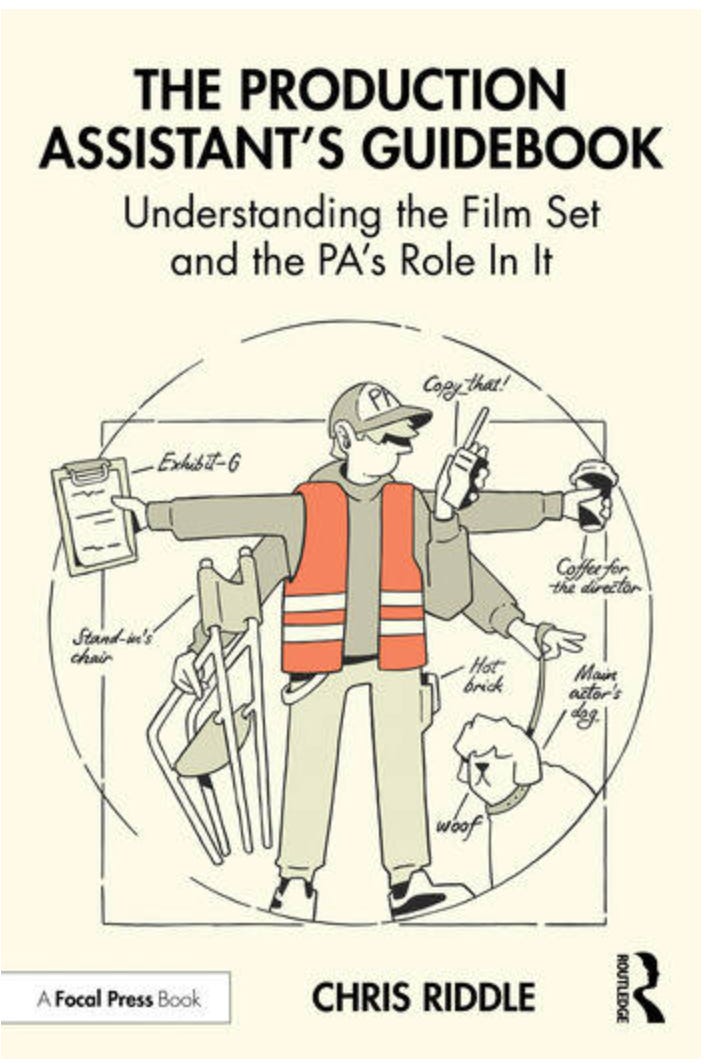
In addition to that he is the author of “The Production Assistant’s Guidebook.” A new book from Focal Press to help new set PAs learn the job. The book is available for Pre-Order and will be officially released on October 19th.
Book Purchase Link: www.paguidebook.com