



Where Does The Ecosystem Actually Exist?
This is Part Seven, and the final installment, of Who Will Be Responsible For “Independent Cinema”? Parts One through Six looked at what our support organizations say they do, the Missing Middle, who might build what next, better operating practices for NonDē, and finally a map of 74 organizations showing who is doing what. Now I want to add one more question: where can filmmakers actually find enough of those things to build a career?
Here is a question I should have asked much earlier in this series: Does an artist have to leave where they live to gain access to the support needed to build a career?
American cinema has always pulled people toward New York and Los Angeles. Talent attracts opportunity, opportunity attracts capital, and capital attracts institutions. None of this is exactly breaking news. But after putting 74 cinema-support organizations next to one another, something else became hard to ignore: some places have organizations, while a few places have something closer to an ecosystem.
That is a pretty significant difference. A filmmaker can live somewhere with a terrific festival and still have nowhere nearby to turn for distribution help. A state can spend enormous political energy protecting its production incentive while offering very little to the filmmakers who actually live there. A region can have grants, workshops, screenings, and enthusiastic audiences while still doing little to help artists retain rights, build companies, carry audiences forward, or make the next film any easier than the last one.
We keep talking about access as if getting through the front door were the whole problem. I am increasingly interested in what happens after you get inside. Can you develop the work where you live? Can you finance it? Can you show it to an audience that might still be there for the next one? Who helps you distribute it, hold onto the value you create, and fight for the conditions that make a career possible?
And if something actually works, what gets left behind?
The 74 organizations in our current map are heavily concentrated in a few places, although many operate nationally or through distributed networks. So where an organization is based does not tell us everything. A filmmaker in Iowa can apply to Sundance, somebody in Florida can join a national professional network, and knowledge generated in New York, Los Angeles, Chicago, or San Francisco can travel.
But being nearby still matters. People see one another more than once. They recommend one another, know who has equipment, which theater will take a chance, who understands a financing problem, and who just learned something the hard way that might save somebody else a year. That familiarity has value too.
So rather than ask which city has the most organizations, I want to ask something more useful: What does a place need before we can reasonably call it a cinema ecosystem?
1. What Makes A Regional Cinema Ecosystem?
Maybe we should start by admitting that having a film festival does not make a film ecosystem. Neither does having a tax incentive, and a soundstage certainly does not, although judging by some economic-development announcements you would be forgiven for thinking one was the equivalent of discovering oil.
What I am looking for is continuity. Can artists develop and make work where they live? Is there somewhere for that work to meet an audience, and some way for the relationship with that audience to continue? Can filmmakers get help circulating their films rather than simply premiering them? Are there people or institutions paying attention to ownership and sustainable careers? Does anybody organize around policy? And perhaps hardest of all, is there money capable of staying in circulation so one success might make another one a little easier?
No region needs to contain every piece inside its own borders. Some support should be national, and digital communities have made geography considerably more porous than it used to be. But when too many of those functions are missing locally, geography begins to determine who gets to persist.
Our map makes that pretty visible. New York and Los Angeles are still the places where most of these functions exist in meaningful concentration. The Bay Area comes closer than I expected, while Chicago becomes more interesting the more closely we look at it. After that, America starts looking less like a collection of complete cinema ecosystems and more like places that each have some useful pieces.
The missing pieces repeat themselves too. Artist support is relatively common, exhibition often exists somewhere nearby, and states that depend on production spending sometimes develop a political voice around incentives and employment. Distribution becomes scarcer, ownership scarcer still, and capital capable of staying in circulation almost vanishes. Those happen to be the functions that help turn making a movie into building a career.
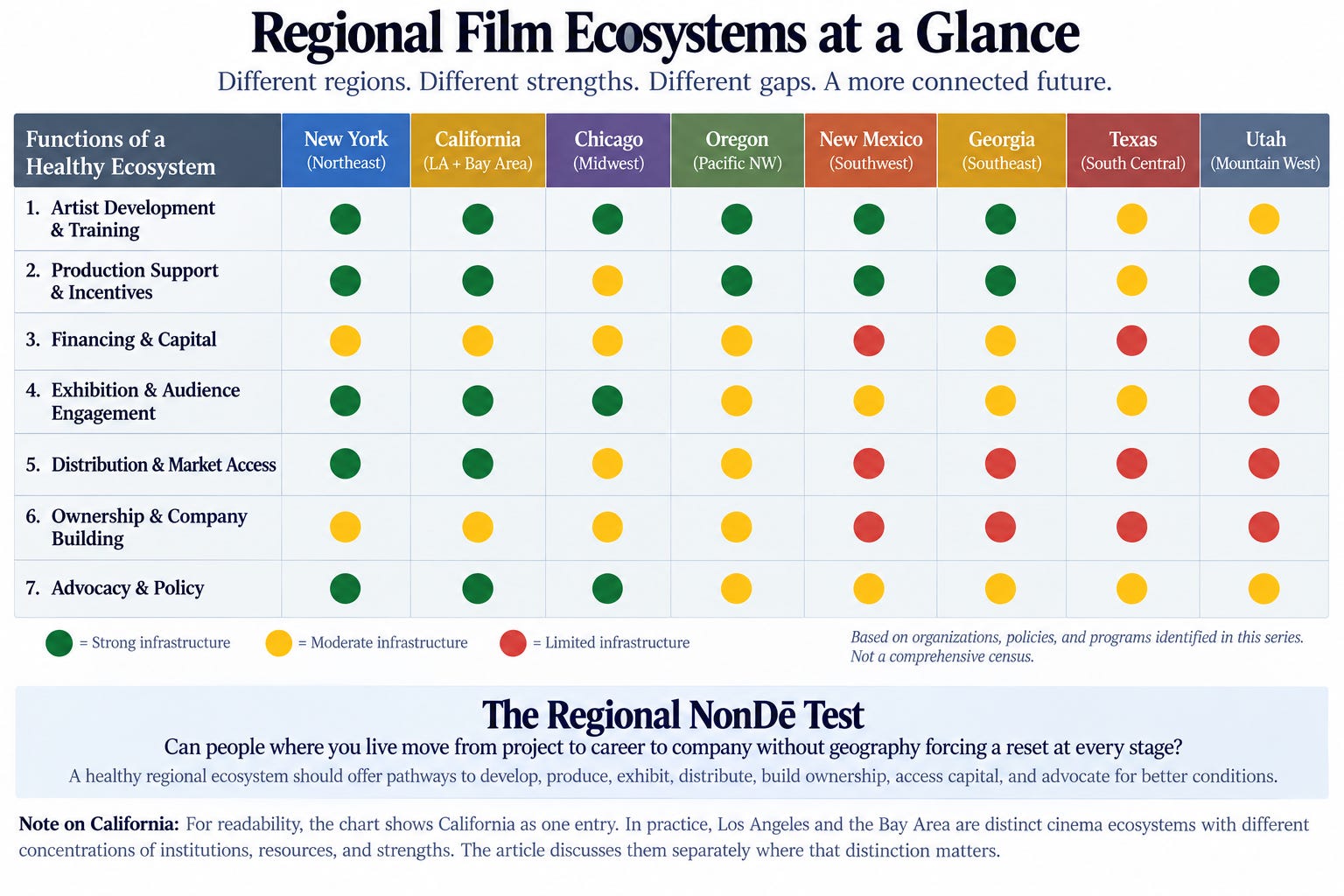
The chart is illustrative, not a census. It reflects the organizations, policies, and programs identified through this series and is intended to show patterns rather than award grades. Please engage with what we missed.
Read more