

I. INTRODUCTION
“A filmmaker who does not understand history, poetry, and philosophy is like a carpenter who has never seen a forest.” –Werner Herzog
When Ted asked me to contribute to his Hope for Film Friday Takeover, I told him I’d love to. I said that without any idea what my contribution would be. “It can even be a poem,” Ted told me, knowing I publish a weekly series called SUNDAY POEMS. But this isn’t Sunday and you’re not here yearning to read poetry.
So, let’s talk about why you’re really here. Films. Making them, distributing them, marketing them, and (if the stars align) making a living from doing so. I’m not a producer, though I’ve done some of the things producers do. I’m not a director, though I try to think like one when I’m writing a script. I’m a writer, an ex-journalist and author-turned-screenwriter.
I stumbled into the film industry while still working as a feature writer for a daily newspaper. I wrote a profile of an agent. We became friends. He convinced me to give screenwriting a try, agreeing to represent me on a handshake deal after reading the first film project proposal I gave him.
He took that proposal to Ridley Scott. Ridley read it, liked it, but ultimately passed. That was all it took. I bought a couple of screenwriting books and a copy of Final Draft (it still came on a CD in those days). I taught myself how to write a screenplay. Then I wrote another one. And a third. My agent got me through doors at Sony, Universal, Dreamworks, and Showtime, as well as some reputable production companies with studio deals.
The feedback we got was positive. People liked my writing. Just not enough to pony up option money, let alone produce what I was writing. I didn’t care (well, not to the point of despair anyway). I kept writing. I still am, all these years later.
You see, when I set out to become a writer, I did so with no idea how to do so, but with the certainty that it was the only thing I truly wanted to be. The problem, of course, was that I started out as a poet. Not a stable job market, even in the best of times. And I had no desire to get an MFA or Ph.D. and teach at a college or university. Much as I loved campuses and campus libraries, I had no desire to enter any hallowed halls and call them home. Hence, my move into journalism. At least I stood a chance of keeping a roof over my head, no matter how humble.
I never lost my connection to poetry however tenuous it was for many years. I stopped writing it altogether for a couple of decades, maybe more. I lost count. But the lessons I’d learned about rhythm and wordplay, structure and pacing, lurked in the background, stealthy affecting my prose. One magazine editor told me my articles were hard to edit because they were so rhythmic and tightly constructed. “I used to be a poet,” I told her.
When I started writing screenplays, I was struck by the similarities to poetry. Less is more in both cases. Attention to the flow of language, too. Which brings me back to Ted’s remark and my need for a topic for this take-over. What if I were to look at some of the ways the movies have affected poets and the ways poets have affected the movies? Now there’s something unexpected for a column focused on filmmaking.
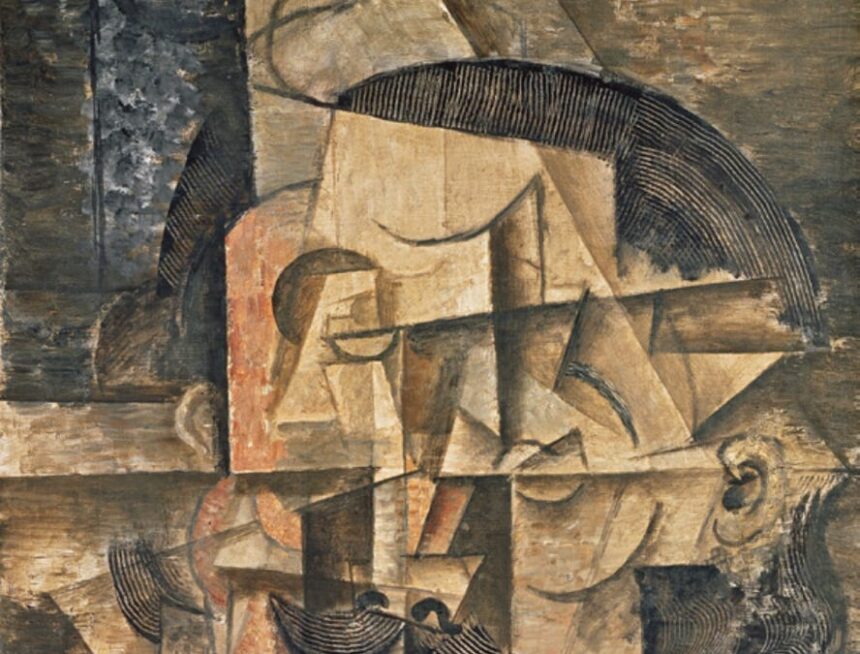
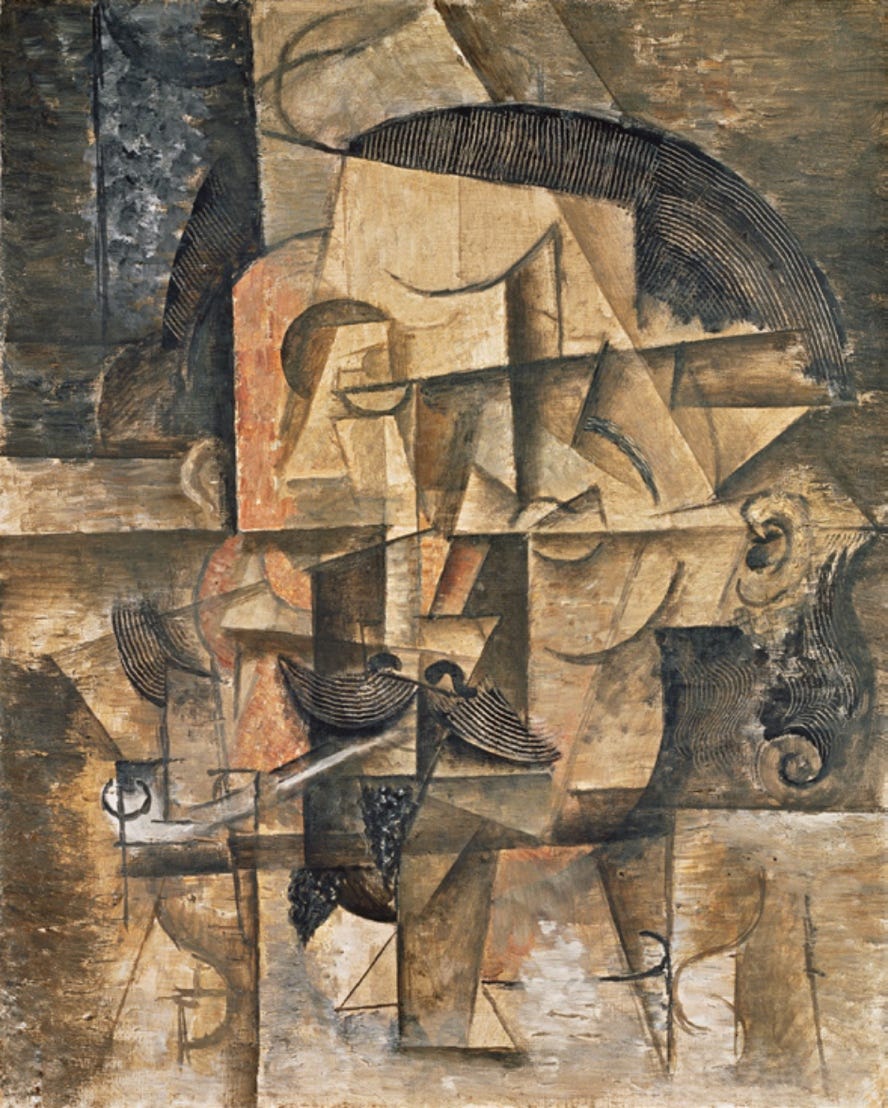
That’s what makes the Picasso painting featured at the top of this column so fitting. It’s done in the deconstructed, Cubist style that Picasso helped create, and that’s a fitting metaphor for the way poets and filmmakers often approach their work. At first, nothing quite aligns: it’s as if reality has been dumped on a table like a heap of jigsaw puzzle pieces and nothing makes sense . . . yet. But if the creative process goes well, those pieces will begin to coalesce, maybe not as the puzzle’s designer intended, but in a manner that gradually reveals a new way of seeing things. In the case of Picasso, it was a person, a poet, represented visually in a radically different type of portraiture. In the case of poets and filmmakers, it’s in a puzzle assembled without concern for anyone else’s notion of how it’s supposed to look. It simply is, which is the essence of the creative act: making something unexpected.
Let’s give it a go. What follows are some inventive ways poets and filmmakers have inspired one another, influenced one another, and collaborated.
II. FILMS ABOUT POETS
“A film is never really good unless the camera is an eye in the head of a poet.” –Orson Welles
The following capsule descriptions from the website poets.org were so well done, I saw no reason to rewrite them. Source: https://poets.org/text/watch-poetry-movie
A Quiet Passion—Cynthia Nixon portrays Emily Dickinson in this biographical drama, which recounts the poet’s life and features some of her famous verses.
The Basketball Diaries—Based on the autobiography by poet and artist Jim Carroll, played by Leonardo DiCaprio, this film depicts Carroll’s reckless youth and the writing that becomes his means of clarity.
Before Night Falls—Javier Bardem plays Cuban poet Reinaldo Arenas in this film, adapted from Arenas’s own memoir.
Bright Star—Ben Whishaw and Abbie Cornish play John Keats and Franny Brawne in this biographical romantic drama about the famous couple, which features several of Keats’s poems and takes its title from one of Keats’s famous love sonnets.
Il Postino—In this 1994 Italian film, a postman develops a relationship with his only customer, famous poet Pablo Neruda, living in exile in Italy, and through Neruda’s poetry, is better able to express his feelings to his love interest.
Kill Your Darlings—This biographical drama, starring Daniel Radcliffe as Allen Ginsberg, Dane DeHaan as Lucien Carr, Ben Foster as William S. Burroughs, and Jack Huston as Jack Kerouac, takes place in the early days of the Beat Movement when a 1944 murder affects the group of young writers.
Piñero—Benjamin Bratt stars in this biopic about Puerto Rican poet-playwright Miguel Piñero, who cofounded the Nuyorican Poets Café in New York City.
Mrs. Parker and the Vicious Circle—The Algonquin Round Table comes alive in this film, which features Jennifer Jason Leigh as Dorothy Parker.
Set Fire to the Stars—Elijah Wood stars as poet John M. Brinnin and Celyn Jones stars as Dylan Thomas in this 2014 Welsh film, based on Brinnin’s memoir of the same name.
Sylvia—The relationship of Ted Hughes, played by Daniel Craig, and Sylvia Plath, played by Gwyneth Paltrow, is detailed in this film, which begins with the couple’s courtship as young college students.
Tom & Viv—Willem Dafoe and Miranda Richardson star as T. S. Eliot and Vivienne Haigh-Wood in a film that depicts their tumultuous marriage and Eliot’s literary success.
Total Eclipse—This film captures the turbulent, explosive affair between Parisian poets Paul Verlaine, played by David Thewlis, and Arthur Rimbaud, played by Leonardo DiCaprio.
HOWL—Starring James Franco as Allen Ginsberg, this film largely revolves around the text of “Howl,” its composition, initial reading, and the public’s reaction. By the movie’s end, nearly the entire poem has been recited.
Wilde—Based on Richard Ellmann’s Pulitzer Prize-winning biography of the famous poet, novelist, and playwright, Wilde, starring Jennifer Ehle, Vanessa Redgrave, Jude Law, and Stephen Fry as the eponymous writer, recounts Oscar Wilde’s growing realization and acceptance of his sexuality, leading up to his notorious trial and imprisonment.
Paterson—This subtle, meditative film follows the mundane daily life of a bus driver named Paterson, played by Adam Driver, who lives in Paterson, New Jersey, and writes poems about his everyday life. The film features poems by Ron Padgett.
Dead Poets Society—Robin Williams plays an English teacher in an East Coast boys’ prep school who inspires his students to love poetry, among other life lessons. The film, which popularized the tradition of carpe diem poems, features verse by Frost, Tennyson, and Shakespeare.
A recent film not on the poets.org source list:
Late Fame—With Willem Dafoe as a poet-turned-postal worker, this film by critic-turned-film-festival-programmer-turned-director Kent Jones follows Dafoe’s character Ed as he meets and mingles with a group of wannabe writers and their lone female member played by Greta Lee. Rediscovered decades after his late-1970s moment of fame, Ed is both flattered and bemused by a new generation’s attention.
III. THOUGHTS ON POETRY & SCREENPLAYS
“We don’t read and write poetry because it’s cute. We read and write poetry because we are members of the human race… But poetry, beauty, romance, love, these are what we stay alive for.” –Robin Williams in Dead Poet’s Society (1989)
“The Well-Versed Movie”—This is a long, very insightful essay from 2004 by Stacey Harwood on poetry’s use in films. You can find it here.
“Lessons from Lyric Poetry for Screenwriters”— This lovely entry by Shannon Valenzuela, writing for Stage 32’s blog in 2020, moves from haiku to lyric poetry and the lessons that they teach about the economy of language, the use of figurative language, the rhythm and musicality of speech, and the use of white space on the page. Each topic is related to screenwriting in a useful way. You can read the piece here.
“Birdman: Writing a Screenplay Is Like Writing a Poem”— This piece by Jacob Krueger on his namesake site Jacob Krueger Studio uses the screenplay for the movie Birdman as an example of thinking like a poet while writing a screenplay. It includes a companion podcast episode. You can find both here.
“The Poetry of Screenwriting” — This 2017 piece by Scott Meyers starts with the line “When writing scene description, think poetry not prose.” He goes on to explore how effective short, precise descriptions do as much or more than long, rambling passages. It’s a good reminder that, in screenwriting, less is more. You can read it here.
IV. Poets on Screen
While the stereotype of a poet is either a recluse (Emily Dickinson) or a spotlight-seeker (Allen Ginsberg), the truth is usually somewhere in-between. Many poets prefer to let the poems stand on their own, often in small literary publications or chapbooks. Others like to interpret their work for audiences, whether at poetry readings or slams, on audio recordings, or in films or videos. Some of the latter appear in one way or another in the following:
The United States of Poetry: In 1996, PBS aired this five-part series directed by . It features 60 poets, including Derek Walcott, Rita Dove, Amiri Baraka, Allen Ginsberg, Lawrence Ferlinghetti, Sandra Cisneros, and Czeslaw Milosz, as well as Johnny Depp, Lou Reed, and Leonard Cohen. You can also watch selected clips from the series on the website of its producer Bob Holmes here. You can buy the entire series on Amazon Prime here.
Poems as Screenplay: Six Video Collaborations: A compilation ob. f six videos ranging from basic to artful, each one featuring a poet reading one of his/her poems. Among the poets are Mark Strand, Amy Hempel, and Anne Waldman. You can watch them here.
FILMPOETRY.org: Created by the Institute for Experimental Arts, this digital platform supports poetry and experimental visual arts. You can watch a variety of international films, including shorts featuring poets from around the world reading their work in two categories: “Video Poetry” here and “Film Poetry” here.
V. FRANK O’HARA GOES TO THE MOVIES
Thinking how best to end this piece, I returned to Ted’s remark about making my contribution a poem. I’m taking his advice and ending with a poem by one of my favorite poets, Frank O’Hara. He was a curator at the Museum of Modern Art in New York in the late 1950s and early ‘60s, a friend of such mid-century artists as Jasper Johns and Larry Rivers, and a writer with an unerring eye for the details of modern life. In addition to being fun to read, this poem’s title seems particularly apropos at this point in the short history of making movies. (Note the year of publication for the book this poem appeared in: the film industry has always been in one sort of crisis or another. Oh, and the weird line lengths are O’Hara’s, not random choices by me.)
To the Film Industry in Crisis
Not you, lean quarterlies and swarthy periodicals
with your studious incursions toward the pomposity of ants,
nor you, experimental theatre in which Emotive Fruition
is wedding Poetic Insight perpetually, nor you,
promenading Grand Opera, obvious as an ear (though you
are close to my heart), but you, Motion Picture Industry,
it's you I love!

In times of crisis, we must all decide again and again whom we love.
And give credit where it's due: not to my starched nurse, who taught me
how to be bad and not bad rather than good (and has lately availed
herself of this information), not to the Catholic Church
which is at best an over-solemn introduction to cosmic entertainment,
not to the American Legion, which hates everybody, but to you,
glorious Silver Screen, tragic Technicolor, amorous Cinemascope,
stretching Vistavision and startling Stereophonic Sound, with all
your heavenly dimensions and reverberations and iconoclasms! To
Richard Barthelmess as the "tol'able" boy barefoot and in pants,
Jeanette MacDonald of the flaming hair and lips and long, long neck,
Sue Carroll as she sits for eternity on the damaged fender of a car
and smiles, Ginger Rogers with her pageboy bob like a sausage
on her shuffling shoulders, peach-melba-voiced Fred Astaire of the feet,
Eric von Stroheim, the seducer of mountain-climbers' gasping spouses,
the Tarzans, each and every one of you (I cannot bring myself to prefer
Johnny Weissmuller to Lex Barker, I cannot!), Mae West in a furry sled,
her bordello radiance and bland remarks, Rudolph Valentino of the moon,
its crushing passions, and moonlike, too, the gentle Norma Shearer,
Miriam Hopkins dropping her champagne glass off Joel McCrea's yacht,
and crying into the dappled sea, Clark Gable rescuing Gene Tierney
from Russia and Allan Jones rescuing Kitty Carlisle from Harpo Marx,
Cornel Wilde coughing blood on the piano keys while Merle Oberon berates, Marilyn Monroe in her little spike heels reeling through Niagara Falls, Joseph Cotten puzzling and Orson Welles puzzled and Dolores del Rio eating orchids for lunch and breaking mirrors, Gloria Swanson reclining, and Jean Harlow reclining and wiggling, and Alice Faye reclining
and wiggling and singing, Myrna Loy being calm and wise, William Powell
in his stunning urbanity, Elizabeth Taylor blossoming, yes, to you
and to all you others, the great, the near-great, the featured, the extras
who pass quickly and return in dreams saying your one or two lines,
my love!
Long may you illumine space with your marvelous appearances, delays
and enunciations, and may the money of the world glitteringly cover you
as you rest after a long day under the klieg lights with your faces
in packs for our edification, the way the clouds come often at night
but the heavens operate on the star system. It is a divine precedent
you perpetuate! Roll on, reels of celluloid, as the great earth rolls on!
--From Meditations in an Emergency by Frank O'Hara, © 1957