
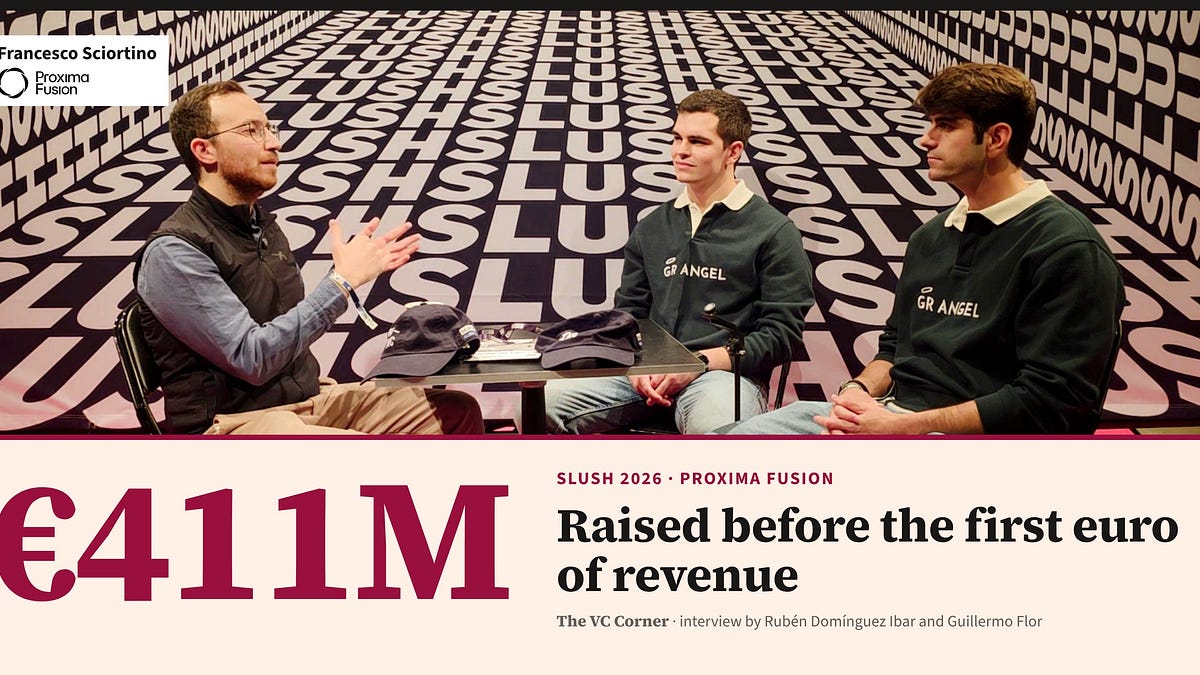
Proxima Fusion has secured more than ‐650 million in funding over the last three and a half years, despite the company reporting zero revenue. The Munich-based startup, a spin-out from the Max Planck Institute for Plasma Physics, recently closed a ‐411 million equity round at a ‐2.4 billion valuation.
CEO Francesco Sciortino argues that the lack of revenue is a defining characteristic of true deep-tech companies. The latest funding round in July 2026 included strategic investments from Google and RWE, alongside venture capital firms XTX Ventures and East X Ventures. The capital injection marks the second-largest fusion investment globally over the past year, according to the Fusion Industry Association.
The Stellarator Strategy
Proxima Fusion is developing stellarators, complex machines designed to harness the power of the sun by fusing light atoms. Unlike the more common donut-shaped tokamaks that operate in pulses, stellarators use a twisted cage of magnets to maintain a steady plasma reaction. This design is based on the Wendelstein 7-X, an advanced stellarator operated by the Max Planck Society in northern Germany.
The company’s roadmap involves two primary phases. First, it is developing a demonstrator called Alpha near Munich, which aims to show net energy gain in a stellarator for the first time by the early 2030s. This will be followed by Stellaris, a commercial power plant intended to launch later in that decade. The state of Bavaria has committed ‐400 million in non-dilutive funding to the Alpha project, conditioned on the company matching that amount with private capital.
Public-Private Financing Models
Sciortino describes Proxima as a 100% research and development company that relies on a mix of public grants and private equity. He notes that while public money de-risks the early science, private capital is necessary to prove commercial viability within a 30-year window. Once technical risks are mitigated by the first operational plant, the company plans to transition to traditional debt financing for future infrastructure projects.
The CEO compares the company's trajectory to that of SpaceX, noting that energy development is heavily influenced by policy. He credits recent German legislative reforms for providing a clear regulatory framework. On Nov. 12, the Bundestag passed a reform placing fusion plants under the Radiation Protection Act rather than the stricter atomic laws designed for nuclear fission.
European Supply Chain Advantages
While the United States often leads in startup creation, Sciortino believes Europe holds a significant advantage in the fusion sector due to its industrial base. He points to high-precision engineering and heavy mechanical manufacturing in Europe as critical components for building fusion reactors. Proxima currently employs about 200 people across offices in Munich, Zurich, and Oxford.
The company also utilizes artificial intelligence to manage the complex geometry of stellarator design. AI models help the technical team—half of whom focus on magnets and simulation—to visualize integration trade-offs that previously made such machines too expensive or difficult to construct.
A Platform for Energy and Industry
Beyond generating electricity for the grid, Sciortino views fusion reactors as platforms for industrial applications. The neutrons produced during the fusion process can generate high-temperature steam for chemical plants, steel manufacturing, and cement production. Additionally, the technology could be used to create medical isotopes for cancer treatments.
Proxima’s investor list includes a wide range of European and American backers, such as Redalpine, Cherry Ventures, Balderton, Lightspeed, and DST Global Partners. The company has raised ‐95 million in public grants to date, positioning it as the most well-funded stellarator startup in the world.