
Energy storage experts are increasingly pointing to sodium-ion batteries as a transformative force in the global power market, despite the technology trailing behind lithium iron phosphate in current production scale. According to industry analysis, global battery demand surpassed one terawatt-hour in 2024, driven heavily by stationary storage systems used to stabilize grids and power artificial intelligence data centers.
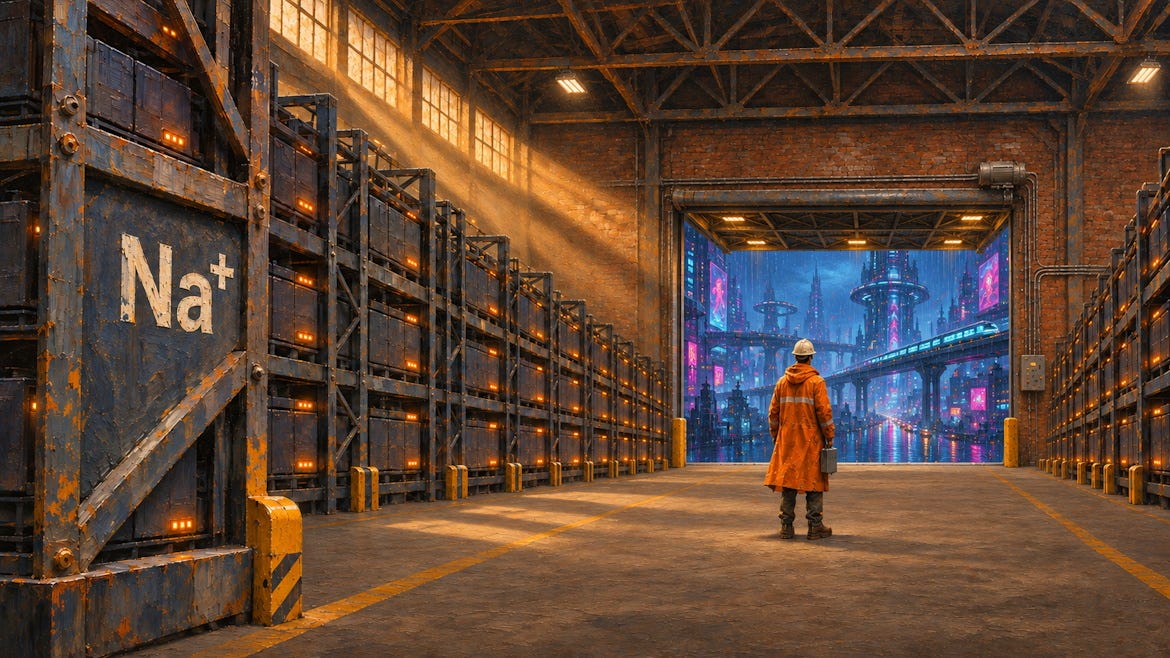
While electric vehicle batteries prioritize weight and energy density, stationary storage systems sit on concrete pads and do not require lightweight materials. Instead, buyers focus on lifetime costs, safety, and supply chain reliability. Sodium-ion batteries utilize abundant raw materials found across every continent, including sodium carbonate, which typically trades between $100 and $500 per ton. By contrast, lithium carbonate prices have experienced volatile swings ranging from $6,000 to $86,000 per ton since 2020.
Current Market Adoption and Manufacturing
Sodium-ion manufacturing currently lags far behind lithium-ion, with output measured in tens of gigawatt-hours compared to terawatt-hours. However, major battery manufacturers are scaling up production. In 2025, CATL launched a sodium-ion platform called Naxtra and signed large supply agreements for grid storage. BYD has invested in dedicated sodium-ion production lines, while Hithium launched a 785 amp-hour sodium cell designed for grid systems. In 2024, a 50 MW / 100 MWh sodium-ion station utilizing HiNa Battery cells came online in Hubei, China.
Independent commodity research firms project significant growth for the sector. Morgan Stanley forecasts sodium-ion demand reaching 830 gigawatt-hours by 2030 and 2.4 terawatt-hours by 2035, accounting for roughly a third of the battery market. Meanwhile, CRU estimates more conservative demand of 135 gigawatt-hours by 2030 and 346 gigawatt-hours by 2035.
Performance Advantages in Safety and Cold Weather
Beyond raw material costs, sodium-ion cells offer distinct operational advantages over lithium iron phosphate. Sodium batteries perform significantly better in deep cold weather. BYD rates its sodium storage cells to operate between minus 30 degrees Celsius and 55 degrees Celsius, reducing the need for parasitic heating systems in regions like northern China, Minnesota, or Alberta.
Sodium cells are also less prone to thermal runaway and can be shipped fully discharged at zero volts without damaging internal copper components, a capability lithium-ion batteries cannot safely match. This zero-volt shipping characteristic simplifies hazardous materials logistics and allows distributors to maintain larger inventories without degradation risks.
Some manufacturers claim substantial cycle life for the technology. Hithium rates its new sodium cell for 20,000 cycles and a 30-year calendar life, while HiNa storage cells carry ratings of 8,000 cycles. Furthermore, sodium-ion batteries can sustain higher continuous and peak discharge rates—typically 3C to 5C—making them well-suited for microgrids and data centers requiring rapid backup power responses.
Supply Chain Realities and the US Outlook
Despite escaping the geopolitical and environmental complications of lithium mining, the sodium-ion supply chain remains heavily concentrated in China. Because sodium cells are produced on largely the same equipment and manufacturing processes as lithium iron phosphate, Chinese firms maintain a dominant position in gigawatt-scale factory operations and hard-carbon supply chains.
In the United States, startups such as Natron Energy and Bedrock Materials have faced severe financial hurdles, with Bedrock shutting down entirely. Peak Energy remains a domestic bright spot, having shipped its first grid systems in 2025 alongside a five gigawatt-hour supply agreement with Jupiter Power. Energy analysts suggest that rather than attempting to directly rival Chinese manufacturing on current lithium or sodium battery chemistries, United States strategy should focus on deploying available sodium storage, building domestic anode supply chains, and directing policy investments toward next-generation solid-state battery research.