

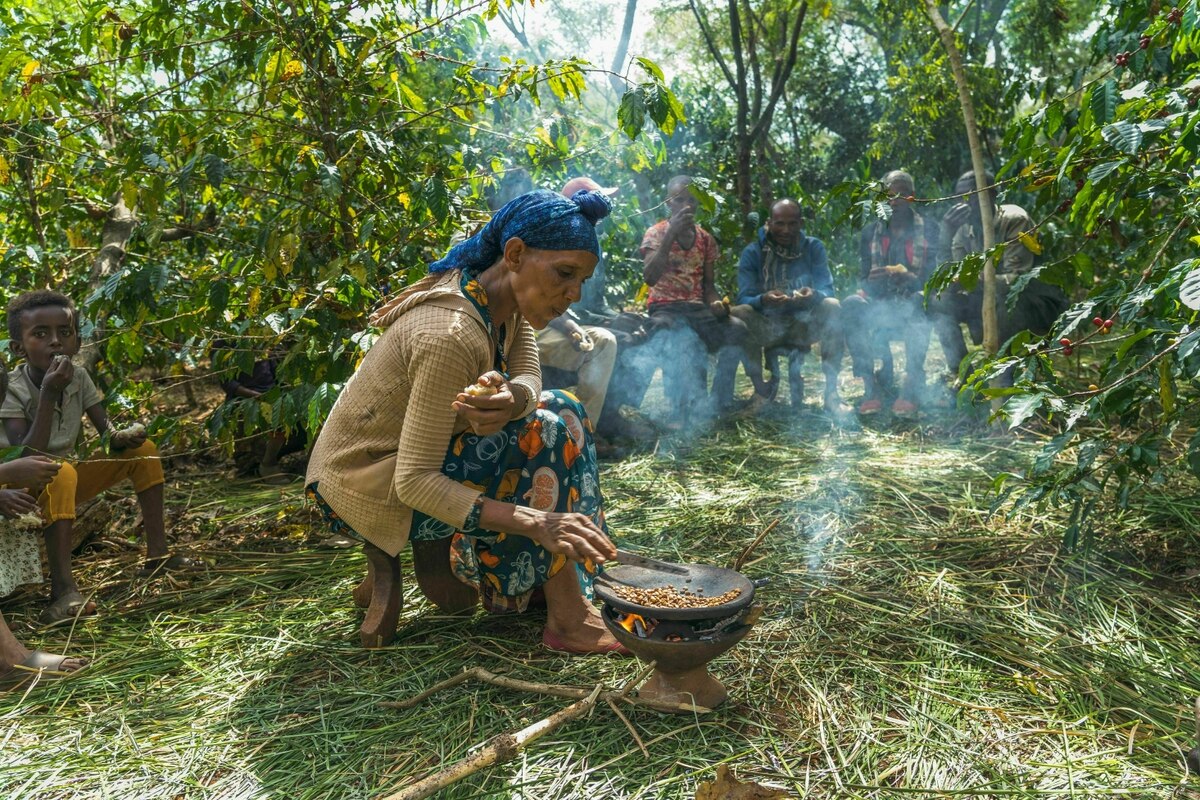
Mulu Tashome sits on a wooden stool in a small clearing. In front of the 35-year-old Ethiopian woman, a pan lies over the glowing coals of a fire bowl. Tashome carefully moves milky-green coffee beans back and forth until they shine dark brown. She then uses rhythmic blows to push a one meter long pestle into the beans, which are lying in a wooden mortar. She puts the finely ground coffee powder directly into the boiling water of a metal coffee pot.
“No farmer drinks coffee alone at home. When I make coffee, I have to invite my neighbors left and right,” says Tashome. She pours strong, black coffee into small, handleless porcelain cups for the guests sitting in a circle around her. In Ethiopia, coffee is not only a source of livelihood, but also a cultural asset.
Mulu Tashome and her husband Mulugeta Kenea are among an estimated four million smallholder farmers in Ethiopia, making the country Africa’s largest coffee producer. Only the dirt under her fingernails reveals that Mulugeta Kenea’s long, elegant hands are hard at work. Without running water, internet or electricity, the gaunt 40-year-old Ethiopian grows his coffee.
Acacias and African cordias spread between the dense rows of coffee bushes on his plantation, casting shadows. Despite the cloud-free sky, it is pleasantly cool here. Red Arabica coffee cherries shine out from the deep green thicket of leaves. It’s harvest time.
New EU regulation will take effect from 2027
Kenea could have big problems next year. Because from then on December 30, 2026 must Coffee traders and coffee processing companies According to the EU Deforestation Regulation (EUDR), they must prove that no forest has been cut down for their coffee cultivation. The law applies to companies with fewer than 50 employees and an annual turnover of less than 10 million euros 30 June 2027.
To do this, Kenea would have to provide location data for its parcels. In comparison with satellite images from before 2021 It can then be determined whether there used to be forest on his plantation.
Kenea has never heard of the EU regulation. He doesn’t understand why he has to prove that he didn’t cut down any trees. On the contrary: “These trees here didn’t exist before I planted coffee bushes.” His gray temples and thoughtful voice radiate life experience.
Agricultural scientist Dr. Addis Alemayehu Tassew from the Southwest Ethiopia Agricultural Research Institute can understand the surprise: “Almost all Ethiopian coffee is Arabica coffee. This type is grown under trees.” In contrast, coffee in Brazil often grows in over 50 Acres large monocultures. Kenea’s coffee plantation is only a quarter hectare in size, typical for Ethiopia.
More income, more trees, more coffee
Until four years ago, Kenea lived on millet, corn and teff, an Ethiopian grain. Then the aid organization People for People provided him with coffee seedlings. The idea: growing coffee increases income, the trees next to the coffee contribute to reforestation.
With the coffee, Kenea now earns 300,000 Birr a year, around 1,700 euros, much more than before. He and his wife can use this to better provide for their six children. He has installed a small solar panel on his roof, he says, and lists all of his light bulbs that he can use it to power: “The first is in the living room, the second is in my bedroom. The third is in the kitchen and the fourth is in the room where my children study.”
One of its four light bulbs hangs from the ceiling on a gray cable. Plastic sheets and newspapers cover the clay walls. He can’t read the newspapers, but the pictures provide some color. Two benches, two round tables, small stools and a shelf, all hand-made, stand on the sandy floor. The coffee farmer says his house used to not be so well equipped.
“This will be another major burden for these already poor farmers,” says Bahritu Seyoum, project director of People for People, about the EU regulation. “It starts with the cell phone, which can collect location data. Then they also have to be able to collect the data.” There is hardly any mobile network in Kenea’s village of Genji. He couldn’t use a smartphone anyway because he hasn’t learned to read or write. But he has an old push-button cell phone for making calls.
Ethiopia’s government is confident
The Ethiopian Minister of State for Natural Resources, Professor Eyasu Elias, is confident: “I think we can meet the deadline.” Ethiopia takes the EUDR very seriously and will strive to meet EU requirements, the minister said.
Agricultural scientist Tassew disagrees: “We are not preparing as the EU requires. I think most coffee farmers haven’t even heard of the EUDR.” Millions of farmers need to be informed and the location data of their many small coffee plantations collected. Tassew doubts Ethiopia’s coffee farmers will be able to meet the deadline. “We lack everything: technical equipment, qualified personnel and financial resources.”
Possible financial losses do not only affect small farmers. “During the harvest season, we hire women as harvest helpers. In this way, women outside our household also benefit from the daily work here,” says Kenea’s wife, Mulu Tashome. During the current harvest season, the couple pays five to eight harvest workers every day.
Decisions about the implementation of the EUDR are made without small farmers like Kenea. Local traders also dictate the selling price of his harvest. “They say that they are not responsible for it, but that the international market determines the price of coffee,” says Kenea. “I don’t think that’s fair.”
Prices are already low
In 2025, coffee traders in Nono Benja paid around three euros per kilo for unroasted beans. Taking into account the weight loss during the roasting process, this corresponds to around 15 percent of the price of Arabica coffee in German supermarkets. But Kenea has to sell its untreated coffee cherries at even lower prices. Because he doesn’t have a machine to remove the pulp and peel. His work remains manual work.
The EU deforestation regulation did not take the special features of Ethiopia’s forest-friendly coffee into account. It solves the existing one EU Timber Trade Regulation and is intended to ensure deforestation-free supply chains not only for wood imports, but also for cocoa, palm oil, beef, rubber, soy and coffee.
“Due to the expansion, there was no focus on the specific needs of individual raw materials,” says Dr. Jonathan Zeitlin. The professor emeritus at the University of Amsterdam has been following the EUDR legislative process for years. Overall, for him, the EUDR’s potential contribution to environmental protection outweighs its weaknesses, he says. But: “It is remarkable that coffee was hardly discussed in the entire debate.”
The harvest from coffee farmer Kenea will probably also end up in German coffee cups. Ethiopia exports coffee worth approximately 40 million euros to Germany. This makes Germany currently the largest sales market for Ethiopian coffee. Agricultural scientist Tassew expects Ethiopia’s coffee exports to shift towards other markets such as Saudi Arabia as a result of the EUDR.