

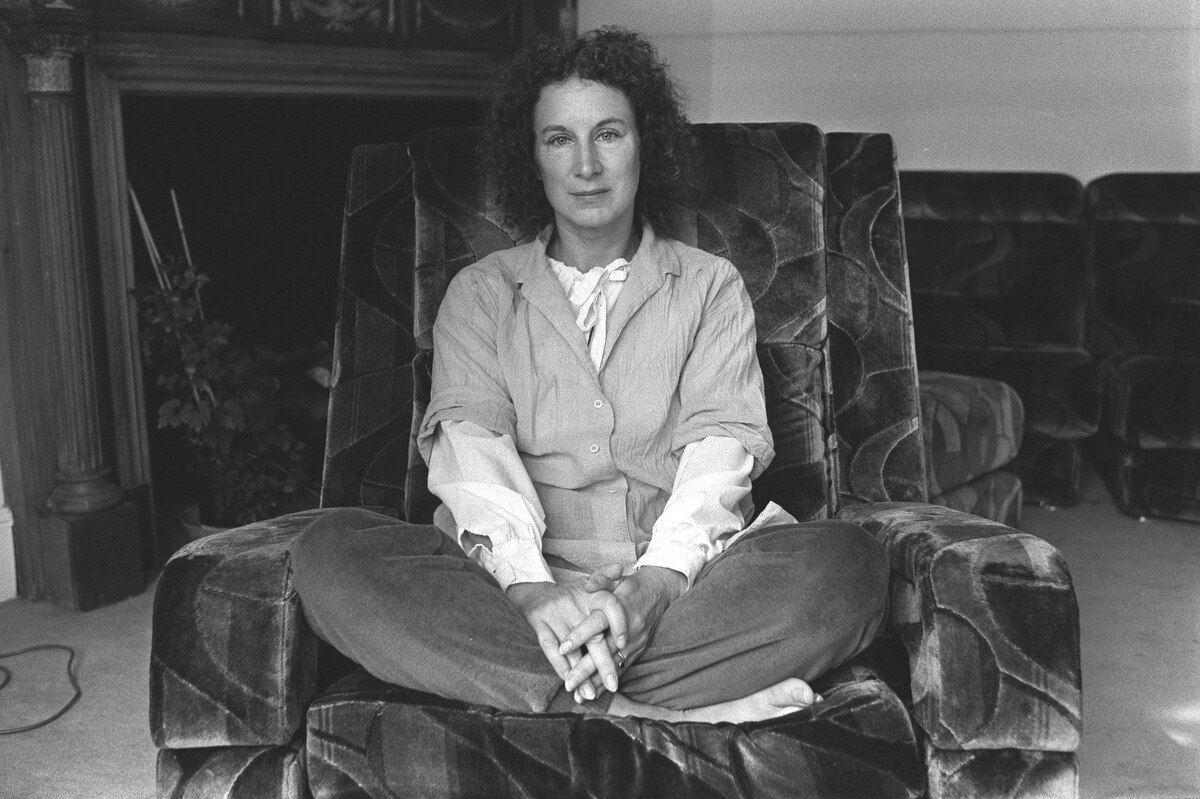
Almost at the end of her memoirs, Margaret Atwood writes: “Sooner or later the body decides to go on an adventure of its own, no matter what I think about it.” And then she continues: “But so far we are still traveling together.”
This is not a declaration of war on physical deterioration, but rather a completely unsentimental assessment of the state of things. Atwood has experienced first-hand what the body’s “own adventure” can mean since her husband, the writer and ornithologist Graeme Gibson, who died in 2019, suffered from dementia. The author herself is now 86 years old and definitely still writes with her characteristic verve, if the gesture of this “Book of Lives” can be seen as exemplary of the current status quo.
Atwood writes at the beginning that she is a kind of “threshold creature”, at home in many worlds. The fact that these worlds also include cultural practices that are more esoteric or even occult is a frequently recurring theme in her memoirs. This sub-theme is only surprising at first glance, as there is a strong undercurrent in Margaret Atwood’s writing, whose energy is directed at the dark spots of human existence and at invisible forces or power structures by which destinies are influenced.
Dancing counterclockwise
The fact that this is not just an artistic quirk is shown by the fact that the author explains her birth horoscope in detail in the chapter that deals with her birth (although the book begins much earlier). As the memoir progresses, the zodiac constellations of people close to her are regularly mentioned, we also learn that Atwood is a master of both hand reading and tarot card reading, and that she hired “some exorcists of the ‘crystal and incense’ variety” after her husband’s ex-wife committed suicide and the acquaintance who was supposed to sell the house of the dead found it afflicted with an oppressive gloom.
Atwood himself also took part in the expulsion ritual: “We danced counterclockwise, rang little bells and placed sprigs of sage in the kitchen drawers.” She always tells such things with a humorous undertone of inauthenticity. But it is only logical that a person who has demonstrated an almost inexhaustible imagination over a decades-long writing career is able to imagine things as real that others consider to be pure imagination.
Margaret Atwood: “Book of Lives – Something like a memoir”. Translated from English by Helmut Krausser and Beatrice Renauer. Berlin Verlag, Berlin 2025. 768 pages, 36 euros
On the other hand, Margaret Atwood is also influenced and inspired by the world of science – and by intensive early childhood experiences with nature. As the daughter of an entomologist who did a lot of field research, she spent much of her childhood in the Canadian forests. The father used to build the wooden huts in which the family lived with his own hands, and when he had to be away for long periods of time for research purposes, the intrepid mother watched over the children in the wilderness and drove away bears single-handedly. Only when the children had to go to school (Atwood has an older brother and a younger sister) did the family’s center of life move to the city.
Increased self-confidence
Born in 1939, Margaret Atwood belongs to the founding generation of the Canadian literary scene. As a huge country and a dwarf in terms of population, Canada was politically and culturally overshadowed for a long time by both the British Kingdom (Charles III is still the country’s official head of state) and the United States. The literary canon consisted of British and American classics.
It was only in the decades following the Second World War that the self-confidence of Canadian authors and their public perception gradually grew. But this by no means happened by itself. As late as 1961, Atwood writes, “exactly five novels were written in Canada by Canadian authors and published by publishers based in Canada.”
In the years that followed, she did her part to increase the recognition of local literature, including as co-editor at an independent publishing house and as the author of a survey of Canadian literature. With her dual qualifications as a writer and literary scholar, she was ideally suited for this task.
Atwood began her studies in Toronto, went to Harvard for a master’s degree and later held teaching positions at various North American universities over many years. Although she was already receiving prizes and public attention for her poetry as a young poet, it would take a long time before her literary success paid off in sufficient cash.
Icon of the women’s movement
Her popularity increased noticeably after Atwood established herself as a novelist. With her first novel, “The Edible Woman,” which was published in 1969, she became a kind of icon for those who were currently forming Women’s movement and has basically remained so ever since – a fact that she under-emphasizes in her autobiography. After all, there are many sources from which… their socially critical, creative spirit dines.
It is no coincidence that she wrote “The Maid’s Report” while she was living in West Berlin in the 1980s and from there made trips to socialist countries. The totalitarian theocracy Gilead designed in the novel was largely inspired by these oppressive trial visits to the GDR and Czechoslovakia. Added to this was the experience brought from the USA of an essentially radically puritanical, illiberal idea of gender roles.
Even before “The Handmaid’s Tale” came out Netflix-Serie and the red robes of the “maids” became the insignia of a global protest movement, this novel was by far Atwood’s best-known and also gets a lot of space in the memoirs (although she is silent about the film adaptation by Volker Schlöndorff).
Men who move through their lives
Close behind in terms of detail is “Alias Grace,” in which Atwood deals with a historical crime story from early 19th-century Canada. This novel, which was also made into a film as an excellent series, is an opportunity for narrative theory and practical considerations that provide interesting insight into the author’s literary workshop and way of thinking.
Of the almost 800 pages of this autobiography, relatively few fall into the subject area of “making of”. After all, it’s important to talk about life. The number of men who passed through the author’s life – before Graeme Gibson – is remarkable. Not everyone is mentioned by name, certainly after consultation with those mentioned.
Overall, however, there are significantly more women, including some (named this time) whose relationship with the author was not characterized by friendly feelings. Anyone who is well versed in the Canadian literary scene will certainly appreciate such gossip passages.
In passages, this energetically written, yet very thick autobiography is quite lengthy. It feels a bit like Atwood went a little too long for her life stories; Because the book becomes more and more interesting towards the end, while the opening chapters tend to be very detailed – although it is astonishing how many childhood memories the author seems to have retained.
Formative bullying experiences
She describes the bullying experiences she had in elementary school as having an enormous impact on her life and returns to this topic several times. The author of this memoir is definitely a person who does not ignore problems, but rather faces them pragmatically.
For interpersonal imbalances in later phases of her life, she introduces an “inner advisor” into the narrative text as a conversation partner, with whom she conducts a fictitious therapeutic dialogue. Time and time again, this inner advisor causes her to make compromises and adjust her expectations of other people to reality.
Perhaps this sensible attitude is also supported by the author’s belief that the position of the celestial bodies at a person’s birth already determines most things? However, she never claims that Atwood’s horoscope (Scorpio with Gemini ascendant) would have led to such a brilliant literary world career right from the start. And in general, as a Scorpio, she is “fundamentally skeptical – even towards horoscopes”.