

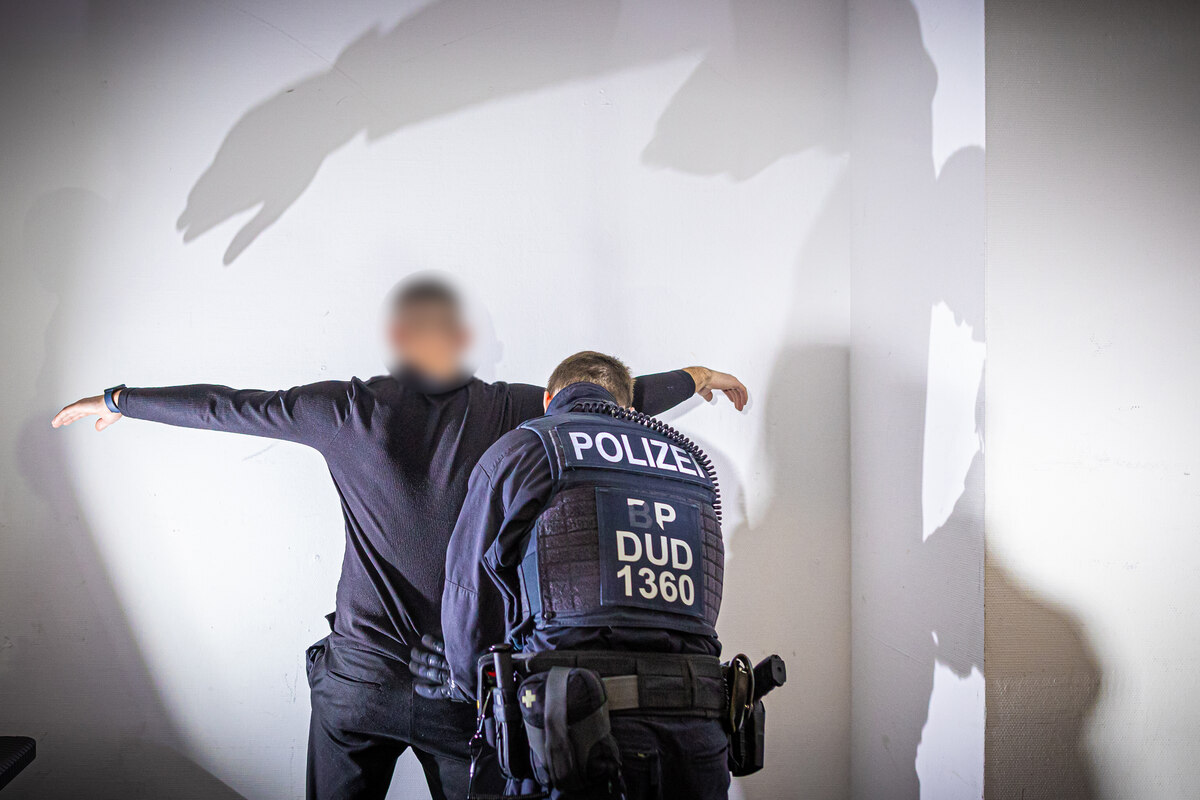
The evening on which the young police officer Daniel M. met the wrong man was a while ago. On November 24, 2024, a police operation took place in Hanover’s Nordstadt, which was supposed to result in M. being charged with coercion and negligent bodily harm.
This police operation has a history: the Austrian band Nachtmahr was performing in the music center at the time. Nachtmahr is one of those bands that place themselves in the industrial/aggrotech genre and enjoy provocative play with militaristic, sometimes fascist aesthetics – something with uniforms, Fraktur script, whips and “fight” bleating, something like Rammstein. Lyrically they do not engage in Nazi propaganda and regularly reject such allegations, but visually it is enough to at least be considered controversial.
In any case, it was enough for a group of presumably anti-fascist activists in Hanover. They stormed the stage that night, knocked over a few things and lit a smoke pot. The audience initially believed that this was part of the show and joined in the chants of “Nazis out” – but that was all over when not only the smoke pot but also the stage curtain burned and instruments were damaged.
Due to the situation being completely unclear at the time and the danger to around 300 concert goers, the police and fire brigade responded with considerable force. The situation at the music center was brought under control relatively quickly and the crew had practically extinguished the fire. At the same time, the police officers began searching for the suspects in the immediate area – up to 20, according to witness statements.
ID photos with your private cell phone
For this purpose, extensive personal checks were also carried out on Kopernikusstrasse. That’s not a far-fetched idea in itself, not only because it’s very close, but also because the punk hangout “Kopi” is located here. Here people are decidedly anti-fascist and have also been victims of attacks from the right-wing spectrum.
As luck would have it, there was also a concert in the Kopi that evening. In the audience: the B. couple, whose son was on stage. After the concert, they helped load the band’s equipment into another father’s car. Then they wanted to make their way home in a small group consisting of the couple, their son and three other friends.
They were running into the police checkpoint. There are a few minor differences in detail about what happened next. Mr. B. described the events to the taz as follows: The check was initially carried out very politely and professionally. The officers wanted to see the ID cards, which were also given to them.
A policewoman took photos of it – with a smartphone that was in a pale purple case and looked as if it was her private one. That seemed strange to him and he started asking questions about whether it was correct in terms of data protection law and the like. The policewoman responded briefly and evasively.
The identity checks are escalating
Then photos should also be taken of the people from this group. B’s wife was asked to stand against the wall of the house. B., who said this situation seemed increasingly strange, said that maybe he could take a few photos and took his smartphone out of his pocket.
A male police officer next to him then harshly asked him not to do that. He said “okay” and slipped the cell phone into his pocket. Nevertheless, the police officer suddenly grabbed him and – with the help of two colleagues who rushed over – turned his arms behind his back, pushed him face down on his knees and his back against the wall of the house. This also resulted in an injury to his index finger, a fracture involving the joint, which caused him pain for over a year.
The police officer also took his cell phone and asked him to hand over the PIN. B. initially refused, whereupon the police officer threatened that he could also confiscate the device and then he would not get it back for another year. That wouldn’t work, said B., as it contained sensitive patient data. He wanted to delete the photos himself – in front of the police officer, but the police officer refused to return the device.
After some back and forth and further threats, he finally unlocked the cell phone, the police officer deleted the photos and gave it back to him. The descriptions of the police officers involved differ slightly here: there is talk of multiple requests to which B. did not respond, and of “uncooperative behavior”. B. is also said to have taken photos directly in the face – but he says he held the cell phone high above his head.
A letter to the police chief
The – in his eyes – sudden and unjustified attack concerns B. for a long time. And he’s not one to let it go so easily. As a psychotherapist and psychiatrist, he has already gained some professional experience with the police and judicial system. He wrote a letter directly to the police chief.
In it, he eloquently describes how violently the attack affected him and his wife – bringing back memories of an attack in Brazil for him and memories of her friend being beaten almost to death by skinheads.
His trust in the police as a state institution has been permanently shaken; not to mention the devastating impact on young people’s image of police officers. And he also asks whether they would have really seemed so suspicious as an older, inconspicuously dressed couple with bikes and bicycle helmets.
At that point, he said, he had more of a kind of perpetrator-victim reconciliation in mind. He wanted to work through what had happened in a conversational manner – as a therapist – and make it clear to the police officer what he had done.
But the police chief immediately passes the letter on to the responsible department, which initiates a formal investigation into bodily harm in office. In this, 27-year-old Daniel M. is identified as the “main perpetrator”.
According to the young police officer’s defense attorney, his client mistakenly assumed that he was entitled to take the cell phone and have it deleted. So, he suggests, he may not be the only one on the police force
“I was very impressed by the internal investigation, everything went smoothly, they questioned very carefully and thoroughly,” says B. on the sidelines of the court hearing.
In fact, in this situation, the young police officer should not have confiscated the cell phone and should not have blackmailed B. into unlocking it. Therefore, in addition to the bodily harm, which was classified as negligent, the public prosecutor’s indictment also included coercion in office.
His client mistakenly assumed that he was entitled to take the cell phone and have it deleted, says Daniel Brunkhorst, the young police officer’s defense attorney. He suggests that he may not be the only one with the police, even if the legal situation is actually clear.
The legal situation and police practice differ
In fact, this problem is a long-running issue in German courts. In recent years, however, the legal opinion has become increasingly widespread that documenting police operations using photos or videos is generally permissible – as long as the operation is not hindered.
Borderline cases or deviating judgments only exist where Audio recordings of situations that are not in themselves public are made (violation of the confidentiality of the word), close-ups or portraits are taken of individual officials (they also have a right to their own image) or the publication and distribution occurs without a legitimate public interest.
In principle, the police may only confiscate the cell phone with a court order or if there is imminent danger. Imminent danger here means: There is a risk of evidence being destroyed. In this case, the court order can be obtained subsequently. But in this case, Mr. B. wasn’t the one who wanted to destroy evidence.
But the legal situation is one thing, police practice is often another. The responsible public prosecutor in Hanover also says that he has recently conducted a number of similar proceedings.
A shocked police officer
That’s why Daniel M. is now the one who has to go to the dock in the Hanover district court. It’s visibly heavy on him. In the courtroom he doesn’t radiate the slightest bit of aggression, on the contrary: he sits next to his defense attorney like a heap of misery. He seems like someone who is not only worried about his career, which has just begun, but who is seriously shaken in his self-image.
He says right at the beginning that he was transferred to internal service after the incident. His voice breaks as he apologizes in the courtroom. Otherwise many police officers will react first in his situation with a counter-charge for resisting law enforcement officers – he also preferred to forego that.
In the end he gets away with a black eye: the proceedings are stopped after an agreement between the public prosecutor’s office, defense and co-plaintiff’s lawyer – for a fine of 3,000 euros. In addition, there are court and legal fees, including for the accessory lawsuit. And he will have to face the conversation again with Mr. B., his wife and his son. He gets the desired perpetrator-victim balance.