



The HopeForFilm Guide to Debt, Gap, Bridge, Presale & Incentive Financing
Part One: The 13 Specialist Film Lenders Who Still Turn Pre-Sales, MGs and Tax Credits Into Production Cash
There are many ways to claim you finance movies. I mean… who wouldn’t want to be known as a “film financier”? You certainly can dine out on that, although you may get stuck with the tab.
We let many get away with proclaiming themselves such, instead of actually probing how they spend their cash and what they want in return. I think it is high time we change that and get into those juicy details where god and the devil both play.
For years I have maintained a long list of companies that finance American films. Last year I shared it with you, and I’ve done my best to keep it updated.
The problem with my list—and with most film-funder lists—is that we tend to throw very different kinds of money into the same bucket. Equity investors, studios, distributors, philanthropists, banks, gap financiers and lenders all get called “financiers.” There’s a huge difference between what each group provides and what they want in return. So today I am breaking the list into more definable groups for you.
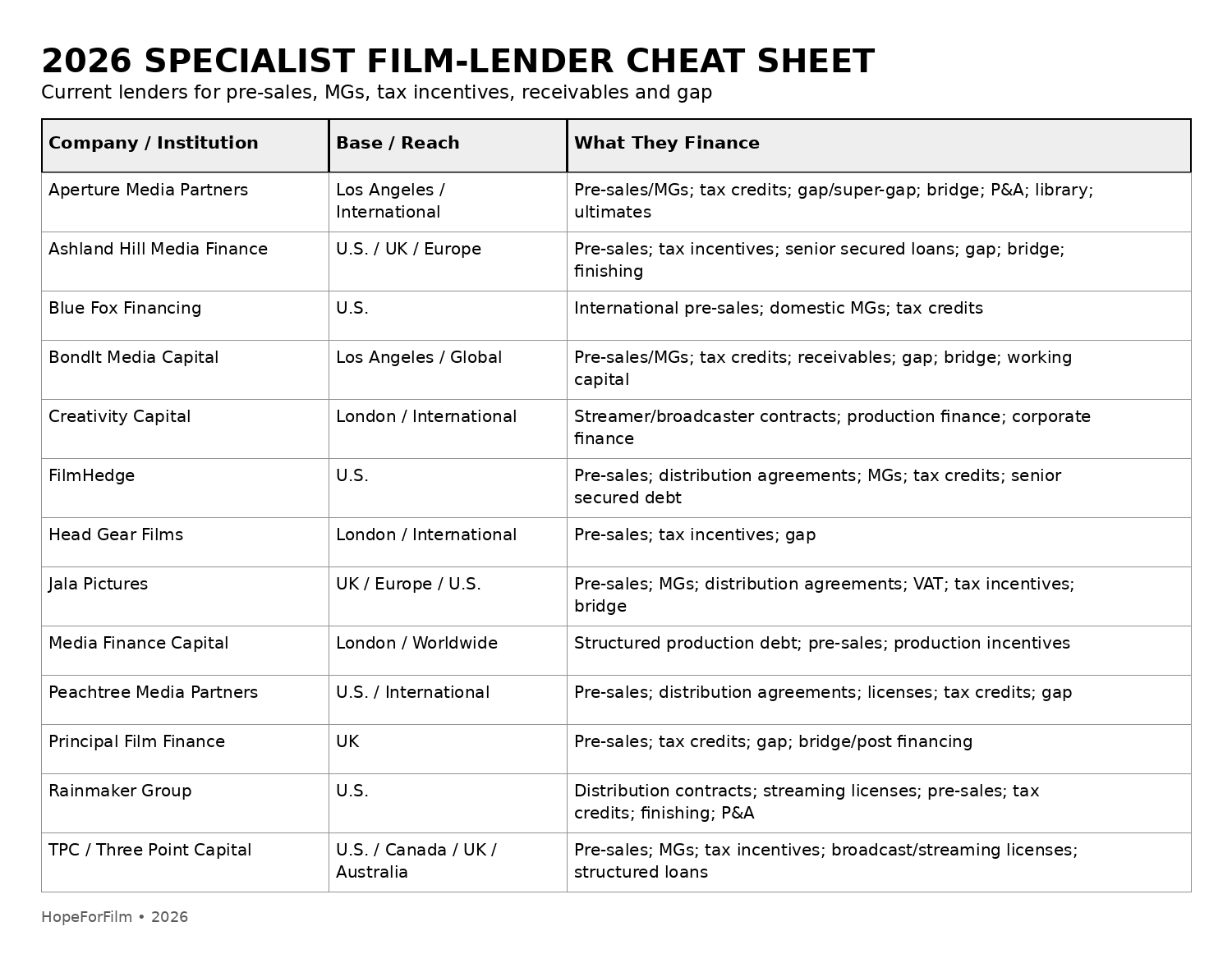
I am starting with debt: the companies that lend against something. Yes, there is a cheat sheet at the end, but understanding what they lend against may save you more time than having the names. Do yourself a favor and read the post; don’t just skip to the end.
A MESSAGE FROM OUR SPONSOR

One of the oddities of independent film finance today is that producers can have financing committed and still not have the money they need to make their movie. You sold Germany for $500,000, secured a $2 million domestic minimum guarantee, qualified for a local tax credit, and signed a license agreement with a streamer. On paper it looks like you are fully financed, except for one little issue: much of that money may not arrive until delivery or months after production has finished.
This typical timing problem creates the need for one of the oldest and most essential businesses in independent film: cash-flow lending. A lender advances the production money now against a contractual payment expected later, usually after delivery, completion of a tax-credit process, or satisfaction of other defined conditions.
For decades, entertainment banks played a central role in this process, and several still do. Private lenders and specialist film-finance companies have become increasingly important, particularly for independent productions that may not easily qualify for a conventional banking relationship.
Who is actually doing this in 2026? Which companies lend against some combination of pre-sales and foreign distribution contracts, domestic minimum guarantees, streamer and broadcaster license agreements, production tax incentives, other contracted production receivables, and gap against unsold territories?
This first installment concentrates on the specialist lenders that independent producers can approach with pre-sales, MGs, tax credits, streamer licenses and other identifiable receivables. The second looks at the entertainment banks, the different species of film debt, and what the changing lending landscape tells us about the broader state of independent film finance.
A lender can turn tomorrow’s receivable into today’s production money.
THE CLASSIFICATIONS
The companies below do overlapping things, but they do not all occupy the same place in the financing ecosystem. To make the list easier to use, I have grouped them according to the role they most clearly play. Please send me a note if you think I’ve got any of these wrong.
Core specialist lender: A company whose business substantially revolves around lending directly against film and television collateral such as pre-sales, MGs, tax incentives and other contracted receivables.
Direct lender: A company deploying its own capital directly into production loans rather than primarily arranging financing on behalf of others.
Receivables specialist: A company particularly focused on advancing money against identifiable contractual payments, including distribution agreements, MGs, tax credits, VAT and other receivables.
Content-finance specialist: A lender working across film, television, streaming and broadcaster contracts, often with a broader mandate than traditional feature-film lending.
Institutional private-credit lender: A larger private-credit platform bringing institutional capital into film and television lending.
Global production lender: A specialist lender with a substantial international footprint and the ability to finance productions across multiple jurisdictions.
THE 13 SPECIALIST FILM LENDERS
1. Aperture Media Partners — Los Angeles
Aperture seems to resemble how the traditional entertainment banks operated. CEO Jared Underwood spent eighteen years at Comerica’s Entertainment Group, President Andrew Robinson was also at Comerica, and other members of the team have backgrounds at MUFG, East West Bank, Union Bank and Banc of California.
Aperture explicitly offers production loans collateralized by pre-sale contracts and receivables. Its menu also includes gap and super-gap, tax-credit loans, bridge loans, sales-agent advances, P&A financing, library loans and ultimate-based financing. Its financing guidelines identify distribution and licensing agreements containing MGs from creditworthy domestic and foreign distributors as acceptable collateral.
What they finance: Pre-sales/MGs; tax credits; gap/super-gap; bridge; sales-agent advances; library; P&A; ultimates.
Geography: U.S. and international transactions.
People: Jared Underwood — CEO; Andrew Robinson — President & COO; Dan Mandel — EVP; Slava Vladimirov — EVP; Matthew Anderson — SVP.
Classification: Core specialist lender.
2. Ashland Hill Media Finance — Los Angeles / London / Europe
Ashland Hill was built specifically to provide capital to independent film and television. Its principals come out of traditional entertainment finance, and the company says its team has closed hundreds of transactions and provided billions of dollars to independent film and television projects over their careers.
The company provides senior secured loans, gap financing, bridge loans and finishing financing against tax incentives and pre-sales. Ashland Hill has also been publicly discussing the state of the independent financing market in 2026, useful confirmation that we are dealing with a currently active financier rather than a legacy name that remains visible online long after its lending activity has diminished.
What they finance: Pre-sales; tax incentives; senior secured production loans; gap; bridge; finishing.
Geography: International, with U.S., UK and European presence.
People: Joe Simpson — Managing Partner; Simon Williams — Managing Partner; Jonathan Bross — Managing Partner; Juliana Lubin — VP, Investments; Andy Wang — VP, Investments; Joe Jenckes — SVP, Production.
Classification: Core specialist lender.
3. Blue Fox Financing — U.S.
Blue Fox has become considerably more explicit about its lending activities. The company describes itself as a direct lender deploying its own balance sheet, with three core products: tax-credit loans, international pre-sale financing and U.S. minimum-guarantee loans.
The domestic MG business is particularly relevant here. Blue Fox describes lending against pre-commitments from credible domestic distributors and streamers, while its international business evaluates distributor creditworthiness, territory strength and contract structure before advancing against foreign pre-sales.
What they finance: International pre-sales; domestic MGs; tax credits.
People: Patrick Rizzotti — Founder & Managing Director; James Huntsman — Partner; Joshua Huntsman — VP, Finance & Development; Patrick Alach — General Counsel.
Classification: Direct lender.
4. BondIt Media Capital — Los Angeles
BondIt belongs near the top of any producer’s research list. The company describes itself explicitly as a senior secured media lender, with loans collateralized by pre-sale agreements and MGs, tax credits, tax rebates, negative pickups and other defined receivables.
Its product list includes pre-sales, unsold-territory or gap loans, bridge loans, sales-receivable purchases, sales-receivable loans and tax-credit loans. BondIt reports more than 500 transactions and over $600 million invested since inception. Its published information is particularly useful because it tells producers who handles what: Matthew Helderman handles business development and the structuring and early negotiation of many opportunities, while Luke Taylor oversees underwriting, servicing and legal operations.
What they finance: Pre-sales/MGs; tax credits; receivables; negative pickups; gap; bridge; working capital.
Geography: Global, headquartered in Santa Monica.
People: Matthew Helderman — Co-Founder / Executive Director; Luke Taylor — Co-Founder / COO.
Classification: Core specialist lender.
5. Creativity Capital — London
Creativity Capital is particularly relevant for UK and European producers, as well as filmmakers dealing with streaming and broadcaster contracts rather than conventional territorial pre-sales.
The company describes itself as a London finance boutique providing lending throughout the content ecosystem. Its activities include discounting streaming and broadcaster contracts, production financing for individual films and television slates, and corporate financing for production and distribution companies. That range reflects an important evolution in independent finance: increasingly, the valuable receivable may come from Netflix, the BBC or another platform rather than from a stack of territorial theatrical and home-entertainment sales.
What they finance: Streamer contracts; broadcaster contracts; production financing; corporate production/distribution financing.
Geography: UK and international.
People: Patrick Fischer — Managing Director; Richard Kondal — Director; Oliver Garboe — Senior Associate.
Classification: Content-finance specialist.
6. FilmHedge — U.S.
FilmHedge is attempting to turn a historically relationship-driven form of film lending into something closer to an institutional financial product. The company provides senior debt secured by pre-sales, tax credits, distribution agreements and minimum guarantees.
Its published criteria indicate a minimum production budget above $3 million, while the company’s public materials describe individual production financings reaching into the tens of millions. FilmHedge emphasizes identifiable senior collateral, making it particularly relevant to producers who already possess contractual commitments rather than those seeking speculative financing against future sales potential.
What they finance: Pre-sales; distribution agreements; MGs; tax credits; certain guarantees.
Typical fit: Projects above approximately $3M in budget with identifiable senior collateral.
People: Jon Gosier — Founder & CEO; Mickey Vetter — Co-Founder & Chief Growth Officer.
Classification: Direct lender.
7. Head Gear Films — London
Head Gear remains one of the clearest examples of the kind of lender this article is intended to identify. The company provides traditional collateralized lending against pre-sales and production incentives, along with gap financing against unsold territories.
Its project-submission process asks producers to identify the financing requested as PRE, TAX or GAP, and its underwriting requirements reveal much about how this market works today. Producers are expected to provide the finance plan, budget, schedule, sales agent, sales estimates, indicative terms and other materials surrounding the package.
What they finance: Pre-sales; tax incentives; gap.
Geography: International.
People: Phil Hunt — Co-Founder & CEO; Compton Ross — Co-Founder & CEO; Charlie Kemball — Head of Acquisitions & Packaging; James Cannon — Investment Associate.
Classification: Global production lender.
8. Jala Pictures — London
Jala describes its business very specifically as receivables-backed film finance. Its financing can encompass VAT receivables, tax credits, pre-sales, minimum guarantees, distribution agreements and other identifiable production receivables, with activity across the UK, France, Belgium, Ireland and the United States.
That specificity makes Jala an especially clean example of the business this article is trying to map: converting a future contractual payment into usable production capital.
What they finance: Pre-sales; MGs; distribution agreements; VAT; tax incentives; bridge loans and other production receivables.
Geography: UK, France, Belgium, Ireland and U.S.
People: Alex Tate — Director & Partner; Alexander Akoka — Partner, Film Finance & Sourcing; Jacques Leuger — Partner, Credit & Structured Finance.
Classification: Receivables specialist.
9. Media Finance Capital — London
Media Finance Capital, or MFC, is another significant current lender that deserves to be better known among U.S. independent producers. Established in 2018, the company explicitly provides debt financing worldwide for independent film and television productions.
Its submission requirements include a producer’s finance plan, sales agent, sales estimates, confirmed pre-sales and tax-credit estimates. Those requirements provide a useful indication of the kinds of financing packages MFC is accustomed to underwriting.
What they finance: Structured production debt against various forms of collateral, including transactions incorporating pre-sales and production incentives.
Geography: Worldwide.
People: Marlon Vogelgesang — CEO; Nathan Adabadze — Investment Director; Jonathan Gorner — Investment & Development Manager; Charles Dorfman — Chairman & Co-Founder.
Classification: Global production lender.
10. Peachtree Media Partners / Peachtree Group — U.S.
Peachtree is an important newer source of institutional private credit for independent production. It currently advertises film financing for productions with budgets generally between $5 million and $50 million, structured using tax credits, pre-sales and gap financing.
Its pre-sale product specifically converts domestic or international distribution agreements and licensing contracts into production capital, with repayment coming from distribution payments or other contracted receivables. For producers working in the $5M–$50M production range, that makes Peachtree particularly interesting.
What they finance: Pre-sales; distribution agreements; licensing contracts; tax credits; gap.
Typical production budget: Approximately $5M–$50M.
People: Joshua Harris — Managing Partner / Executive Producer; Greg Friedman — Managing Principal & CEO; Jatin Desai — Managing Principal & CFO.
Classification: Institutional private-credit lender.
11. Principal Film Finance — UK
Principal is smaller than some of the companies above, but its mandate fits this list exceptionally well. The company says it provides production financing to cash-flow tax credits and pre-sales, as well as gap financing against unsold territories.
Its site also identifies projects currently in production, giving us useful evidence that Principal remains an active participant in the market.
What they finance: Pre-sales; tax credits; gap; bridge and post-related financing.
Geography: UK-based.
Classification: Core specialist lender.
12. Rainmaker Group — U.S.
Rainmaker offers another version of the contract-lending model. The company advertises advances against existing distribution contracts with major distributors and streaming platforms and says it can lend against such contracts at different stages of production.
Its entertainment private-credit business also encompasses pre-sale and tax-credit financing, finishing finance, P&A and other contracted entertainment receivables. That broader receivables orientation makes Rainmaker potentially useful beyond the traditional foreign-sales model.
What they finance: Distribution contracts; streaming licenses; pre-sales; tax credits; finishing; P&A; other receivables.
Geography: U.S., with New York, Los Angeles and Miami presence.
Classification: Receivables specialist.
13. TPC / Three Point Capital — U.S., Canada, UK, Australia
TPC is another major company that generic film-finance lists often overlook. It explicitly describes its film and television lending as financing against tax incentives, pre-sales and minimum guarantees.
TPC says it has financed or serviced more than 2,000 projects and operates across the U.S., Canada, UK and Australia. Its lending team also has considerable experience with structured film and television finance involving tax incentives and broadcast, streaming and distribution licenses in domestic and international co-productions.
What they finance: Pre-sales; MGs; tax incentives; broadcast and streaming licenses; structured production loans.
Geography: U.S., Canada, UK, Australia and international structures.
People: Ali Jazayeri — Managing Director, Head of Global Lending; Ben Rappaport — Managing Director, Lending; Ross Mrazek — Managing Director, Lending; Pippa Nicholl — Assistant VP, Lending / Asset Purchase.
Classification: Global production lender.
WHAT THESE COMPANIES ACTUALLY WANT
A signed distribution agreement can be valuable collateral, but its financing value depends upon much more than the face amount of the contract. The lender will examine the distributor’s creditworthiness, the enforceability and assignability of the MG, the conditions governing payment, delivery requirements, completion risk and the lender’s position in the collection-account waterfall.
They will also want to know who controls delivery, whether the film is bonded, which sales agent is involved, how reliable the production incentives are, what other lenders have claims on the receivables, and whether the production can realistically be completed for the proposed budget. Two $1 million distribution contracts can therefore support very different amounts of borrowing.
The lender is also evaluating the broader structure surrounding the receivable. An MG from a well-capitalized studio or streamer carries a different credit profile from an obligation owed by a lightly capitalized territorial distributor. A tax incentive with a long-established statutory framework may be underwritten differently from one whose timing or transferability is uncertain. A production with an experienced completion guarantor and established sales agent presents a different risk profile from a film attempting to assemble all of those pieces for the first time. Get it?
BEFORE YOU CALL THEM
A producer seeking this kind of financing should ideally already have a locked or near-locked budget, finance plan, production cashflow, signed distribution or MG contracts, sales-agent information and estimates, tax-credit documentation, key cast and director agreements, chain of title, production schedule, completion-bond information where applicable, and a clear explanation of exactly how much needs to be borrowed and which receivables will repay the loan.
Media Finance Capital’s submission requirements, for example, ask for the script, budget, shooting schedule, finance plan, talent, sales agent, confirmed pre-sales, tax-credit estimate and bond company. Aperture asks for a remarkably similar package. Head Gear likewise wants to understand the finance plan, production structure, sales estimates and collateral before deciding whether the transaction works.
The conversation will be most productive when a producer can approach a lender with something along the lines of: “I have a $7.2 million bonded production with $3.3 million of equity, a $1.4 million Georgia incentive, $2.1 million of bankable foreign pre-sales through a recognized sales agent, and a $750,000 domestic MG. I need $3.9 million of senior production debt.” That gives a lender an actual financing structure to evaluate rather than a movie still searching for one.
THE HARDER PART COMES BEFORE THE LOAN
Some of the lending once concentrated inside traditional entertainment banks has migrated toward specialist private-credit firms. It helps explain why companies such as Head Gear, Ashland Hill, BondIt, Aperture, Peachtree, FilmHedge, Blue Fox and TPC get asked to dance so often now. But getting them onto the floor still may not get you to the altar.
A robust lending market cannot help much if producers have fewer meaningful pre-sales, smaller MGs, weaker distributor credit, or fewer contracts that lenders consider financeable.
That is the larger question Part Two takes up: not simply who will lend, but what has happened to the assets and relationships those lenders depend upon.
For now, here is the promised cheat sheet.
A FINAL CAUTION
Terms, appetites and personnel change. A company willing to finance a particular form of collateral this year may tighten its criteria next year, and individual transactions will depend on far more than the category of receivable involved. Producers should confirm current requirements directly with each lender before building a finance plan around them.
Coming in Part Two: the entertainment banks that remain in the business, the different types of film debt available now, where traditional bank lending has retreated, and whether private credit has genuinely replaced what independent producers have lost.
BTW…
If all of this interests you (pun intended)…
Check out this film finance course and Head Gear’s Phil Hunt are offering:
https://www.filmbusinessschool.com/advanced-film-financing
Six sessions! Online material! And even an EFM meetup!