
Financial planning and analysis teams often face a significant bottleneck during late November as boards request upcoming annual plans before the Thanksgiving holiday. The traditional budgeting process frequently relies on disparate data sources, including separate files for actuals, headcount, and revenue drivers often buried in communication threads. To address these inefficiencies, a new tool called Annual-Budget.skill has been developed for the Claude artificial intelligence platform.
Automating the Workbook Lifecycle
The manual nature of budget season often transforms the role of a Chief Financial Officer from a strategic decision-maker into a technical rebuilder. In a typical finance department, a profit and loss statement may consist of 40 individual spreadsheet tabs. When a single revenue driver changes, staff must often rebuild the entire year-over-year bridge by hand. This cycle frequently leads to stale executive presentations, as drivers often shift during the time it takes to finalize documentation.
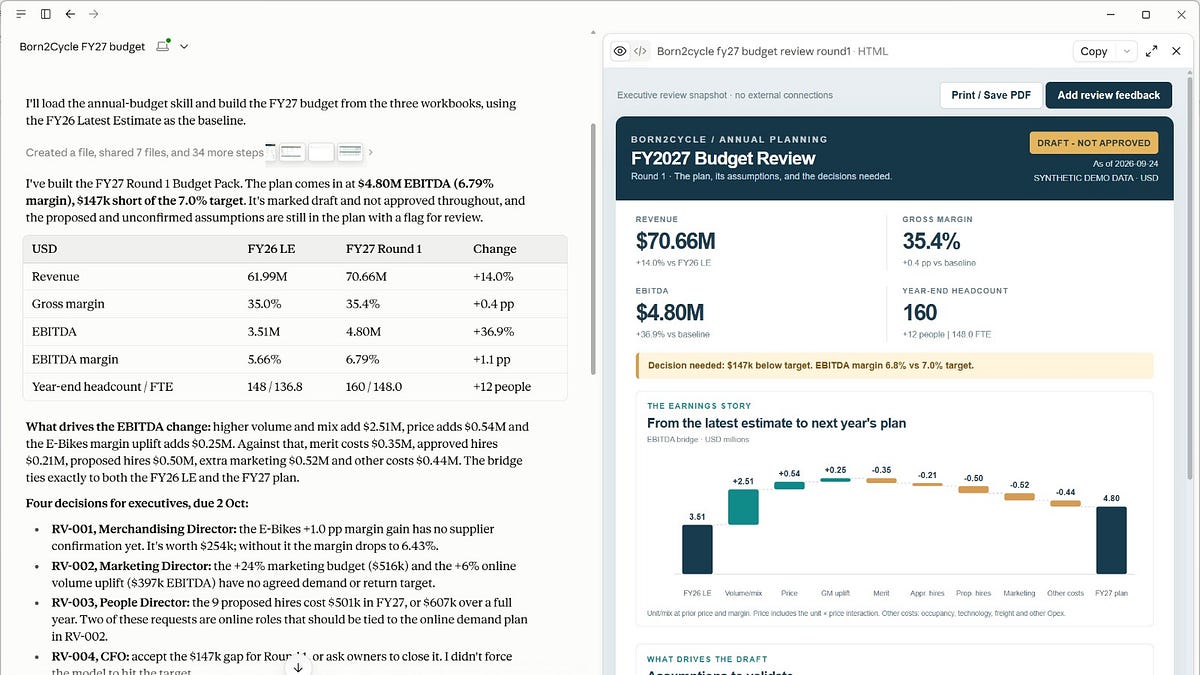
The Annual-Budget.skill allows users to install a specific set of instructions into Claude once. By uploading historical actuals and current drivers, finance teams can generate a comprehensive budget pack in approximately 15 minutes. This automation is designed to handle the core components of a financial plan, including the P&L build, year-over-year bridges, and a summary of risks and necessary decisions.
Enforcing Data Integrity with AI Rules
To ensure accuracy in financial reporting, the tool includes specific operational rules for the AI model. The system is programmed to never invent numbers and will actively flag missing drivers or stale actual data. Rather than requiring a full workbook reconstruction when a variable changes, users can rerun the skill to update the entire model instantly. This approach mirrors other automation efforts, such as how Anthropic's CFO uses Claude for the monthly financial review to manage rapid growth.
By automating the technical assembly of the budget, the tool aims to move finance teams toward the "decide" phase of the planning cycle earlier in the week. This shift is part of a broader trend where CFOs can build a finance team that learns and adapts through technological integration rather than repetitive manual labor.
Integrating Advanced Modeling
The released skill includes full prompts and a template for the budget review process. It is designed to be as efficient as other specialized AI workflows, similar to how CFOs can build a customer P&L with Claude in a matter of minutes. The goal is to provide a standardized framework that identifies the specific calls and decisions that belong on an executive's calendar for the current week, ensuring that the budget remains a living document rather than a static, outdated spreadsheet.
As budget season reaches its peak, the ability to rapidly iterate on financial models becomes a competitive advantage. The Annual-Budget.skill focuses on removing the manual friction of data entry and reconciliation, allowing finance leaders to focus on the strategic implications of their revenue and expense drivers.