
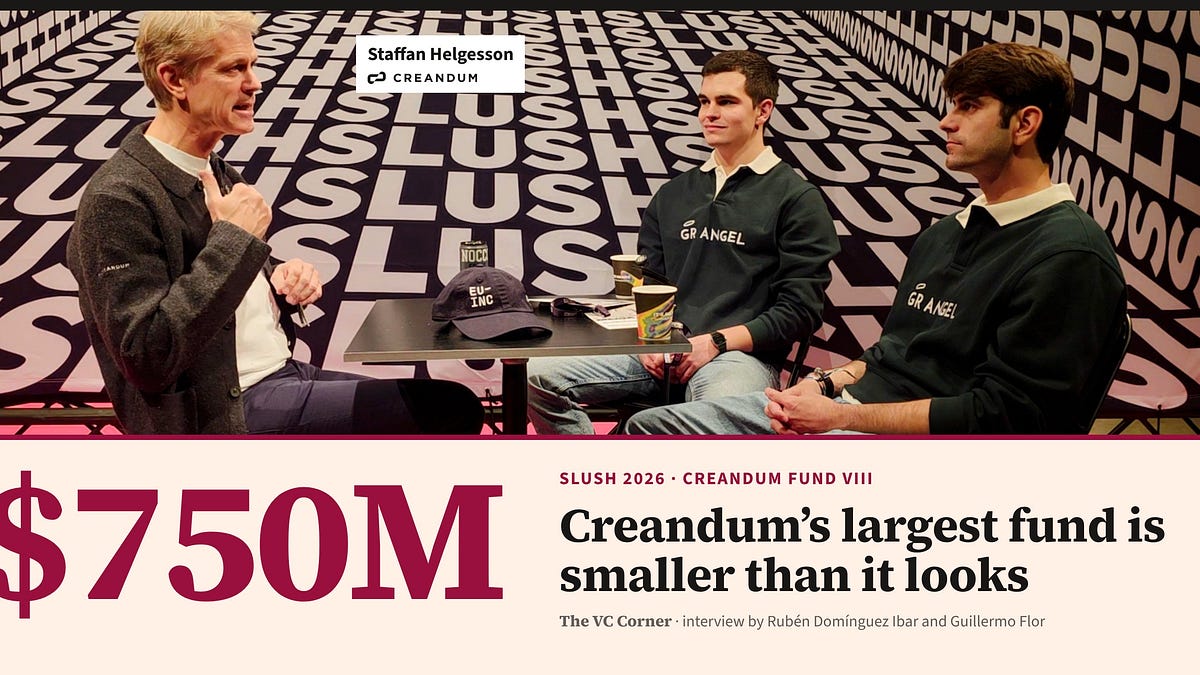
Creandum founder Staffan Helgesson says the firm’s newly closed $750 million Fund VIII is effectively smaller than it appears. While the fund is the largest in the venture capital firm’s 23-year history, Helgesson argues that a phenomenon he calls "VC inflation" means the capital will not go as far as it did in previous decades.
The $750 million (–668 million) vehicle is roughly one-third larger than Creandum’s previous –500 million fund raised in 2024. However, Helgesson calculates that the combination of standard inflation and rising company prices adds approximately 10% to costs annually. Under this math, a company valued at $100 million today would require a $259 million exit in a decade just to maintain relative value. By his estimation, Fund VIII is roughly the same size in real terms as the firm’s 2022 fund.
Strategic Expansion in San Francisco
Founded in Stockholm in 2003 with an initial –40 million fund, Creandum has become a prominent early-stage investor in Europe. The firm co-led Spotify’s Series A in 2008 and has backed other notable companies including iZettle, Klarna, Bolt, and Trade Republic. Today, one in six of its portfolio companies has reached a valuation of $1 billion or more.
As part of its current strategy, Creandum is tripling its team in San Francisco. Helgesson, who now spends more than half his time in California, identifies the city as the global epicenter for artificial intelligence development. He maintains that while European and U.S. markets are increasingly integrated, the high cost and competitive nature of Silicon Valley act as a filter that attracts the strongest teams.
The firm plans to make about 30 investments over the next two years using the new capital. These deals will span from pre-seed to Series A, maintaining the firm's long-term focus on early-stage founders.
The "Wayne Gretzky" Approach to AI
Creandum utilizes strategy sessions nicknamed "Wayne Gretzky" meetings, named after the hockey legend who skated to where the puck was going rather than where it had been. Helgesson says the firm is currently monitoring sectors like AI security, though he emphasizes that the firm follows founders rather than rigid sector theses.
"Investors that are early into new emerging areas tend to do better than the ones that are not," Helgesson said during a recent interview at the Slush conference in Helsinki. He noted that the firm has invested across the entire AI stack, including applications and inference chips.
When evaluating founders, Helgesson looks for a trait he describes as "obsession." He argues that because the current market requires significant capital and recruitment efforts, founders must possess a drive that borders on the extreme to navigate the difficulties of scaling a tech company.
European Policy and Market Competition
Despite its American expansion, Creandum remains a vocal advocate for the European startup ecosystem. Helgesson has called for a "bottom-up" change across the 27 EU member states to simplify stock option issuance and eliminate outdated administrative requirements like physical notary visits. He suggests that if one sizable country like Spain or Sweden becomes a role model for these reforms, others will follow.
The firm’s competitive philosophy is influenced by a sign Helgesson saw at a Stanford University gym: "The price always increases. What you did last year will not be enough this year." He applies this to venture capital, noting that as more capital enters the market, the methods used to win deals in previous years must be constantly updated.
Creandum's focus on high-growth potential mirrors broader trends in the industry where investors seek exceptional returns. This search for outliers is a common theme among top European firms, including those like Plural which recently raised its own significant fund to back ambitious founders.
As Creandum moves forward with Fund VIII, it continues to track a single primary metric for success: whether the firm holds a stake in the three or four European companies that truly matter each year. Historically, the firm achieved this by entering companies like Spotify and Trade Republic during their first or second institutional rounds.