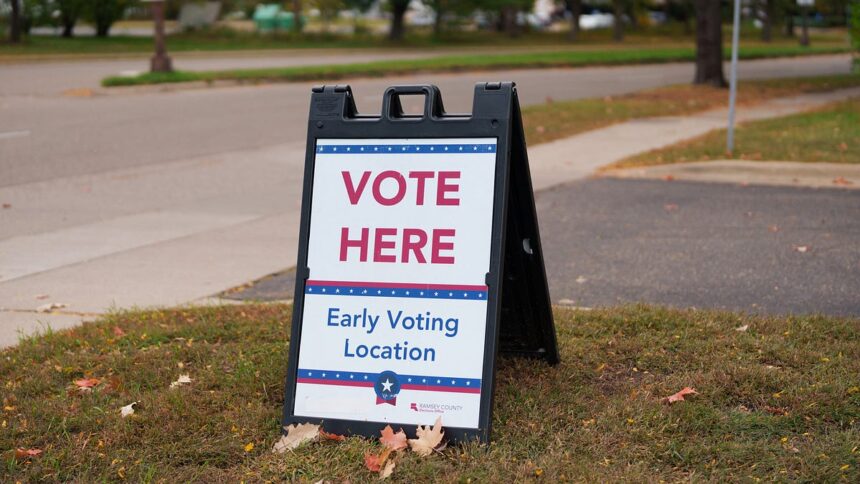
We have been tracking “days to the midterms” — Nov. 3 — but early midterm voting has been underway and from all appearances looks more robust than it has been at this point in past years. According to the Election Lab at the University of Florida, some 28 million people have already cast ballots. We won’t know until the ballots are counted whether those additional early ballots were “cannibalized” from the Election Day vote or whether the turnout will be elevated, but the flood of early voting is itself an expression of democratic determination to thwart the Trump regime’s efforts to muck up mail-in voting and to intimidate voters.
An avalanche of early voters perceived a threat to democracy and took effective evasive action, casting ballots that are now “banked” for their party/candidates. Not only does this avoid problems that might interrupt voting on official Election Day — whether personal or regime-inflicted — but it also allows the party/candidate engaged in get-out-the-vote operations to focus on lower-propensity voters, increasing the chance to boost overall turnout.
Regardless of the results when votes are tabulated, the “winner” here is the anti-regime, pro-democracy coalition that pulled off a political jujitsu — converting Donald Trump’s desperate effort to interfere with elections and rig the midterms into a historic early-voting exercise.
Conversely, the entire anti-democratic, election-suppressing exercise — from demanding state voter rolls to harassing immigrants to sending bogus lists of supposed noncitizen voters to re-redistricting to filing preposterous lawsuits — not only failed in virtually every court case but also arguably boosted a historic blue wave. It’s been a spectacularly inept and counterproductive authoritarian effort (akin to Viktor Orban’s failed stunts in his losing election in Hungary) to cling to power.
A lawsuit filed Friday (which Donald Trump confessed he personally ordered) purported to challenge the eventual result in Alaska’s Senate race unless the incumbent Sen. Dan Sullivan wins. Republicans are whining that an independent candidate with the same name as the incumbent will be on the ballot, but a state court has already handled the matter. As strictly a matter of state law, “the administration has absolutely no authority to tell Alaska when or how to certify the results of its Senate election,” David Becker, executive director of the Center for Election Innovation and Research, said in a statement. The ACLU and ACLU of Alaska on Saturday swiftly intervened to dismiss the case and seek Rule 11 sanctions against the Justice Department. (The latest baseless assault on voting should renew calls for the impeachment of Attorney General Todd Blanche, who now presides over a lawless voter intimidation operation.)
Even Republican Sen. Lisa Murkowski declared that “Alaskans don’t need any help voting for their preferred candidates,” pointing out that a state court “already handled this by clearly distinguishing the candidates on this year’s ballot.” She acknowledged, “The Department of Justice should never have filed this lawsuit.” The attack on their voting rights and implicit insult to Alaska voters (who, with ranked-choice voting, will have a chance to indicate preferences for each candidate) may well boost Democrat Mary Peltola, who was already leading in the polls.
Again, Republicans’ laughable efforts to meddle in the election remind us that Trump’s MAGA cult has lost the battle between voting suppression and voting enthusiasts.
In addition to the larger fight between anti- and pro-voting forces, the campaign has already produced winners and losers among the surrogate forces spread out around the country. Regardless of who wins races in which they are offering their help, several potential 2028 contenders’ performances in the midterms have changed, for better or worse, their future prospects.
Certain Democrats on the radar for 2028 have improved their profiles through energetic appearances and/or fundraising. “JB Pritzker is pouring tens of millions of dollars of his own money into boosting Black and Hispanic candidates this cycle. That could help him win over critical voters in 2028,” Politico reported. “The billionaire Illinois governor — who’s also considered a potential presidential contender — is investing at least $38 million in battleground races.”
However, no 2028 contender has been more visible or effective than former secretary of transportation Pete Buttigieg, who, by Politico’s count, made about 100 endorsements and appeared in person for half of those. By election day, he’ll have stopped in roughly 40 states since leaving office (recently appearing in Iowa, New Hampshire, Georgia, Mississippi, Minnesota, Colorado, and Wisconsin) and been “welcomed in places where candidates shunned some of his potential rivals.”
Buttigieg will finish on Nov. 3 in Detroit. Michigan just happens to be Buttigieg’s home state, and the state where progressive star Abdul El-Sayed is poised for a win in the Senate and Democrat Joyce Benson in the governor’s contest, and an early 2028 primary state.
Buttigieg’s biggest accomplishment has been his success in defining himself not as a remanent of the old guard (a Cabinet member in an administration whose president many Democrats deeply resent for dooming the party’s 2024 prospects) but among the most articulate of the new generation of reformers with bold ideas, including popular vote for president and expansion of the Supreme Court. (It has not hurt him that former vice president Kamala Harris, a potential rival, has been almost invisible during the campaign and, likewise, that California Gov. Gavin Newsom, under fire from progressives for blessing the Paramount-Warner Bros. merger, has been a nonfactor on the trail.)
Meanwhile, no one — with the exception of his addled, grossly uninhibited, and unhinged boss — has done more damage to his image than Vice President JD Vance. (Indeed, Vance’s role as No. 2 for someone so obviously unfit for office will elevate a whole set of 25th Amendment questions should Vance decide to run. Haven’t you noticed his deterioration? Don’t you have an obligation under the 25th Amendment to ensure the president is mentally fit?)
In addition to Trump’s blatant snub in refusing to endorse Vance for 2028, Vance’s sparse crowds, clumsy interviews, awkward performances, cringeworthy defense of Vivek Ramaswamy’s widely denounced vile ad, and feeble attempts to distance himself from Trump (e.g., on Iran via his leaks to the New York Times, on the economy) have cemented the imagine of a soulless, creepy character without ideas of his own or a modicum of likability. Simply being “not Vance” might be the best calling card for a flock of lesser-known Republicans eyeing 2028 runs.
We don’t know the ballot winners yet, but the surrogate race has been decided. If Buttigieg is the big surrogate winner, Vance is the undisputed surrogate loser of 2026.
In sum, the extent of the blue wave remains an open question. However, this historic midterm has already shaped the battle to preserve free and fair elections and the two parties’ 2028 nominating contests. What happened during the 2026 race won’t be forgotten after Nov. 3.